





CUSTOMER SERVICE
www.sensors.vn
Admin@sensors.vn
www.cambien.com.vn
0-10V SIGNAL ISOLATOR
Date 04/Aug/2026 at 04:33 PM - View: 8
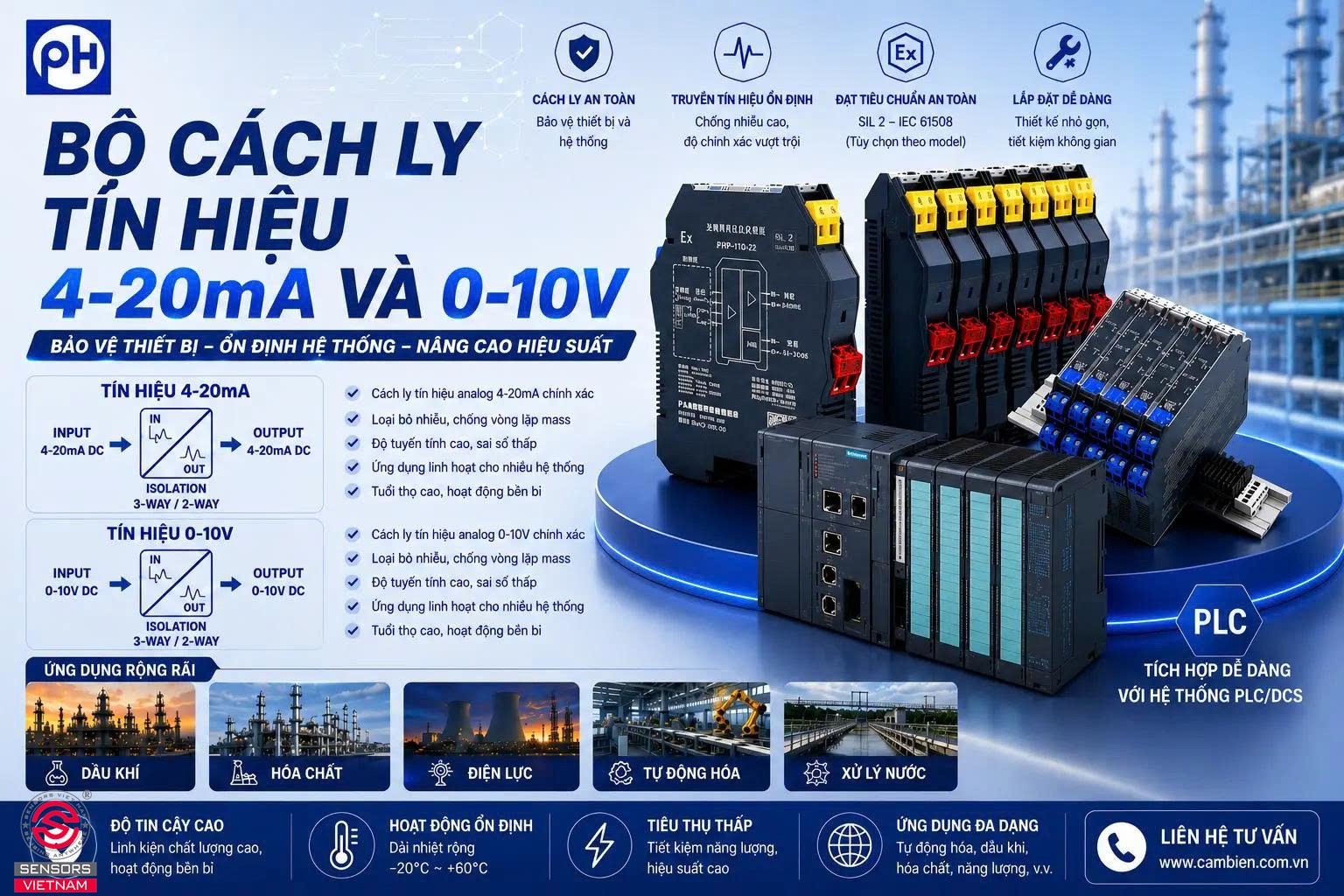
The 0-10V signal is one of the most widely used analog voltage standards in HVAC systems, damper actuators, variable frequency drives (VFDs), and various industrial automation applications. It is popular because voltage-based signal processing is simple, cost-effective, and easier to implement than 4-20mA current loop systems.
However, 0-10V signals are more susceptible to voltage drop, electrical noise, and ground loop interference, especially over long cable runs. A 0-10V signal isolator is specifically designed to eliminate these issues while protecting connected equipment. This article explains what a 0-10V signal isolator is, how it works, and when it should be used in industrial control systems.
What is a 0-10V signal isolator?
A 0-10V signal isolator is an interface device installed between a field device (such as a sensor or transmitter) and a receiving device like a PLC, BMS controller, or DDC controller.
The isolator receives a 0-10V analog input, reproduces the same signal at the output, and electrically isolates the input circuit from the output circuit. Although the signal is accurately transmitted, there is no direct electrical connection between the two sides.
Many people confuse a signal isolator with a signal converter, since both process analog signals. The difference is straightforward:
- A signal converter changes one signal type into another for example, converting 0-10V to 4-20mA or vice versa. Electrical isolation may or may not be included.
- A signal isolator is designed primarily to eliminate electrical continuity between two circuits, preventing ground loops, electrical interference, and equipment damage. Some models also provide signal conversion while maintaining galvanic isolation.
In industrial control systems, a 0-10V isolator is typically installed between field sensors and controllers to ensure stable signal transmission in electrically noisy environments.
Why does a 0-10V signal need isolation?
Compared with 4-20mA current loops, 0-10V analog signals are more vulnerable during long-distance transmission.
The first challenge is voltage drop. As cable length increases, cable resistance also increases, causing the voltage measured at the receiving device to be lower than the voltage generated by the sensor. Current-loop signals are far less affected by cable resistance, making them more suitable for long-distance transmission.
The second issue is electrical noise. Nearby VFDs, large motors, switching power supplies, and high-current equipment generate electromagnetic interference (EMI), which can distort analog voltage signals. Ground potential differences between separate electrical panels may also introduce unwanted offset voltages, resulting in inaccurate measurements.
A 0-10V signal isolator eliminates these problems by generating a new, clean, isolated output signal. Since the input and output are galvanically isolated, electrical disturbances cannot travel directly between connected devices.
As a result, controllers receive a more accurate analog signal while remaining protected against electrical faults originating from field devices.
How does a 0-10V signal isolator work?
Although different manufacturers use different circuit designs, the operating principle is generally the same.
Step 1 - Signal acquisition
The incoming 0-10V analog signal is received and conditioned for transmission through the isolation stage.
Step 2 - Galvanic isolation
The signal passes through an isolation barrier without allowing direct electrical conduction. Depending on the design, isolation may be achieved using:
- Optical isolation (optocouplers)
- Magnetic isolation (transformers)
- Capacitive isolation
The signal information is transferred across the isolation barrier while electrical current cannot pass directly from the input side to the output side.
Step 3 - Signal reconstruction
The isolated circuitry reconstructs an accurate 0-10V output signal, which is then transmitted to the PLC, controller, or monitoring system.
A simple way to visualize the process is to imagine sending a message through a glass window. The information reaches the other side without any physical electrical contact between the two circuits.
See more: Signal Isolator 0-10V?
When should you use a 0-10V signal isolator?
Not every automation system requires signal isolation. The decision should be based on the actual installation environment rather than applying isolators to every analog signal.
A 0-10V signal isolator is recommended when:
- Signal cables run over long distances across buildings or industrial facilities.
- Analog wiring passes near VFDs, large motors, or heavy electrical equipment.
- Sensors and controllers are powered from different electrical panels.
- PLC readings fluctuate even though the sensor operates normally.
- Separate electrical systems require galvanic isolation to eliminate ground loops.
- Multiple control panels are interconnected in BMS or HVAC installations.
On the other hand, if cable lengths are short, all devices share a single power supply and electrical interference is minimal, installing a signal isolator may not be necessary.
Likewise, if the only requirement is converting 0-10V to 4-20mA, and there are no concerns about electrical noise or ground loops, a standard signal converter may be sufficient.
Common applications of 0-10V signal isolators
0-10V signal isolators are widely used wherever analog voltage signals serve as the primary control interface.
- HVAC Systems: Signal isolators are commonly installed between:
- Temperature sensors
- Humidity sensors
- Damper actuators
- HVAC controllers
- Building Management Systems (BMS)
They ensure stable analog signals even when devices are located on different floors or supplied by different electrical panels.
- Variable frequency drive systems: VFDs generate significant electromagnetic interference during motor speed control. Installing a 0-10V signal isolator on the analog speed reference prevents electrical noise from affecting the control signal.
- Industrial automation: Factories with distributed sensors often rely on signal isolation to maintain measurement accuracy across long cable runs and electrically noisy production environments.
Benefits of using a 0-10V signal isolator
Adding a 0-10V signal isolator provides several important advantages compared with direct wiring.
The most significant benefit is improved signal stability, reducing fluctuations caused by electrical noise, EMI, and ground potential differences.
Because the input and output circuits are galvanically isolated, the receiving equipment is also protected against voltage surges, electrical faults, and unexpected disturbances originating from field devices.
In systems integrating equipment from multiple manufacturers, particularly HVAC, BMS, PLC, DCS, and SCADA applications, signal isolation helps prevent electrical problems from propagating between devices, improving overall system reliability and reducing maintenance costs.
Purchase genuine 0-10V signal isolators from Sensors Vietnam
Sensors Vietnam is a trusted supplier of signal isolators, signal converters, signal splitters, intrinsic safety isolators, temperature transmitters, and industrial measurement devices from leading global manufacturers.
Backed by an experienced engineering team, Sensors Vietnam provides professional technical consultation to help customers select the right solution for improved signal integrity, enhanced system reliability, and long-term operational performance.
For more information about 0-10V signal isolators or to request technical support and pricing, please contact Sensors Vietnam today.
Hot news


SENSORS VIETNAM CO., LTD
VAT CODE: 0313 355 473
Head Office: 03rd Floor, Indochina Tower, 04 Nguyen Dinh Chieu, Tan Dinh Ward, Ho Chi Minh City, Vietnam.
HCM Branch: 92/14/9A Vuon Lai Str., An Phu Dong Ward, Ho Chi Minh City, Vietnam.
Hanoi Branch: S106 Tower, Vinhomes Smart City, Tay Mo Ward, Hanoi City, Vietnam.

® Registered trademark – National Office of Intellectual Property Vietnam
OUR SERVICES
Specializing in the import and distribution of industrial sensors.
Sensors for HVAC/R systems and building automation applications.
Supplying gauges, transmitters, switches, controllers, PLCs, HMIs, and gas detectors.
Providing integrated consulting services for sensor and controller systems.


CONTACT US
Email: sales(at)sensors.vn
Hotline: +84 0911 660 660
Asia Commercial Bank Account (ACB):
VND: 357 246 888 | USD: 1357 246 888
Support Online ZALO Official Account
(From 8:00 am to 5:00 pm)





SENSORS VIETNAM CO., LTD
- Specialized in the import and distribution of sensors and controllers.
- Integrated data acquisition systems and industrial communication solutions.
- Design and installation of smart home systems and industrial equipment.
- Stack lights, signal beacons, LED warning horns, and RGB warning lights.