






CUSTOMER SERVICE
www.sensors.vn
Admin@sensors.vn
www.cambien.com.vn
4-20MA SIGNAL ISOLATOR
Date 30/Jul/2026 at 04:28 PM - View: 13
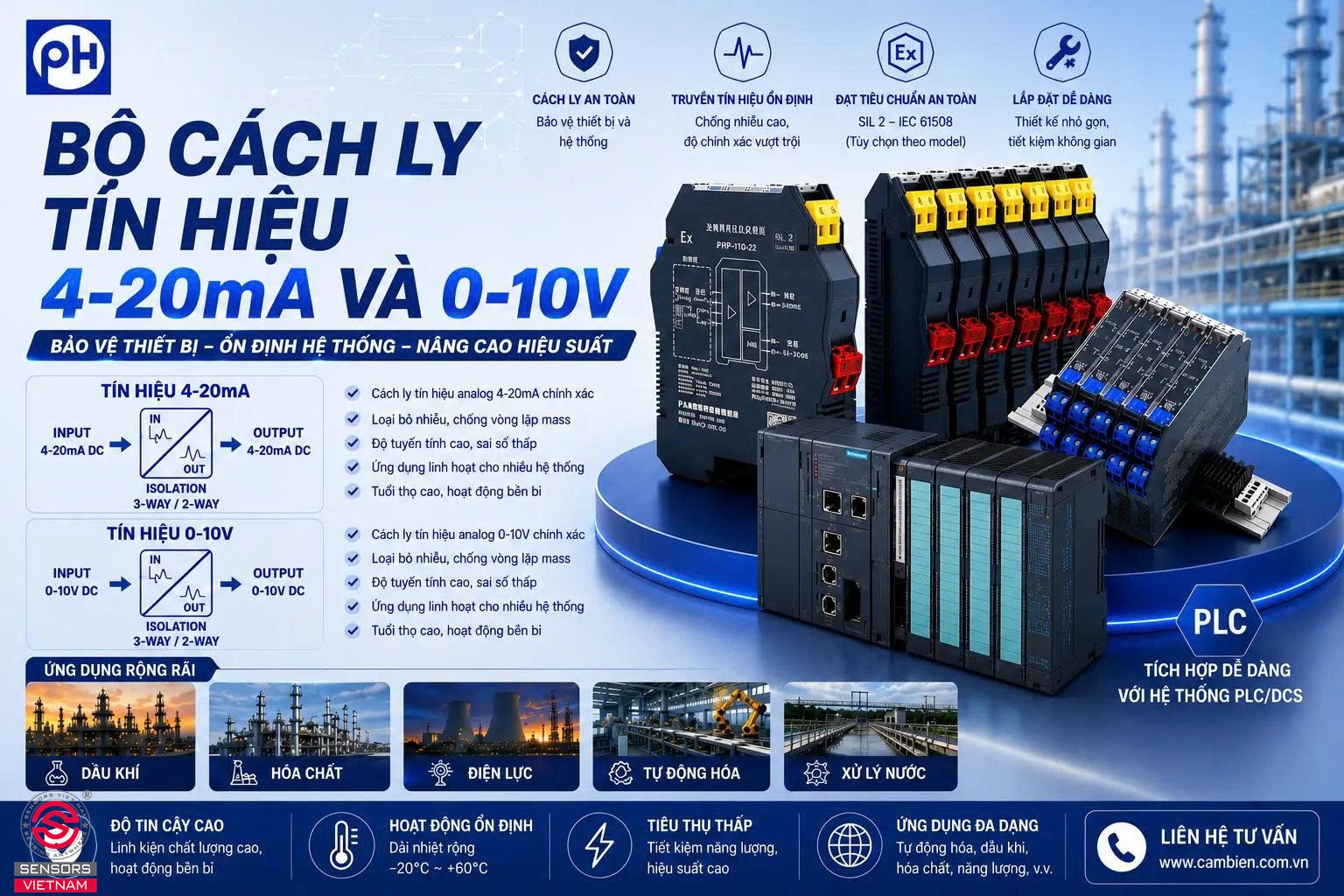
The 4-20 mA signal is the most widely used analog signal standard in industrial automation. It is employed by most pressure, temperature, level, and flow sensors to transmit process data to PLC, DCS, or SCADA systems. However, when signal wiring passes through multiple control panels or is routed near variable frequency drives (VFDs) or high-power motors, the signal can still be affected by electrical noise or ground potential differences.
A 4-20 mA signal isolator is specifically designed to address these issues. This article explains what a 4-20 mA signal isolator is, how it works, and, more importantly, when it is truly necessary.
What Is a 4-20 mA signal isolator?
A 4-20 mA signal isolator is an electronic device that receives a 4-20 mA current signal from a sensor or signal transmitter and reproduces an equivalent 4-20 mA output signal without a direct electrical connection between the input and output circuits. In other words, the signal value is preserved while the electrical circuits remain completely isolated.
In industrial control systems, a 4-20 mA signal isolator is typically installed between the sensor and the analog input module of a PLC or DCS, serving as a protective interface. When the signal passes through areas with strong electromagnetic interference or between control panels with different grounding systems, the isolator ensures that the measurement received by the controller remains accurate and unaffected.
Why does a PLC need a signal isolator?
In large industrial facilities, signal cables from field sensors to the central control panel may extend over tens or even hundreds of meters, passing through areas containing variable frequency drives, high-power motors, or welding equipment. These devices generate electromagnetic interference (EMI) that can be superimposed on the 4-20 mA signal, causing unstable or inaccurate analog readings at the PLC.
In addition, when the sensor and PLC are powered by different grounding systems, differences in ground potential can create leakage currents along the signal loop. This phenomenon, known as a ground loop, increases measurement errors and may cause unstable operation of the PLC's analog input module.
A 4-20 mA signal isolator addresses both issues by completely separating the input and output circuits. As a result, the PLC receives a clean and accurate signal while the analog input module is protected against abnormal voltages that may propagate from field devices. For this reason, signal isolators are often considered essential in medium- and large-scale automation systems.
Operating principle of a 4-20 mA signal isolator
A 4-20 mA signal isolator operates through three consecutive stages that occur almost instantaneously, ensuring no noticeable impact on control loop response time.
First, the 4-20 mA current signal from the sensor enters the isolator's input stage, where it is conditioned and converted into a suitable format for transmission through the isolation stage.
Next, the signal passes through the isolation stage, where there is no direct electrical connection between the input and output circuits. Using optical or magnetic coupling, the signal information is transferred accurately while preventing electrical current from flowing directly between the sensor and the PLC. This completely eliminates ground loops and leakage currents.
Finally, the signal is demodulated and reconstructed as a standard 4-20 mA output signal, ready for connection to the analog input module of a PLC or DCS.
When should you use a 4-20 mA signal isolator?
Not every automation system requires a signal isolator. The decision should be based on the actual installation conditions and the likelihood of signal interference.
A 4-20 mA signal isolator is typically recommended when one or more of the following conditions apply:
- The signal cable between the sensor and the PLC or DCS is long or passes through multiple control panels with different power supplies and grounding points.
- The installation area contains variable frequency drives, high-power motors, welding equipment, or other high-power electrical devices operating near the signal wiring.
- The PLC or monitoring system records unstable or inaccurate analog values even though the sensor is functioning correctly.
- The application requires high measurement accuracy, where even minor errors can affect product quality or operational safety, such as temperature, pressure, or gas concentration control.
- Electrical isolation is required between hazardous and safe areas or between network segments powered by independent electrical systems.
Applications of 4-20 mA signal isolators
A 4-20 mA signal isolator is commonly installed wherever analog signal wiring is exposed to electrical interference or ground potential differences. Its applications span a wide range of industrial sectors.
- In the oil & gas and chemical industries, 4-20 mA signal isolators are installed to isolate pressure and temperature sensor signals located in hazardous areas before transmitting them to the central control room.
- In manufacturing plants with numerous variable frequency drives and high-power motors, such as cement, steel, and food processing facilities, 4-20 mA signal isolators maintain stable flow and level measurement signals before they reach the PLC.
- In water treatment and HVAC systems, they provide electrical isolation between distributed temperature and pressure sensors and the central Building Management System (BMS).
Advantages of 4-20 mA signal isolators
Installing a 4-20 mA signal isolator provides measurable operational benefits in industrial automation systems.
A 4-20 mA signal isolator effectively suppresses electrical noise, ensuring stable analog measurements even when signal cables are routed near high-power electrical equipment.
It also prevents voltage surges and leakage currents from propagating from field devices to the PLC's analog input module, reducing the risk of damage to high-value control equipment.
Furthermore, by eliminating ground loops, a signal isolator minimizes measurement errors caused by differences in ground potential, a common but often difficult-to-diagnose issue in industrial installations.
Purchase genuine signal isolators from Sensors Vietnam
Sensors Vietnam specializes in supplying signal isolators, signal converters, signal splitters, intrinsically safe isolators, temperature converters, and genuine industrial instrumentation products from globally recognized manufacturers.
We offer a comprehensive range of 4-20 mA signal isolators, 0-10 V signal isolators, RTD signal isolators, Pt100 signal isolators, and thermocouple signal isolators for PLC, DCS, SCADA, HVAC, BMS, and industrial automation systems. Backed by an experienced engineering team, Sensors Vietnam provides expert technical consultation to help customers select the most suitable solution, improving system reliability and operational efficiency.
Hot news


SENSORS VIETNAM CO., LTD
VAT CODE: 0313 355 473
Head Office: 03rd Floor, Indochina Tower, 04 Nguyen Dinh Chieu, Tan Dinh Ward, Ho Chi Minh City, Vietnam.
HCM Branch: 92/14/9A Vuon Lai Str., An Phu Dong Ward, Ho Chi Minh City, Vietnam.
Hanoi Branch: S106 Tower, Vinhomes Smart City, Tay Mo Ward, Hanoi City, Vietnam.

® Registered trademark – National Office of Intellectual Property Vietnam
OUR SERVICES
Specializing in the import and distribution of industrial sensors.
Sensors for HVAC/R systems and building automation applications.
Supplying gauges, transmitters, switches, controllers, PLCs, HMIs, and gas detectors.
Providing integrated consulting services for sensor and controller systems.


CONTACT US
Email: sales(at)sensors.vn
Hotline: +84 0911 660 660
Asia Commercial Bank Account (ACB):
VND: 357 246 888 | USD: 1357 246 888
Support Online ZALO Official Account
(From 8:00 am to 5:00 pm)





SENSORS VIETNAM CO., LTD
- Specialized in the import and distribution of sensors and controllers.
- Integrated data acquisition systems and industrial communication solutions.
- Design and installation of smart home systems and industrial equipment.
- Stack lights, signal beacons, LED warning horns, and RGB warning lights.