






CUSTOMER SERVICE
www.sensors.vn
Admin@sensors.vn
www.cambien.com.vn
CO2 DETECTOR
Date 25/Oct/2025 at 04:10 PM - View: 181
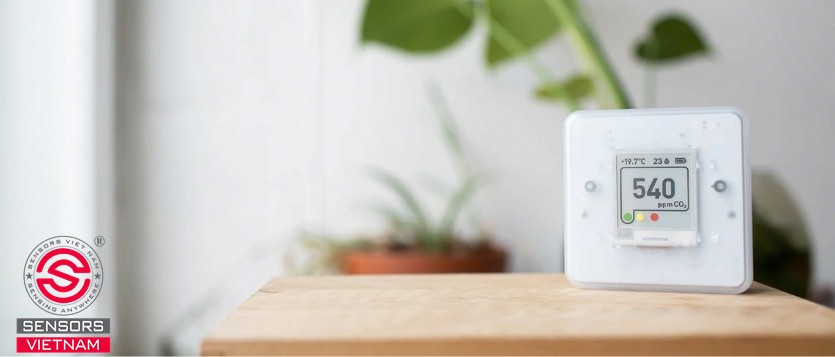
Carbon dioxide (CO2) is a colorless, odorless gas that is a natural part of the Earth's atmosphere. It is produced by animal and human respiration, the decomposition of organic matter, and the burning of fossil fuels. Although CO2 is essential for plant life and is used in various industrial processes, elevated levels can be hazardous to human health. Therefore, monitoring CO2 concentrations in various environments is important. A CO2 gas detector is an instrument designed to measure the concentration of carbon dioxide in the air and provide an alert when the levels become dangerous.
What is a CO2 gas detector?
CO2 gas detectors are devices designed to measure the concentration of carbon dioxide in the air. These detectors are used in a variety of applications, including indoor air quality monitoring, industrial safety, environmental monitoring, and HVAC systems. By providing real-time data on CO2 levels, these devices help ensure that the environment remains safe and within acceptable limits.
Working principle of CO2 detector
CO2 gas detectors operate on different detection principles, each with its own mechanism and application. The most common types of CO2 gas detectors are:
Non-dispersive infrared sensor (NDIR)
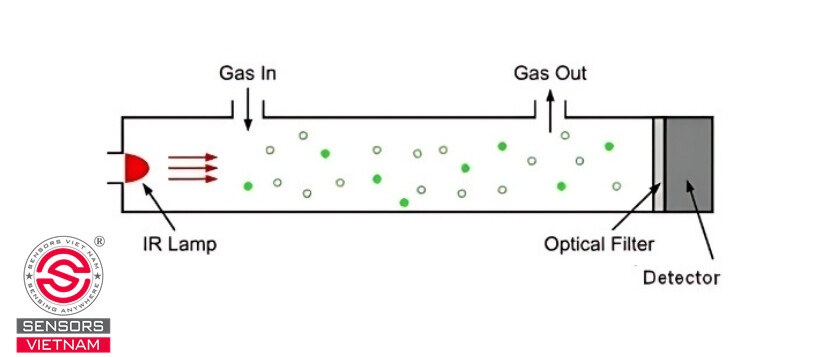
NDIR sensors are the most widely used technology for CO2 detection. They work on the principle that CO2 molecules absorb specific wavelengths of infrared (IR) light.
Principle: The sensor contains an infrared light source, a sample chamber, a wavelength filter, and an infrared detector. Infrared light passes through a sample chamber containing air. A specific wavelength of light, corresponding to the absorption properties of CO2, is filtered and directed to the detector. The presence of CO2 in the air sample will absorb some of the infrared light, reducing the intensity reaching the detector. The reduction in light intensity is proportional to the concentration of CO2 in the air.
Electrochemical sensor
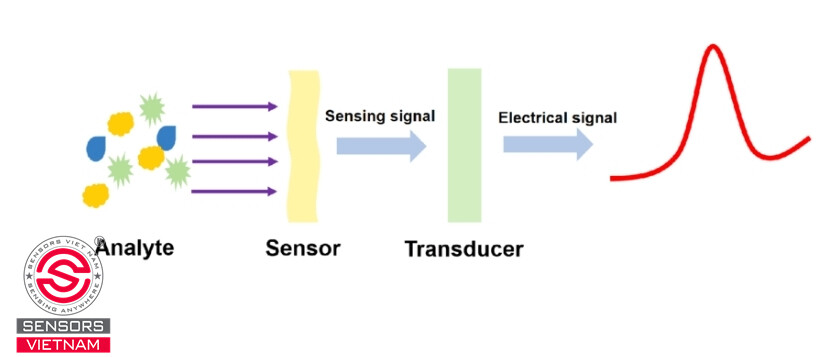
Electrochemical sensors detect CO2 through a chemical reaction that produces an electrical signal proportional to the gas concentration.
Principle: The sensor consists of an electrolyte, electrodes, and a gas-permeable membrane. When CO2 diffuses through the membrane, it reacts with the electrolyte, generating an electric current between the electrodes. The magnitude of this current is proportional to the CO2 concentration.
Metal oxide semiconductor (MOS) sensor
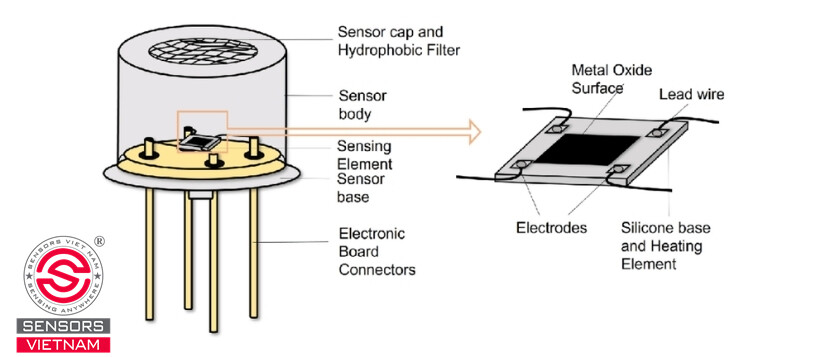
MOS sensors detect CO2 based on the change in resistance of the metal oxide layer when exposed to gas.
Principle: The sensor consists of a metal oxide semiconductor material whose resistance changes in response to CO2. This change in resistance is measured and correlated with the CO2 concentration.
Photoacoustic sensor
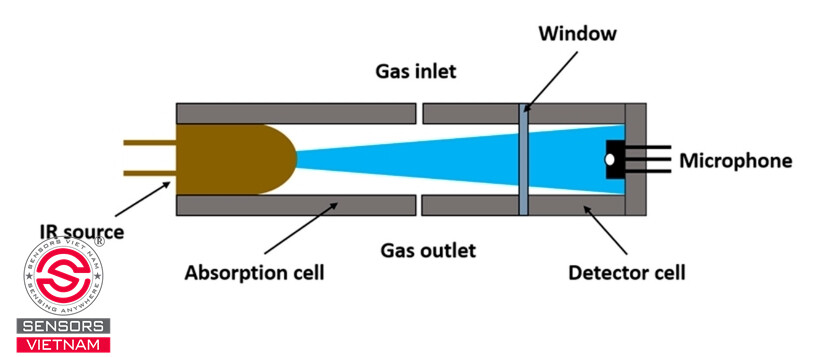 Photoacoustic CO2 sensors measure based on the photoacoustic effect, in which absorbed light energy is converted into sound waves.
Principle: The sensor uses a modulated light source to illuminate an air sample. CO2 molecules absorb the light, causing local temperature and pressure changes that generate sound waves. A microphone detects these sound waves, and the signal is proportional to the CO2 concentration.
Applications of CO2 gas detectors
CO2 gas detectors are used in a variety of applications to ensure safety, maintain air quality, and monitor industrial processes. Some of the main applications include:
Indoor air quality monitoring
Maintaining optimal indoor air quality is important for health and comfort in homes, offices, schools, and other public buildings. CO2 levels are an important indicator of ventilation efficiency. High CO2 concentrations can cause fatigue, headaches, and reduced cognitive performance. CO2 detectors help monitor and control ventilation systems to maintain a safe and comfortable indoor environment.
Industrial safety
In industries such as food and beverage, agriculture and chemical manufacturing, CO2 is used in a variety of processes. Accidental leaks or high CO2 concentrations can pose serious risks to workers. CO2 gas detectors provide early warning of hazardous conditions, allowing for timely evacuation and corrective action.
Greenhouses and Agriculture
CO2 enrichment is used in greenhouses to enhance plant growth. However, it is essential to monitor CO2 concentrations to prevent them from reaching levels that are harmful to workers. CO2 gas detectors ensure optimal conditions for plant growth while ensuring worker safety.
Limited space
Confined spaces such as tanks, silos and underground structures can accumulate high levels of CO2 due to poor ventilation. Workers entering these spaces face significant health risks. Portable CO2 detectors are used to assess air quality prior to entry and continuously monitor conditions during occupancy.
HVAC system
Heating, ventilation, and air conditioning (HVAC) systems in commercial and residential buildings use CO2 detectors to adjust ventilation systems based on occupancy levels. By monitoring CO2 levels, HVAC systems can optimize airflow, improving energy efficiency and indoor air quality.
Fire fighting system
CO2 is used as a fire suppression agent in fire suppression systems for industrial applications. Monitoring CO2 concentrations ensures the effectiveness of these systems and prevents accidental overexposure to CO2.
Advantages of using CO2 gas detector
CO2 gas detectors offer several benefits across a variety of applications:
Health and Safety
Monitoring CO2 levels is important to prevent health problems associated with high CO2 levels, such as respiratory problems, cognitive impairment, and unconsciousness. CO2 detectors provide early warning, allowing timely intervention to protect health and safety.
Comply with regulations
Many industries are subject to regulations and standards for indoor air quality and worker safety. CO2 detectors help ensure compliance with these regulations, avoiding fines and liability.
Energy efficiency
By using CO2 detectors to optimize ventilation systems, buildings can reduce energy consumption and lower utility costs. Efficient ventilation based on real-time CO2 levels helps minimize unnecessary heating, cooling, and air circulation.
Increased productivity
Maintaining optimal CO2 levels in the work environment can improve productivity and cognitive function. Proper ventilation will prevent symptoms such as fatigue, headaches and drowsiness, improving overall performance.
Environmental control
CO2 detectors play an important role in monitoring environmental conditions, contributing to climate research and managing greenhouse gas emissions. Accurately measuring CO2 concentrations helps monitor environmental changes and develop mitigation strategies.
For more details: https://cambien.com.vn/cam-bien-khi-co2
Hot news


SENSORS VIETNAM CO., LTD
VAT CODE: 0313 355 473
Head Office: 03rd Floor, Indochina Tower, 04 Nguyen Dinh Chieu, Tan Dinh Ward, Ho Chi Minh City, Vietnam.
HCM Branch: 92/14/9A Vuon Lai Str., An Phu Dong Ward, Ho Chi Minh City, Vietnam.
Hanoi Branch: S106 Tower, Vinhomes Smart City, Tay Mo Ward, Hanoi City, Vietnam.

® Registered trademark – National Office of Intellectual Property Vietnam
OUR SERVICES
Specializing in the import and distribution of industrial sensors.
Sensors for HVAC/R systems and building automation applications.
Supplying gauges, transmitters, switches, controllers, PLCs, HMIs, and gas detectors.
Providing integrated consulting services for sensor and controller systems.


CONTACT US
Email: sales(at)sensors.vn
Hotline: +84 0911 660 660
Asia Commercial Bank Account (ACB):
VND: 357 246 888 | USD: 1357 246 888
Support Online ZALO Official Account
(From 8:00 am to 5:00 pm)





SENSORS VIETNAM CO., LTD
- Specialized in the import and distribution of sensors and controllers.
- Integrated data acquisition systems and industrial communication solutions.
- Design and installation of smart home systems and industrial equipment.
- Stack lights, signal beacons, LED warning horns, and RGB warning lights.