






CUSTOMER SERVICE
www.sensors.vn
Admin@sensors.vn
www.cambien.com.vn
CO2 INCUBATOR
Date 27/Oct/2025 at 08:51 AM - View: 197
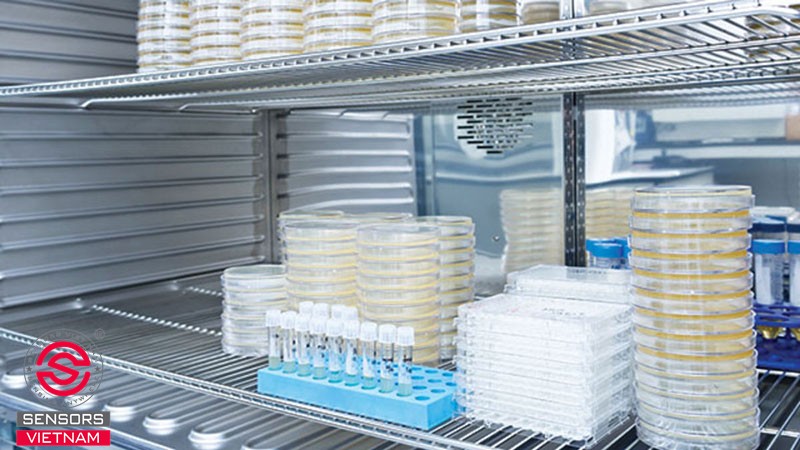
A CO2 incubator is a specialized laboratory device used for cultivating and maintaining cell cultures under controlled conditions. It is widely used in medical, biological, and pharmaceutical research for growing mammalian cells, tissue cultures, and other biological samples that require a stable environment with controlled temperature, humidity, and carbon dioxide levels.
Why is CO2 Needed in an Incubator?
CO2 plays a crucial role in cell culture by helping maintain the correct pH balance in the culture medium. The buffering system in the medium, typically based on sodium bicarbonate, relies on CO2 levels to stabilize the pH. Without adequate CO2, the medium can become too alkaline, affecting cell viability and growth.
A CO2 incubator is designed to replicate the optimal physiological conditions for cell growth by maintaining a stable environment of temperature, humidity, and CO2 concentration throughout the cultivation process.
Temperature Control
The internal temperature of a CO2 incubator is typically maintained at 37°C, which is ideal for mammalian cell culture. There are two common heating methods: direct heating and water-jacketed heating. In direct heating systems, electrical heaters warm the air inside the chamber, ensuring quick temperature recovery. In contrast, water-jacketed systems circulate heated water around the chamber walls, providing more uniform temperature distribution and better insulation against external fluctuations.
CO2 Concentration Control
The CO2 level is usually maintained at 5% to stabilize the pH of the culture medium. The incubator is equipped with CO2 sensors that continuously monitor and regulate gas concentration. Two types of sensors are commonly used: infrared (IR) sensors and thermal conductivity sensors. The IR sensor measures CO2 concentration based on light absorption at specific wavelengths, providing high accuracy and long-term stability. Meanwhile, thermal conductivity sensors determine CO2 levels by detecting changes in the thermal properties of the gas mixture, though their accuracy can be affected by humidity.
Why Choose Infrared (IR) CO2 Sensors?
In modern CO2 incubators, infrared CO2 sensors are preferred due to their superior accuracy in humid environments, faster response times, low drift, and minimal interference from water vapor. These advantages ensure consistent CO2 regulation and reliable cell culture performance.
Humidity Control
High relative humidity, typically around 95%, prevents evaporation of the culture medium and maintains optimal cellular conditions. Humidity levels are usually controlled through a built-in water pan or an automatic humidification system inside the incubator.
Contamination and Sterility Control
A HEPA filtration system removes up to 99.97% of airborne particles and microorganisms, ensuring purified air circulation inside the chamber. Integrated UV sterilization eliminates bacteria, fungi, and viruses, minimizing cross-contamination risk. Additionally, the inner chamber is often made of copper, a material with natural antimicrobial properties that inhibit microbial growth and enhance biological safety.
Applications of CO2 Incubators
CO2 incubators are essential for various research and industrial applications, including:
Cell Culture Research
CO2 incubators provide a stable environment for growing mammalian, bacterial, and fungal cells used in biomedical research, drug discovery, and regenerative medicine.
Stem Cell and Tissue Engineering
They are used in stem cell cultivation and tissue engineering for developing artificial organs, medical implants, and regenerative therapies.
In Vitro Fertilization (IVF)
CO2 incubators play a critical role in assisted reproductive technology (ART) by providing optimal conditions for embryo development during IVF procedures.
Pharmaceutical and Vaccine Development
They are used in laboratories for drug testing, vaccine production, and antibody development, where maintaining precise environmental conditions is crucial.
Microbiology and Virology
CO2 incubators help grow pathogenic bacteria and viruses for medical diagnostics, vaccine research, and antimicrobial resistance studies.
CO2 incubators are indispensable tools in biomedical and pharmaceutical research, providing an ideal environment for cell cultures, tissue engineering, and microbiological studies. By maintaining precise control over temperature, CO2 concentration, and humidity, these incubators facilitate critical scientific advancements in medicine, drug development, and regenerative therapies. Choosing the right CO2 sensor and ensuring proper sterilization and maintenance are crucial for achieving consistent and reliable experimental results.
Sensors Vietnam is a leading importer of sensors and industrial equipment in Vietnam. If you are looking for CO2 gas sensors, please contact Sensors Vietnam for consultation and a quotation.
For more details: https://cambien.com.vn/cam-bien-khi-co2
Hot news


SENSORS VIETNAM CO., LTD
VAT CODE: 0313 355 473
Head Office: 03rd Floor, Indochina Tower, 04 Nguyen Dinh Chieu, Tan Dinh Ward, Ho Chi Minh City, Vietnam.
HCM Branch: 92/14/9A Vuon Lai Str., An Phu Dong Ward, Ho Chi Minh City, Vietnam.
Hanoi Branch: S106 Tower, Vinhomes Smart City, Tay Mo Ward, Hanoi City, Vietnam.

® Registered trademark – National Office of Intellectual Property Vietnam
OUR SERVICES
Specializing in the import and distribution of industrial sensors.
Sensors for HVAC/R systems and building automation applications.
Supplying gauges, transmitters, switches, controllers, PLCs, HMIs, and gas detectors.
Providing integrated consulting services for sensor and controller systems.


CONTACT US
Email: sales(at)sensors.vn
Hotline: +84 0911 660 660
Asia Commercial Bank Account (ACB):
VND: 357 246 888 | USD: 1357 246 888
Support Online ZALO Official Account
(From 8:00 am to 5:00 pm)





SENSORS VIETNAM CO., LTD
- Specialized in the import and distribution of sensors and controllers.
- Integrated data acquisition systems and industrial communication solutions.
- Design and installation of smart home systems and industrial equipment.
- Stack lights, signal beacons, LED warning horns, and RGB warning lights.