





CUSTOMER SERVICE
www.sensors.vn
Admin@sensors.vn
www.cambien.com.vn
FORMALDEHYDE CH2O SENSOR
Date 23/Oct/2025 at 10:58 AM - View: 150
Formaldehyde (CH2O) is a volatile organic compound (VOC) widely used in the production of plastics, resins, building materials, and household products. It is also a byproduct of combustion and various industrial processes. Exposure to formaldehyde can cause a range of health effects—from mild irritation to serious respiratory problems and even cancer. Because of these health risks, formaldehyde sensors play a crucial role in ensuring air quality and safety across residential, commercial, and industrial environments.
What is a Formaldehyde Sensor (CH2O Sensor)?
A formaldehyde sensor is a device designed to detect and measure the concentration of formaldehyde (CH2O or HCHO) in the air. Formaldehyde is a colorless gas with a strong, pungent odor, commonly present in industrial processes and household products.
Due to its toxic and carcinogenic nature, monitoring CH2O concentration is essential for maintaining safe air quality in both residential and industrial environments.
Electrochemical CH2O Sensor
Metal Oxide Semiconductor (MOS) CH2O Sensor
Photoionization Detector (PID) CH2O Sensor
Colorimetric CH2O Sensor
Working Principles of a Formaldehyde Gas Sensor
A formaldehyde gas sensor (CH2O sensor) detects and quantifies the concentration of CH2O in the air. Formaldehyde emissions often originate from building materials, furniture, paints, adhesives, or industrial production processes. Depending on the sensing technology and application, CH2O sensors operate on different principles such as electrochemical reaction, metal oxide semiconductor detection (MOS), photoionization (PID), or colorimetric response.
Electrochemical CH2O Sensor
An electrochemical formaldehyde sensor detects CH2O through an oxidation-reduction reaction occurring on the surface of an electrode. When formaldehyde reacts with the chemical reagent inside the sensor, an electrical current is generated. This current is directly proportional to the concentration of CH2O in the air and is converted into an output signal.
Electrochemical sensors are known for high sensitivity, low detection limits, and excellent stability, making them ideal for indoor air quality monitoring devices and laboratory environments.
Metal Oxide Semiconductor (MOS) CH2O Sensor
MOS-type formaldehyde sensors utilize semiconductor materials such as tin dioxide (SnO2) or zinc oxide (ZnO). When CH2O molecules are adsorbed onto the sensor surface, they cause a measurable change in the material’s electrical conductivity. This variation is then converted into an electrical signal proportional to the gas concentration.
Photoionization Detector (PID) CH2O Sensor
A PID formaldehyde sensor works on the principle of photoionization using ultraviolet (UV) light. When exposed to UV radiation, CH2O molecules become ionized, generating free ions and electrons. This produces a measurable current directly proportional to the gas concentration.
Colorimetric CH2O Sensor
Colorimetric formaldehyde sensors rely on a chemical reagent that changes color when it reacts with CH2O. The degree of color change is measured by an optical detector or photometric device and converted into a gas concentration value.
Applications of Formaldehyde Gas Sensors
Formaldehyde gas sensors (CH2O sensors) are widely used in air quality monitoring, health protection, and environmental safety across multiple industries and settings.
Residential Air Quality Monitoring
Formaldehyde sensors are integrated into indoor air quality (IAQ) systems to detect CH2O emissions from furniture, flooring, paints, or adhesives. Monitoring CH2O concentration helps:
- Prevent eye, nose, and respiratory irritation.
- Protect residents from chronic exposure, especially in newly built or sealed homes.
- Maintain healthy indoor air by controlling ventilation and filtration systems.
These sensors are often embedded in air purifiers, smart home devices, and HVAC systems, providing real-time air quality insights.
Industrial and Commercial Applications
In industries such as plastics, textiles, coatings, and chemical manufacturing, formaldehyde is frequently used or generated as a byproduct. Formaldehyde sensors are essential to:
- Continuously monitor workplace air for CH2O concentrations.
- Detect leaks or toxic accumulation to prevent occupational hazards.
- Ensure compliance with OSHA, EPA, and EU REACH safety standards.
In commercial buildings and offices, CH2O sensors integrated into HVAC systems help regulate ventilation, reducing chemical exposure and improving overall indoor air quality.
Healthcare and Laboratory Environments
Formaldehyde is commonly used for sterilization, tissue preservation, and sample fixation. Therefore, CH2O sensors are critical in:
- Hospitals and clinics — monitoring sterilization and disinfection areas.
- Medical and research laboratories — maintaining safe working conditions within regulated exposure limits.
- Chemical handling zones — detecting leaks and supporting automated ventilation systems.
With fast response time and high accuracy at low concentrations, formaldehyde sensors help protect medical staff and researchers from harmful gas exposure.
Environmental Monitoring and Research
Formaldehyde is a key compound in urban and industrial air pollution assessments. Environmental agencies and research institutes deploy CH2O sensors to:
- Track outdoor emissions near industrial zones and densely populated areas.
- Analyze air pollution trends and assess environmental risks.
- Study the impact of formaldehyde on climate, smog formation, and fine particulate matter (PM2.5).
Formaldehyde gas sensors (CH2O sensors) are essential tools for maintaining safe air quality, protecting human health, and ensuring environmental compliance. By integrating CH2O detection technology, organizations can create safer, cleaner, and healthier environments for both workers and the public.
Sensors Vietnam is a leading importer and distributor of industrial sensors and automation equipment in Vietnam. For consultation and quotation on CH2O sensors, please contact Sensors Vietnam
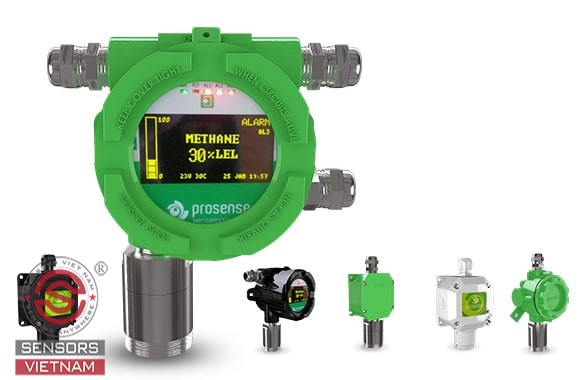
PQD-7434-SS-R – Explosion-Proof Formaldehyde (CH2O) Gas Detector Prosense
Measuring Range: 0–10 ppm
Output: 4–20mA, RS485, Relay
Power Supply: 24VDC
Explosion-Proof Rating: ATEX II 2G Ex db IIC T5/T4 Gb
PQD-7434-SS – Explosion-Proof Formaldehyde (CH2O) Gas Sensor Prosense
Measuring Range: 0–10 ppm
Output: 4–20mA, RS485
Power Supply: 24VDC
Explosion-Proof Rating: ATEX II 2G Ex db IIC T5/T4 Gb
PQD-7434-R – Explosion-Proof Formaldehyde (CH2O) Gas Transmitter Prosense
Measuring Range: 0–10 ppm
Output: 4–20mA, RS485, Relay
Power Supply: 24VDC
Explosion-Proof Rating: ATEX II 2G Ex db IIC T5/T4 Gb
PQD-S-7435-SS-R – Explosion-Proof Formaldehyde Gas Detector Prosense
Measuring Range: 0–100% LEL
Output: 4–20mA, RS485, Relay
Power Supply: 24VDC
Explosion-Proof Rating: ATEX II 2G Ex db IIC T5/T4 Gb
For more details: https://cambien.com.vn/cam-bien-khi-de-chay
Hot news


SENSORS VIETNAM CO., LTD
VAT CODE: 0313 355 473
Head Office: 03rd Floor, Indochina Tower, 04 Nguyen Dinh Chieu, Tan Dinh Ward, Ho Chi Minh City, Vietnam.
HCM Branch: 92/14/9A Vuon Lai Str., An Phu Dong Ward, Ho Chi Minh City, Vietnam.
Hanoi Branch: S106 Tower, Vinhomes Smart City, Tay Mo Ward, Hanoi City, Vietnam.

® Registered trademark – National Office of Intellectual Property Vietnam
OUR SERVICES
Specializing in the import and distribution of industrial sensors.
Sensors for HVAC/R systems and building automation applications.
Supplying gauges, transmitters, switches, controllers, PLCs, HMIs, and gas detectors.
Providing integrated consulting services for sensor and controller systems.


CONTACT US
Email: sales(at)sensors.vn
Hotline: +84 0911 660 660
Asia Commercial Bank Account (ACB):
VND: 357 246 888 | USD: 1357 246 888
Support Online ZALO Official Account
(From 8:00 am to 5:00 pm)





SENSORS VIETNAM CO., LTD
- Specialized in the import and distribution of sensors and controllers.
- Integrated data acquisition systems and industrial communication solutions.
- Design and installation of smart home systems and industrial equipment.
- Stack lights, signal beacons, LED warning horns, and RGB warning lights.