






CUSTOMER SERVICE
www.sensors.vn
Admin@sensors.vn
www.cambien.com.vn
HIGH-TEMPERATURE PROXIMITY SENSOR
Date 09/Nov/2026 at 03:38 PM - View: 11
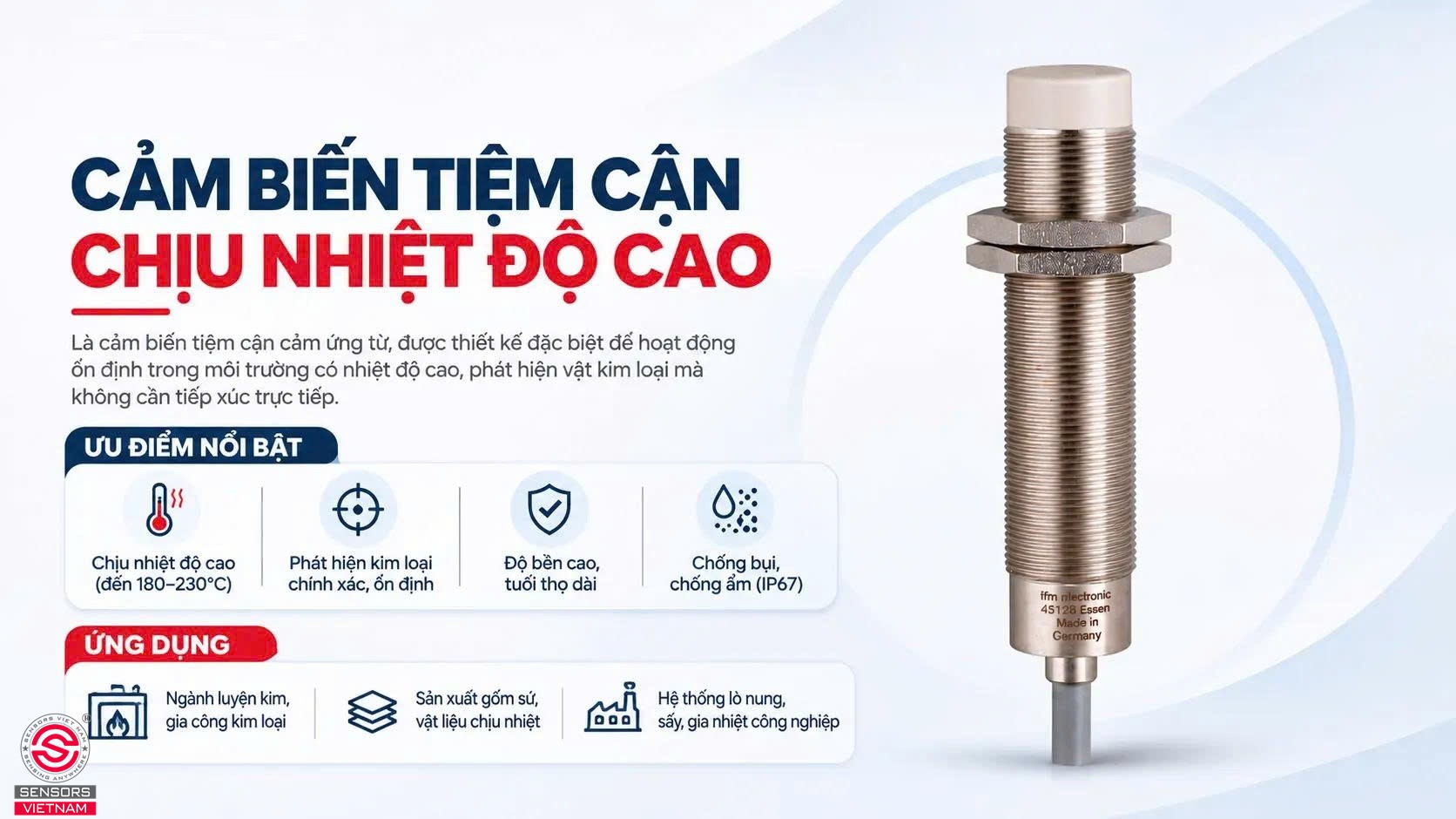
Standard proximity sensors have specific operating temperature limits and are generally unsuitable for installation near drying ovens, furnaces or metal processing lines operating at high temperatures. When exposed to temperatures beyond their rated limits, electronic components, coils and insulating materials can deteriorate, causing inaccurate detection or complete sensor failure.
High-temperature proximity sensors are designed to overcome these limitations. Depending on their construction and design, they can detect metal objects in environments with temperatures ranging from 120 °C to 250 °C. Thanks to their non-contact detection capability, these sensors are widely used in industrial automation systems.
WHAT IS A HIGH-TEMPERATURE PROXIMITY SENSOR?
A high-temperature proximity sensor is a type of inductive proximity sensor designed to detect metal objects without direct contact while operating in environments with temperatures higher than the limits of standard proximity sensors.
While standard industrial proximity sensors typically have a maximum ambient operating temperature of approximately 70 °C, high-temperature models can withstand higher temperatures, such as 120 °C, 150 °C, 180 °C, 200 °C or 250 °C, depending on the product design.
Based on the electromagnetic induction principle, these sensors can detect metal objects such as steel, aluminum and copper. Non-metallic materials such as plastic, wood, and glass cannot be detected using this operating principle.
High-temperature proximity sensors are commonly used as alternatives to mechanical limit switches in high-temperature areas, where physical contact can cause wear or reduce equipment service life.
OPERATING PRINCIPLE OF HIGH-TEMPERATURE PROXIMITY SENSORS
High-temperature proximity sensors operate based on electromagnetic induction, following the same principle as conventional inductive proximity sensors.
Inside the sensor, a coil and capacitor form an oscillating circuit. When power is supplied, the circuit generates a high-frequency alternating magnetic field at the sensing face. When a metal object enters this magnetic field, eddy currents are induced on its surface. These currents consume energy from the oscillating circuit, causing its oscillation amplitude to decrease.
When the reduction reaches a defined threshold, the processing circuit detects the change and switches the output signal state. A PLC can use this signal to identify the presence or position of a metal object. When the object moves out of the detection zone, the oscillating circuit recovers its energy and the output returns to its original state.
WHY DO STANDARD PROXIMITY SENSORS PERFORM POORLY AT HIGH TEMPERATURES?
High temperatures can change coil resistance, electronic component characteristics and the properties of insulating materials. These changes affect the operation of the oscillating circuit, potentially causing unstable detection distances and switching behavior.
To overcome these issues, high-temperature proximity sensors typically feature improvements in several components:
- Construction materials: High-temperature-resistant insulating materials, encapsulation materials, and housing materials are used to withstand operating temperatures.
- Electronic circuits: Designed to minimize the effects of temperature variations on detection signals.
- Connection cables: Use heat-resistant insulation materials such as silicone or PTFE, depending on the required temperature rating.
- Sensor construction: Some designs separate the sensing head and amplifier into two independent components to protect electronic circuits from excessive heat.
TYPES OF HIGH-TEMPERATURE PROXIMITY SENSORS
High-temperature proximity sensors can be classified according to their operating temperature limits. Each temperature rating is suitable for different installation conditions and may require a specific sensor construction.
120 °C High-temperature proximity sensors
This type is suitable for installation locations where temperatures exceed the operating limits of standard proximity sensors but are not extremely high. These sensors generally feature a compact design, making them easy to install and connect to control systems.
120 °C high-temperature proximity sensors are commonly used in heating areas, industrial drying machines and production lines with elevated ambient temperatures.
150 °C High-temperature proximity sensors
150 °C high-temperature proximity sensors are designed for applications requiring reliable metal detection in continuously hot environments. Their construction typically focuses on protecting the coil, electronic components, and insulation from the effects of high temperatures.
These sensors are suitable for industrial drying lines, heating processes, and manufacturing applications that require metal component position monitoring.
180 °C High-temperature proximity sensors
At temperatures of 180 °C, material requirements and component protection become more demanding. Connection cables must also have an appropriate temperature rating to prevent damage during long-term operation. Some designs integrate the amplifier into the sensor housing, while others use a separate configuration.
180 °C high-temperature proximity sensors are commonly used in automotive paint curing lines, metal heat treatment processes and manufacturing systems with heated sections.
200 °C to 250 °C High-temperature proximity sensors
This category is designed for extremely high-temperature environments that exceed the operating limits of standard proximity sensors by a considerable margin.
To protect electronic components, many designs use a separate sensing head and amplifier configuration. The sensing head is installed in the hot area to detect metal objects, while the amplifier is positioned in a cooler location and connected through a heat-resistant cable.
High-temperature proximity sensors in this range are particularly suitable for metallurgy, die casting and heat treatment applications.
ADVANTAGES OF HIGH-TEMPERATURE PROXIMITY SENSORS
High-temperature proximity sensors are designed to maintain reliable metal detection in environments where standard sensors cannot perform effectively.
Key advantages include:
- Operation in high-temperature environments.
- Non-contact object detection.
- Reduced production interruptions.
- Easy integration into industrial automation systems.
- Durability suited to industrial operating conditions.
APPLICATIONS OF HIGH-TEMPERATURE PROXIMITY SENSORS
High-temperature proximity sensors are used in systems that require the detection of metal object positions or presence in areas where temperatures exceed the operating limits of standard sensors.
Automotive paint curing lines
In automotive painting lines, vehicle bodies and metal carriers move through high-temperature curing ovens. High-temperature proximity sensors are installed to detect vehicle body positions, monitor hanger movements, and support conveyor control.
Metal heat treatment plants
During metal heating, quenching, and tempering processes, high-temperature proximity sensors are used to identify the positions of billets or metal components on production lines. Their heat resistance allows them to operate at locations close to heating zones.
Electroplating and surface treatment lines
Some metal surface treatment processes involve elevated ambient temperatures. Proximity sensors are used to detect the positions of components, carriers, or transport mechanisms in automated systems.
Industrial Furnace Systems
In industrial furnace systems, high-temperature proximity sensors monitor the positions of moving mechanisms, supports and metal components. Signals from the sensors are transmitted to the controller to manage equipment operating sequences.
HOW TO SELECT THE RIGHT HIGH-TEMPERATURE PROXIMITY SENSOR
To select a suitable high-temperature proximity sensor, it is essential to identify the actual operating conditions and detection requirements at the installation location.
Determine the temperature at the sensor installation point
First, determine the actual temperature at the sensing head location rather than relying solely on the temperature setting of the furnace or heating machine.
Select a sensor with a temperature rating suitable for the highest temperature that may occur during operation. The temperature limits of the connection cable and amplifier, if included, must also be checked separately.
Identify the target material and detection distance
The target material directly affects the sensor's operating distance. Steel, aluminum and copper have different electrical conductivity characteristics, so their detection distances are not the same.
Select a detection distance appropriate for the target dimensions and actual installation distance. Do not use the nominal detection distance as the default installation distance.
Select the appropriate size and mounting type
The sensor dimensions must suit the installation location and available space. For flush mounting types, the sensing face can be installed level with the surrounding surface according to the design requirements. Non-flush mounting types generally offer longer detection distances but require sufficient installation clearance to prevent interference from surrounding metal surfaces.
Check the power supply and output signal
Determine the supply voltage, PNP or NPN output type, and normally open (NO) or normally closed (NC) switching function to ensure compatibility with the PLC or controller.
Select the connection cable and amplifier location
The cable must be able to withstand the temperature along its entire length where it is exposed to the hot environment. For sensors with a separate amplifier, install the amplifier in a location where the temperature remains within the manufacturer's specified operating limits.
Hot news




SENSORS VIETNAM CO., LTD
VAT CODE: 0313 355 473
Head Office: 03rd Floor, Indochina Tower, 04 Nguyen Dinh Chieu, Tan Dinh Ward, Ho Chi Minh City, Vietnam.
HCM Branch: 92/14/9A Vuon Lai Str., An Phu Dong Ward, Ho Chi Minh City, Vietnam.
Hanoi Branch: S106 Tower, Vinhomes Smart City, Tay Mo Ward, Hanoi City, Vietnam.

® Registered trademark – National Office of Intellectual Property Vietnam
OUR SERVICES
Specializing in the import and distribution of industrial sensors.
Sensors for HVAC/R systems and building automation applications.
Supplying gauges, transmitters, switches, controllers, PLCs, HMIs, and gas detectors.
Providing integrated consulting services for sensor and controller systems.


CONTACT US
Email: sales(at)sensors.vn
Hotline: +84 0911 660 660
Asia Commercial Bank Account (ACB):
VND: 357 246 888 | USD: 1357 246 888
Support Online ZALO Official Account
(From 8:00 am to 5:00 pm)





SENSORS VIETNAM CO., LTD
- Specialized in the import and distribution of sensors and controllers.
- Integrated data acquisition systems and industrial communication solutions.
- Design and installation of smart home systems and industrial equipment.
- Stack lights, signal beacons, LED warning horns, and RGB warning lights.