In any technical system, from high-rise buildings and manufacturing plants to water treatment facilities, stable operation always depends on precise control of critical parameters. Among these, liquid level may seem simple, yet it carries significant risks if not properly monitored. When the level exceeds safe limits or drops below the minimum threshold, the entire system can face serious issues such as overflow, pump damage, or operational interruptions.
Driven by this need for control, level monitoring solutions have evolved, and the level switch has become an essential device, capable of detecting and providing timely alerts for various level conditions across multiple applications.
What is a level switch and how does it differ from a level sensor?
A level switch is a point-level sensing device used to detect when a liquid or solid reaches a predefined threshold such as high, low, full, or empty.
In practice, this device is often confused with a continuous level sensor. However, the two serve fundamentally different purposes:
Continuous level sensor (Level transmitter):
- Measures and transmits real-time level values (e.g., 1.35 m or 62%)
- Provides continuous data to control systems (PLC, BMS)
- Suitable for applications requiring precise control
Level switch:
- Detects only whether a level has reached a threshold
- Outputs ON/OFF signal (relay switching)
- Responds directly without intermediate processing
This simplicity creates key advantages for level switches:
- No complex calibration required
- No signal drift over time
- Fast and stable response
- Direct connection to pumps, valves, or alarm systems
Therefore, despite the advancement of continuous measurement technologies, level switches remain essential and are often used in parallel to enhance system safety.
READ MORE: WHAT IS LEVEL MEASUREMENT DEVICE ?
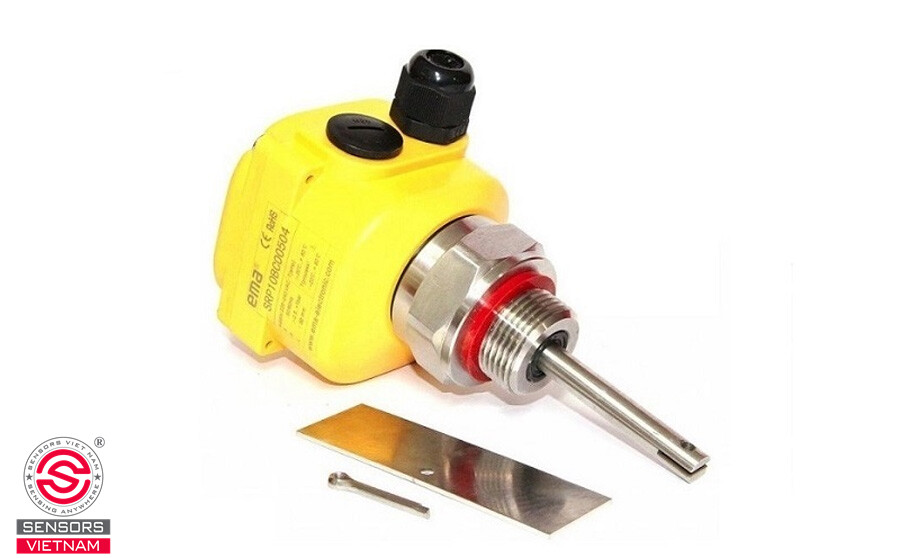
Operating principles of level switches
Although all level switches perform the same function triggering a signal at a set point, they operate based on different physical principles. These differences directly determine their suitability for specific environments.
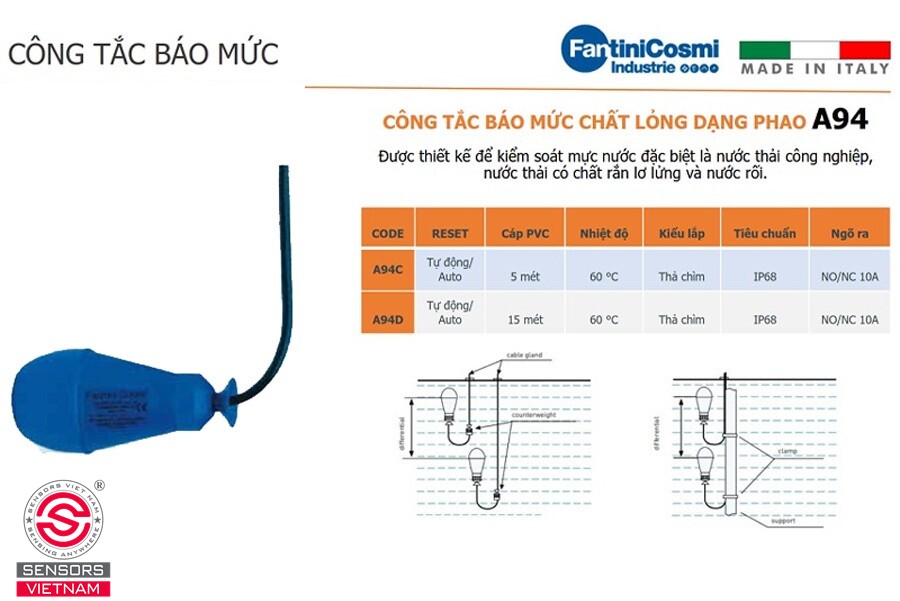
- Float type (Mechanical or magnetic float)
This type operates based on mechanical movement corresponding to liquid level changes. As the level rises or falls, the float moves and activates an internal contact. In magnetic float versions, an internal magnet actuates a reed switch without direct contact, reducing wear and extending lifespan. This solution is ideal for clean water, HVAC systems, and low-viscosity fluids.
Vibrating level switches use a probe oscillating at a resonant frequency. When not in contact with material, the vibration remains stable; when material is present, the vibration changes, and the system detects this deviation to trigger a signal. This method is highly resistant to foam, vibration, and density variations, making it suitable for demanding industrial environments.
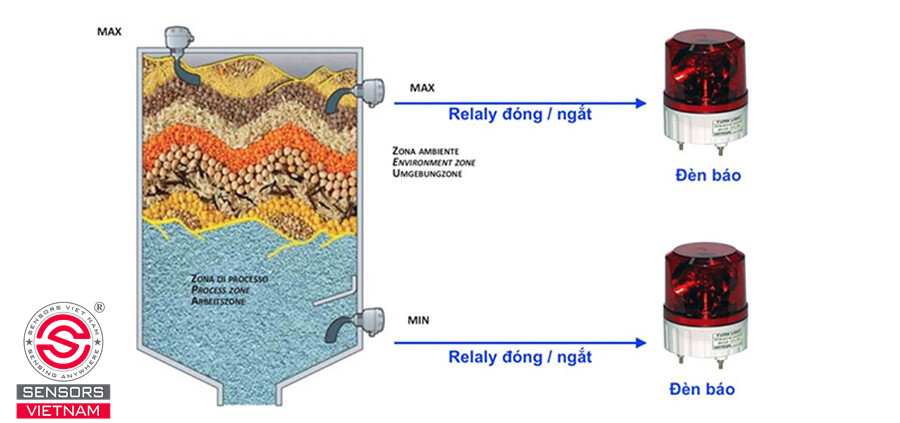
- Capacitive and conductive type
Capacitive level switches rely on differences in dielectric constant between air and the medium. When material surrounds the probe, capacitance changes and triggers the signal. This technology is versatile, suitable for liquids as well as powders and granular solids.
Conductive switches, on the other hand, operate with electrically conductive media such as water or chemical solutions and use a simpler detection principle.
For bulk solids such as cement or plastic pellets, rotary paddle switches are commonly used. The paddle rotates freely when no material is present; when material blocks the movement, resistance increases and triggers a signal. Despite being mechanical, this method is highly effective in dusty and dry environments.
- Non-contact type (Ultrasonic/Optical)
In harsh environments such as corrosive chemicals or sterile processes, non-contact technologies like ultrasonic or optical switches are preferred. Although more expensive, they are often the only viable solution where direct contact is not possible.
READ MORE: COMMON TYPES OF LEVEL SWITCH
Guide to select a good level switch
In the market, the real difference between devices lies not in appearance, but in their long-term operational stability.
A high-quality level switch must ensure three key factors:
- Material compatibility with the medium (316L stainless steel, PTFE, Hastelloy, etc.)
- Protection rating and safety certifications (IP, ATEX, IECEx)
- Fast response time and signal stability
Especially in pump protection or pressure systems, response time is not just a specification, it is a critical safety factor.
Applications of level switches
Level switches are used across nearly all industries, but their roles vary depending on system requirements.
In HVAC and water systems, they act as a fundamental protection layer, preventing dry running or overflow. In the food industry, hygiene requirements make material selection and surface design critical, especially in CIP systems.
In chemical and oil & gas industries, level switches are part of safety systems and must meet strict standards. Meanwhile, in bulk material silos, they help regulate material flow and ensure continuous production.
READ MORE: APPLICATIONS OF LEVEL MEASURING DEVICE IN HVAC SYSTEMS
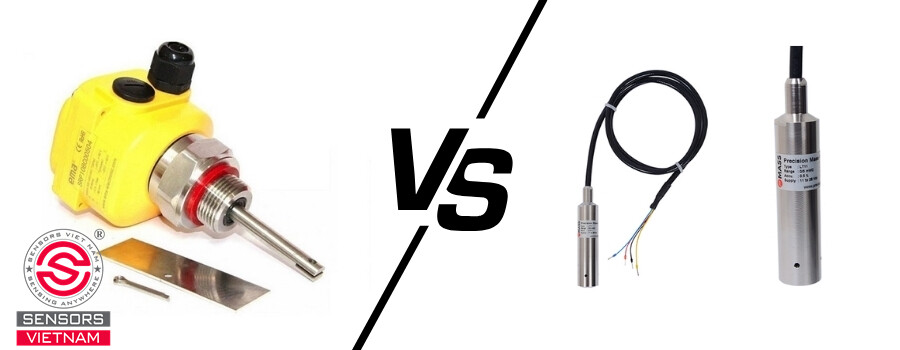
Level switch vs level sensor: Standalone or combined?
For simple applications such as high or low level alarms, level switches are often the optimal choice due to their simplicity and reliability. However, for systems requiring precise control, continuous level sensors provide more comprehensive data.
In practice, the most effective solution is often a combination of both:
continuous level sensors for operation, and level switches as an independent safety layer. This approach ensures system safety even if one device fails.
Purchase genuine level switches at Sensors Vietnam
Sensors Vietnam offers a wide range of level switches for both liquids and solids, including float type, vibrating type, and other specialized technologies. Products are sourced from reputable brands and fully comply with technical standards in HVAC, water treatment, and industrial automation.
Contact us today for expert consultation and the most suitable solution for your specific operating conditions and project requirements.