




CUSTOMER SERVICE
www.sensors.vn
Admin@sensors.vn
www.cambien.com.vn
NH3 SENSOR
Date 20/Aug/2026 at 05:25 PM - View: 217
In the cold storage, seafood processing and industrial ice manufacturing sectors, ammonia (NH3) has long been the refrigerant of choice thanks to its outstanding heat transfer efficiency and low operating cost. But alongside these benefits comes a significant risk: NH3 is a toxic, corrosive gas that becomes flammable at high concentrations. A single small leak at a compressor, valve or pipeline can force an entire production area into emergency evacuation. This is exactly why the NH3 gas detector has become mandatory equipment in any industrial refrigeration system using ammonia as its refrigerant.
WHAT IS AN NH3 GAS DETECTOR?
An NH3 gas detector (ammonia gas sensor) is an electronic device designed to detect and measure the concentration of ammonia gas in the air, issuing a warning signal once the concentration exceeds a permissible safety threshold. The device is typically installed in areas with high leak risk, such as compressor rooms, condensers, evaporators, refrigerant piping, and liquid NH3 storage areas.
Technically, NH3 has a distinctive pungent odor that humans can detect at very low concentrations. However, relying on smell alone to detect a leak is far from sufficient, because:
- At 300-500 ppm, NH3 can already cause severe irritation to the respiratory tract, eyes and skin
- At concentrations above 5,000 ppm, ammonia gas can be fatal after only a short period of exposure
- When the NH3 concentration in air reaches approximately 15-28%, the gas mixture becomes flammable, creating a fire and explosion risk in enclosed spaces
As a result, an automated NH3 gas warning system operating continuously 24/7 is an indispensable factor in protecting people, equipment and maintaining continuous production.
A typical NH3 gas detection system consists of: a sensor head, a processing and display unit for the gas concentration, an on-site audible and visual alarm, and a signal output (4-20mA, relay, RS485/Modbus) for connecting to the central control panel, activating emergency exhaust fans or shutting off the refrigerant supply.
WORKING PRINCIPLE OF NH3 GAS DETECTORS - MOST COMMONLY USED TECHNOLOGIES
There are currently three main sensing technologies used to detect NH3 gas in industry, each suited to a specific group of applications:
1. NH3 electrochemical sensor
This is the most commonly used technology in both handheld and mid-range fixed NH3 gas measuring devices. When ammonia gas contacts the sensor electrode, an oxidation-reduction reaction occurs, generating an electrical current proportional to the gas concentration. Its advantages are high sensitivity, fast response and reasonable investment cost; its drawbacks are a limited sensor service life (typically 2-3 years) requiring periodic replacement and calibration.
2. NH3 metal oxide semiconductor sensor (MOS)
The working principle is based on the change in electrical resistance of a semiconductor material (typically SnO2) upon contact with NH3 gas. This technology offers high mechanical durability, withstanding harsh industrial environments with large fluctuations in temperature and humidity, making it well suited to refrigeration compressor rooms.
3. NH3 infrared sensor (NDIR)
This technology uses the characteristic infrared light absorption principle of the NH3 gas molecule. It offers high accuracy, long service life and low sensitivity to cross-interfering gases, though the initial investment cost is higher than electrochemical or MOS sensors.
In practical installations at cold storage facilities and food processing plants in Vietnam, electrochemical and semiconductor sensors remain the two most preferred options thanks to their reasonable operating cost and reliability proven over long periods of use.
 TYPICAL APPLICATIONS OF NH3 GAS DETECTORS
NH3 gas detectors are widely applied across many industries that use ammonia as a refrigerant or production material:
- Industrial cold storage systems
- Seafood processing and frozen food plants
- Industrial ice manufacturing plants
- Fertilizer and chemical plants
- Shopping centers and supermarkets with industrial refrigeration systems
At these facilities, NH3 gas detectors are typically installed in clusters of multiple measurement points, integrated with automatic ventilation systems and interlocked with the central control system. When a leak exceeding the threshold is detected, the system automatically activates exhaust fans, triggers audible and visual alarms, and in many cases shuts off the refrigerant supply to ensure absolute safety.
CHOOSING THE RIGHT NH3 GAS DETECTOR MODEL
To select the right NH3 gas detector model for each project, businesses should consider the following factors:
- Measurement range: for compressor room areas requiring early warning of small leaks, a low measurement range (0-100 ppm or 0-1,000 ppm) is recommended; for areas with high leak risk or requiring fire/explosion threshold monitoring, a higher range (0-10,000 ppm or %LEL) is needed
- Response time: the faster the response, the more exposure risk is reduced, particularly important in areas with high personnel density
- Installation environment: temperature, humidity, vibration levels and the corrosion resistance of the sensor housing need to match actual conditions at the plant or cold storage facility
- System integration capability: priority should go to models with industry standard signal outputs (4-20mA, relay, RS485/Modbus) for easy connection to existing PLC/SCADA systems
- Operating and maintenance costs: consider sensor service life, calibration cycle and long-term component replacement costs
Choosing the wrong model, such as a measurement range too low for actual conditions or a slow response time, not only reduces alarm effectiveness but also carries serious safety risk. Businesses should therefore conduct an on-site survey and consult with a qualified supplier before making an investment decision.
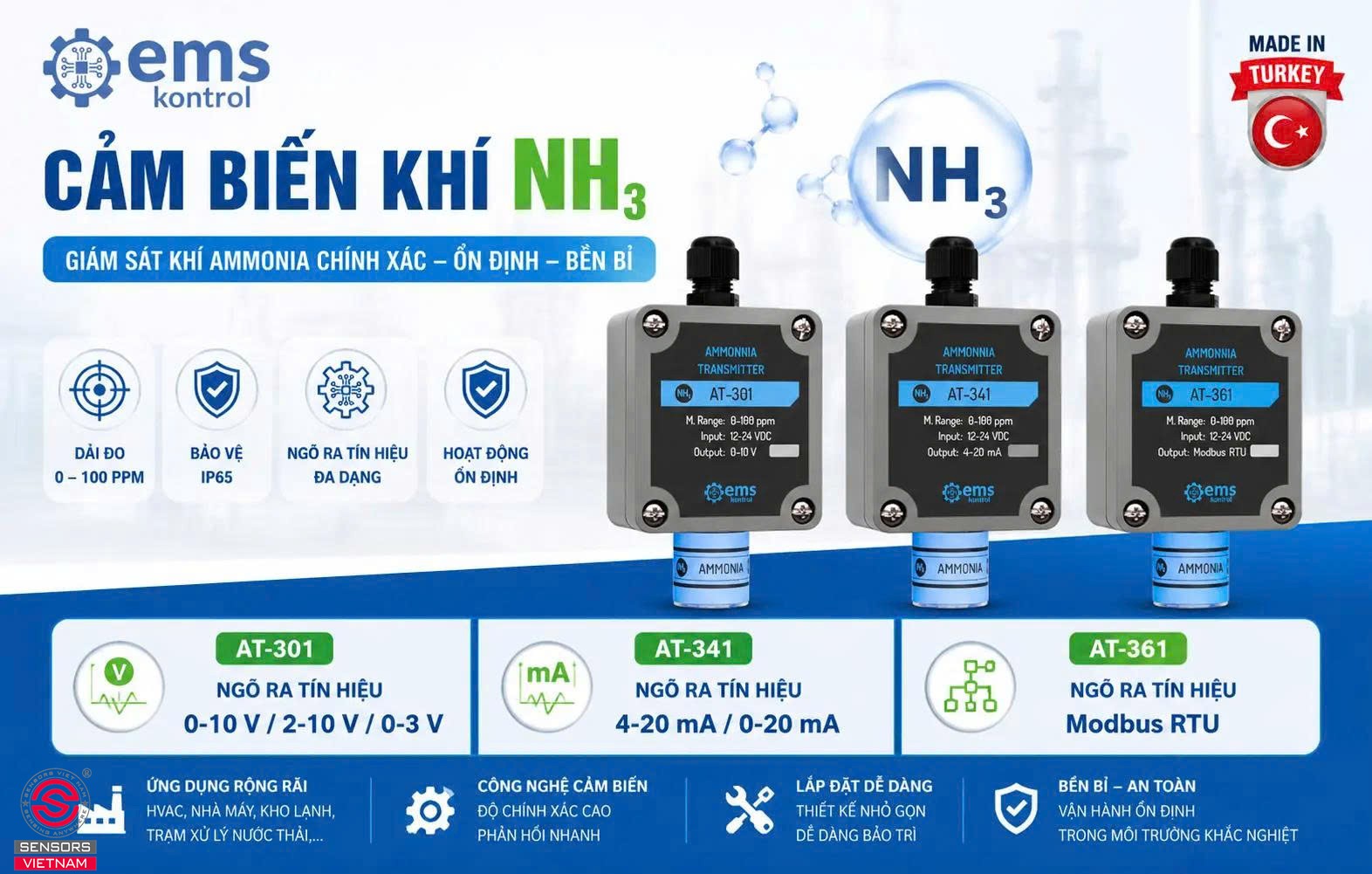
INTRODUCING NH3 GAS DETECTORS FROM THE EMS KONTROL BRAND
In the industrial gas monitoring equipment market, EMS Kontrol is one of the brands trusted by many plants and cold storage facilities in Vietnam for its stability and durability under real-world operating conditions.
EMS Kontrol's NH3 gas detector lines are designed with the following notable advantages:
- High sensitivity and accuracy, meeting monitoring requirements well in areas with NH3 leak risk within industrial refrigeration systems
- Fast response time, allowing the alarm and safety interlock system to activate promptly, minimizing risk to people and equipment
- Durable, highly corrosion resistant design, suited to compressor rooms and cooling coil areas with high humidity and frequent exposure to ammonia vapor
- Industry standard signal outputs (4-20mA, relay, RS485/Modbus), easy to integrate with control panels, PLCs or existing centralized monitoring systems at the plant
- A wide range of measurement ranges and models, suited to facilities of various scales, from small and medium cold storage units to large industrial production plants
If your business operates a refrigeration system using NH3 as the refrigerant, investing in a reliable ammonia gas detection system from the outset will help minimize incident risk, protect personnel safety, and ensure production operations are not disrupted.
 → See more: NH3 gas detector product line distributed by Sensors Vietnam
BUY 100% GENUINE NH3 GAS DETECTORS AT SENSORS VIETNAM
Sensors Vietnam is a provider of advanced measurement, sensing and automation solutions, including NH3 gas detectors. We offer a diverse portfolio of genuine products from leading global manufacturers, fully capable of meeting the full range of customer application needs.
Why choose a solution/product from Sensors Vietnam?
- 100% genuine products from leading global brands
- A comprehensive equipment ecosystem
- Highly competitive market pricing
- Fast nationwide delivery
- Completely free personalized solution consulting with a professional engineering team
- Committed product quality: genuine goods, complete CO/CQ documentation, long term warranty
For detailed information or to order an NH3 gas detector, please contact Sensors Vietnam directly for prompt and dedicated support.
Hot news




SENSORS VIETNAM CO., LTD
VAT CODE: 0313 355 473
Head Office: 03rd Floor, Indochina Tower, 04 Nguyen Dinh Chieu, Tan Dinh Ward, Ho Chi Minh City, Vietnam.
HCM Branch: 92/14/9A Vuon Lai Str., An Phu Dong Ward, Ho Chi Minh City, Vietnam.
Hanoi Branch: S106 Tower, Vinhomes Smart City, Tay Mo Ward, Hanoi City, Vietnam.

® Registered trademark – National Office of Intellectual Property Vietnam
OUR SERVICES
Specializing in the import and distribution of industrial sensors.
Sensors for HVAC/R systems and building automation applications.
Supplying gauges, transmitters, switches, controllers, PLCs, HMIs, and gas detectors.
Providing integrated consulting services for sensor and controller systems.


CONTACT US
Email: sales(at)sensors.vn
Hotline: +84 0911 660 660
Asia Commercial Bank Account (ACB):
VND: 357 246 888 | USD: 1357 246 888
Support Online ZALO Official Account
(From 8:00 am to 5:00 pm)





SENSORS VIETNAM CO., LTD
- Specialized in the import and distribution of sensors and controllers.
- Integrated data acquisition systems and industrial communication solutions.
- Design and installation of smart home systems and industrial equipment.
- Stack lights, signal beacons, LED warning horns, and RGB warning lights.