





CUSTOMER SERVICE
www.sensors.vn
Admin@sensors.vn
www.cambien.com.vn
PORTABLE MATERIAL HARDNESS TESTERS
Date 22/May/2026 at 10:40 AM - View: 95
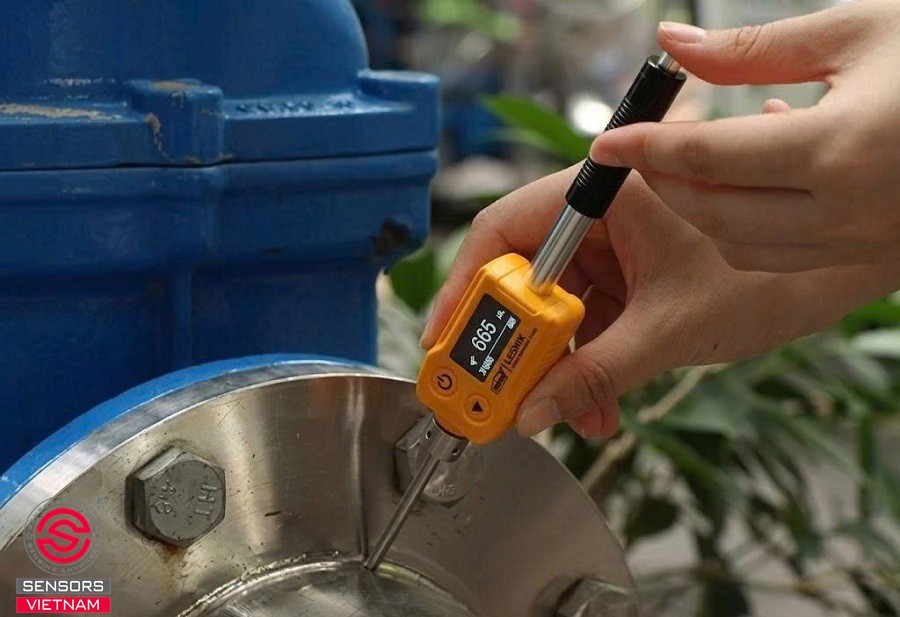
In industrial manufacturing processes, material hardness is a critical technical parameter that directly affects product lifespan, load-bearing capability, and operational safety. That is why hardness and thickness inspection is an essential task in quality control and maintenance operations. However, it is not always practical to bring test samples into a laboratory, especially for large components, fixed structures, or equipment already installed in production lines. In such situations, a portable material hardness tester becomes an indispensable solution.
WHAT IS A PORTABLE MATERIAL HARDNESS TESTER?
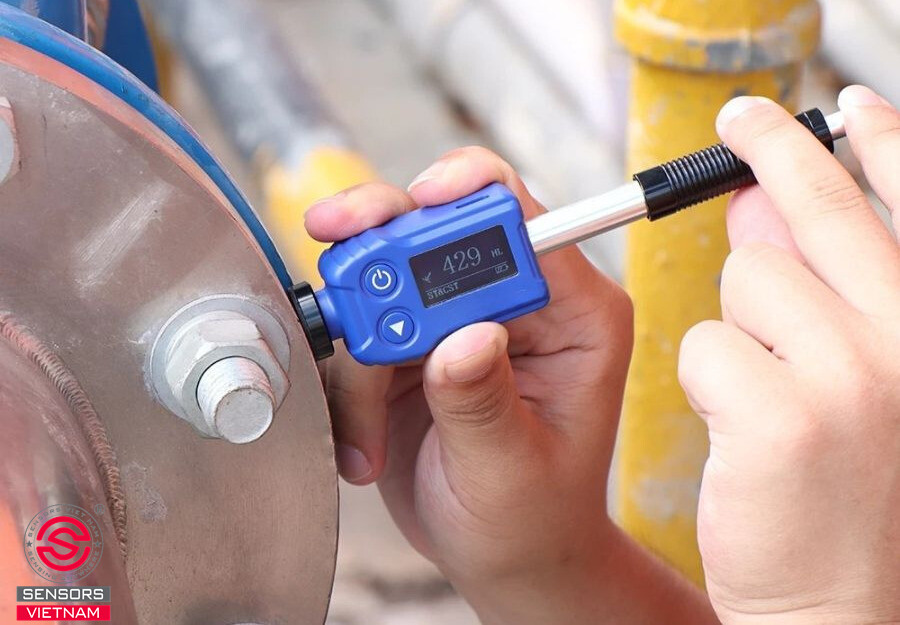
A portable material hardness tester is a compact and intelligent measuring device that allows users to quickly inspect material hardness directly on-site without dismantling components or sending them to a specialized laboratory.
Unlike bulky conventional hardness testing systems that require standard sample dimensions, portable hardness testers can perform measurements directly on the material surface at virtually any angle: horizontal, vertical, or even upside down. This outstanding flexibility significantly improves convenience and saves valuable time in real industrial environments.
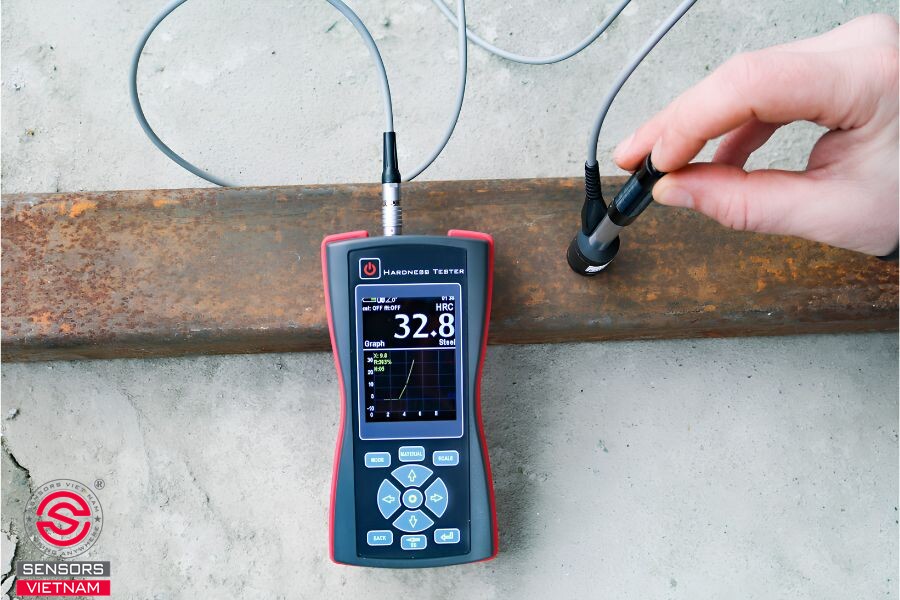
Measurement results from portable hardness testers are typically displayed in multiple hardness scales, including HRC, HRB, HB, HV, HLD, and others. This enables users to easily compare results with industry-specific technical standards.
STRUCTURE AND OPERATING PRINCIPLE OF A PORTABLE MATERIAL HARDNESS TESTER
Basic structure
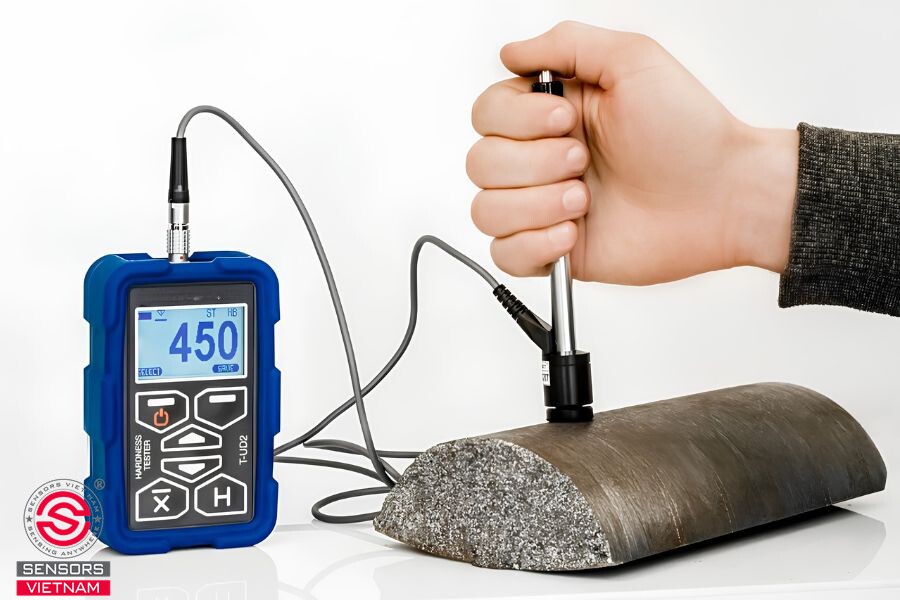
A portable material hardness tester generally consists of the following main components:
- Impact device / Probe: This component directly contacts the material surface being tested and contains an impact ball or indenter made from ultra-hard materials such as tungsten carbide or diamond.
- Main unit: The main body houses the microprocessor, display screen, data storage memory, and functional control buttons.
- Sensor: Used to detect and record the impact velocity before and after the probe strikes the material surface.
- Communication ports: Usually USB, Bluetooth, or RS-232 interfaces for transferring measurement data to computers or printers.
Operating principle
Today, the Leeb hardness testing method is considered the foundation of most portable hardness testers. The operating principle is relatively straightforward:
The impact device strikes the material surface → The sensor measures the velocity before and after impact → The rebound velocity ratio reflects the hardness of the material. The harder the material, the higher the rebound velocity, and vice versa.
Detailed process
- Impact: The device uses an impact body equipped with a diamond tip or steel ball accelerated by spring force.
- Measurement: When the impact body contacts the material surface, it rebounds backward. An integrated magnetic system detects the movement and generates an induced electrical signal proportional to the impact velocity.
- Calculation: The processor calculates material hardness based on the ratio between the impact and rebound velocities.
- Display: Measurement results are displayed in Leeb hardness units (HL) and can be automatically converted into other hardness scales such as HRC, HB, HV, and more.
OUTSTANDING ADVANTAGES OF PORTABLE MATERIAL HARDNESS TESTERS
Portable material hardness testers are increasingly trusted across many industries and are gradually replacing traditional hardness and thickness measurement methods thanks to the following advantages:
- On-site measurement with extremely simple operation
No need to dismantle components before testing. This helps save time, labor, and operational costs, especially for large structures such as machine housings, shafts, gears, and pressure vessels.
- Accurate measurements from any direction
Modern portable hardness testers are not limited by gravity or measuring orientation. Users can obtain accurate results from virtually any angle.
- Instant hardness scale conversion
With only a single measurement, users can instantly view results in multiple hardness scales such as HRC, HB, HV, HRB, HS, and more directly on the display screen.
- Minimal surface damage
The indentation created by portable hardness testers is extremely small (typically less than 0.5 mm), ensuring minimal impact on the appearance and functionality of the tested component.
- Compact and lightweight design
Most devices weigh less than 500g, making them ideal for confined spaces, elevated positions, and outdoor field applications.
- Easy data storage and export
Many portable hardness testers can store between 100 and 1000 measurement results. Users can easily connect the device to a computer for fast and accurate quality inspection reporting.
PRACTICAL APPLICATIONS OF PORTABLE MATERIAL HARDNESS TESTERS
Portable material hardness testers are widely used in applications such as:
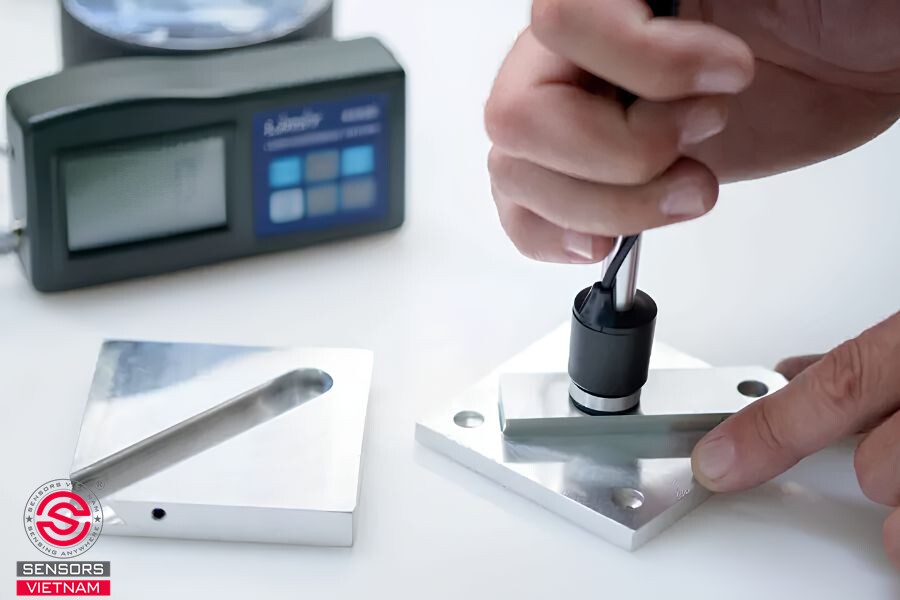
- Mechanical manufacturing: Hardness inspection after heat treatment for components such as shafts, bearings, gears, and stamping dies.
- Oil & gas - Petrochemical industry: Rapid inspection of pipelines, pressure vessels, and industrial valves directly on-site without shutting down the system.
- Shipbuilding and steel structure: Weld quality inspection and detection of abnormal hardness zones within heat-affected areas.
- Incoming material inspection: Portable hardness testers are used to quickly verify the quality of steel and raw materials before manufacturing.
- Maintenance and machinery servicing: Portable hardness testing devices help evaluate wear levels and aging conditions of operating machine components, supporting timely repair and replacement planning.
- Construction and Infrastructure: Inspection of structural steel and construction materials on-site to ensure compliance with ASTM, JIS, and GB standards.
SENSORS VIETNAM - AUTHORIZED DISTRIBUTOR OF GENUINE PORTABLE MATERIAL HARDNESS TESTERS
Sensors Vietnam is an authorized distributor of portable material hardness testers from leading global brands. We are committed to providing genuine, high-quality products with full CO/CQ certification and manufacturer-backed warranty support.
With a team of experienced engineers and consultants specializing in industrial measurement and automation, Sensors Vietnam not only supplies products but also provides professional consultation to help customers choose the right device for the right application. In addition, we offer calibration services, installation and operation training, as well as official warranty support.
Most importantly, Sensors Vietnam provides portable material hardness testers at highly competitive and reasonable prices in today’s market. If you are looking for a fast, compact, durable, and reliable on-site hardness measurement solution, do not hesitate to contact Sensors Vietnam today for free consultation and the best quotation available.
Hot news


SENSORS VIETNAM CO., LTD
VAT CODE: 0313 355 473
Head Office: 03rd Floor, Indochina Tower, 04 Nguyen Dinh Chieu, Tan Dinh Ward, Ho Chi Minh City, Vietnam.
HCM Branch: 92/14/9A Vuon Lai Str., An Phu Dong Ward, Ho Chi Minh City, Vietnam.
Hanoi Branch: S106 Tower, Vinhomes Smart City, Tay Mo Ward, Hanoi City, Vietnam.

® Registered trademark – National Office of Intellectual Property Vietnam
OUR SERVICES
Specializing in the import and distribution of industrial sensors.
Sensors for HVAC/R systems and building automation applications.
Supplying gauges, transmitters, switches, controllers, PLCs, HMIs, and gas detectors.
Providing integrated consulting services for sensor and controller systems.


CONTACT US
Email: sales(at)sensors.vn
Hotline: +84 0911 660 660
Asia Commercial Bank Account (ACB):
VND: 357 246 888 | USD: 1357 246 888
Support Online ZALO Official Account
(From 8:00 am to 5:00 pm)





SENSORS VIETNAM CO., LTD
- Specialized in the import and distribution of sensors and controllers.
- Integrated data acquisition systems and industrial communication solutions.
- Design and installation of smart home systems and industrial equipment.
- Stack lights, signal beacons, LED warning horns, and RGB warning lights.