






CUSTOMER SERVICE
www.sensors.vn
Admin@sensors.vn
www.cambien.com.vn
WATER DIFFERENTIAL PRESSURE GAUGE
Date 24/Mar/2026 at 04:56 PM - View: 174
In real-world operation of water systems, faults do not always manifest clearly through flow rate or temperature. In many cases, the system may appear to be running “normally,” while its efficiency has already degraded due to clogging, fouling, scaling, or equipment operating outside its design conditions.
The challenge lies in the fact that these changes occur internally within pipelines and equipment, making them difficult to detect through visual inspection or conventional parameters. However, whenever water flows through any component, a certain pressure drop is always present. If internal conditions change, this pressure drop will vary accordingly.
Therefore, instead of relying solely on outcome parameters such as flow or temperature, monitoring the differential pressure across equipment provides direct insight into what is happening inside the system. This is the fundamental reason why differential pressure gauges are widely used as essential monitoring tools in operation and maintenance.
Let’s explore in detail the function and applications of differential pressure gauges in water systems.
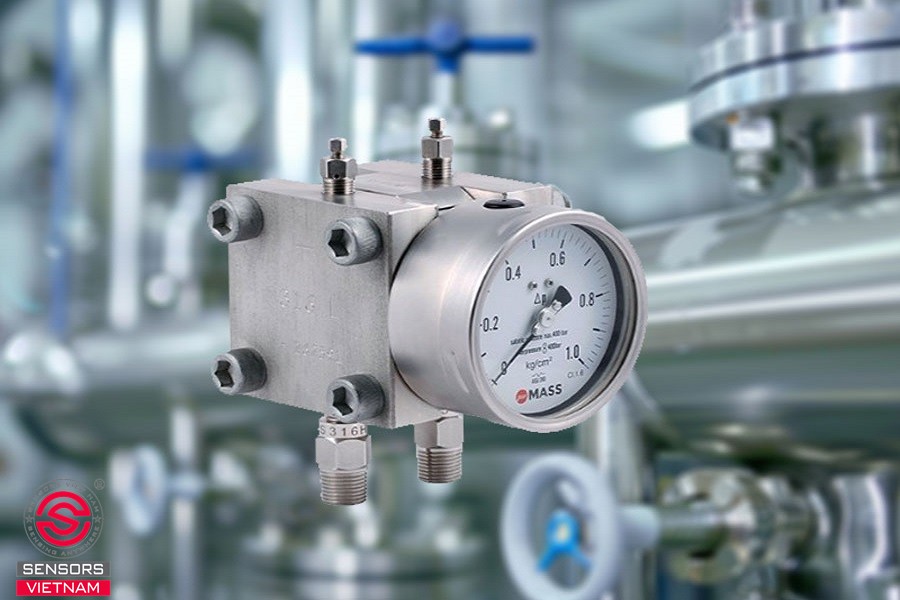
What is a differential pressure gauge?From a technical perspective, a differential pressure gauge is an instrument used to measure the pressure difference between two specific points within the same fluid system. Unlike a standard pressure gauge, which measures pressure at a single point, this device compares two pressure inputs to determine the energy loss of the fluid as it flows through intermediate components such as filters, heat exchangers, or pump assemblies.
By monitoring differential pressure, operators can accurately diagnose four critical conditions:
-
Level of filter contamination
-
Scale buildup inside pipelines
-
Actual pump performance compared to its characteristic curve
-
Heat transfer efficiency of heat exchangers

Detailed analysis of two main differential pressure technologies
Depending on accuracy requirements and system integration capabilities, differential pressure gauges are generally divided into two main categories:
1. Mechanical differential pressure gauge (Analog): A durable solution for harsh environment
This type operates based on classical physical principles. At its core is an elastic sensing element, typically a diaphragm or piston. When high-pressure and low-pressure inputs act on opposite sides of this element, the resulting force difference creates mechanical deformation. This movement is transmitted through a precision gear mechanism, driving the pointer on the dial to indicate the differential pressure.
Key advantages:
-
No power supply required
-
Simple structure, high durability
-
Reliable operation in harsh industrial environments
-
Low initial cost
Limitations:
-
Lower accuracy compared to electronic devices
-
No remote signal transmission
-
Requires on-site visual monitoring
Typical applications:
-
Monitoring water filters
-
Checking pump differential pressure
-
Installation in mechanical rooms and plant facilities

2. Electronic differential pressure gauge (Digital): The core of smart systems
This modern solution integrates semiconductor-based differential pressure sensors. The sensor receives pressure signals from two input ports, and an internal microprocessor calculates the pressure difference, converting it into standard electrical outputs such as 4-20 mA or 0-10 V.
The strength of electronic devices lies in connectivity. In addition to displaying values on a clear LCD screen, they can transmit data via Modbus RTU to Building Management Systems (BMS) or central control systems such as PLC/SCADA. This enables automatic alarm settings and system responses without manual intervention.
This type is essential in applications requiring high precision and automation, such as pharmaceutical plants, food processing facilities, and smart buildings.
Advantages:
-
High accuracy
-
Clear digital display
-
Continuous and automated monitoring
-
Suitable for intelligent systems
Applications:
-
Central HVAC systems
-
Industrial plants
-
Smart buildings
-
Automated control systems
Importance of differential pressure gauges in water systems
A differential pressure gauge is not merely a measuring device, it is a highly effective diagnostic tool. Continuous monitoring enables:
-
Early fault detection: quickly identify clogging or abnormal conditions
-
Optimized maintenance: determine the right time for cleaning or replacement
-
Reduced operating costs: minimize energy waste from overloaded pumps
-
Extended equipment lifespan: prevent damage from improper operation
-
Automation integration: provide input signals for control systems
In large systems, differential pressure is also used to control pump variable frequency drives (VFDs) or regulating valves, ensuring optimal system performance.
Applications of differential pressure gaugesDue to their versatility and diagnostic value, differential pressure gauges are widely used in:
-
Chilled Water (CHW) and Hot Water (HW) systems
-
HVAC systems in buildings
-
Industrial water treatment and RO systems
-
Pumping stations and piping networks
-
Heat exchangers, chillers, and cooling towers
-
Manufacturing plants (food, pharmaceutical, electronics)
-
Infrastructure and utility systems
Recommended installation locations for differential pressure gauges
The effectiveness of a differential pressure gauge depends heavily on proper installation. In practice, there are four key locations where these devices deliver maximum value:
- Across filters: The most common application. It helps determine the optimal time for cleaning or replacing filter elements, avoiding premature replacement or excessive pressure drop.
- Across pumps (inlet and outlet): Used to verify whether the pump operates within its optimal performance range and to detect issues such as cavitation or impeller damage.
- Across heat exchangers (including chillers): Monitors fouling levels on heat transfer surfaces, ensuring maximum thermal efficiency.
- Between supply and return lines: Supports hydraulic balancing in closed-loop water systems within buildings or industrial plants.

A differential pressure gauge is not just an indicator, it is a diagnostic tool that helps optimize operational costs. Selecting the right type of differential pressure device for your system can significantly reduce energy consumption, extend equipment lifespan, and ensure safe, stable operation.
Hot news




SENSORS VIETNAM CO., LTD
VAT CODE: 0313 355 473
Head Office: 03rd Floor, Indochina Tower, 04 Nguyen Dinh Chieu, Tan Dinh Ward, Ho Chi Minh City, Vietnam.
HCM Branch: 92/14/9A Vuon Lai Str., An Phu Dong Ward, Ho Chi Minh City, Vietnam.
Hanoi Branch: S106 Tower, Vinhomes Smart City, Tay Mo Ward, Hanoi City, Vietnam.

® Registered trademark – National Office of Intellectual Property Vietnam
OUR SERVICES
Specializing in the import and distribution of industrial sensors.
Sensors for HVAC/R systems and building automation applications.
Supplying gauges, transmitters, switches, controllers, PLCs, HMIs, and gas detectors.
Providing integrated consulting services for sensor and controller systems.


CONTACT US
Email: sales(at)sensors.vn
Hotline: +84 0911 660 660
Asia Commercial Bank Account (ACB):
VND: 357 246 888 | USD: 1357 246 888
Support Online ZALO Official Account
(From 8:00 am to 5:00 pm)





SENSORS VIETNAM CO., LTD
- Specialized in the import and distribution of sensors and controllers.
- Integrated data acquisition systems and industrial communication solutions.
- Design and installation of smart home systems and industrial equipment.
- Stack lights, signal beacons, LED warning horns, and RGB warning lights.