






CUSTOMER SERVICE
www.sensors.vn
Admin@sensors.vn
www.cambien.com.vn
WHAT IS N2O (NITROUS OXIDE) DETECTOR?
Date 12/Aug/2026 at 04:11 PM - View: 7
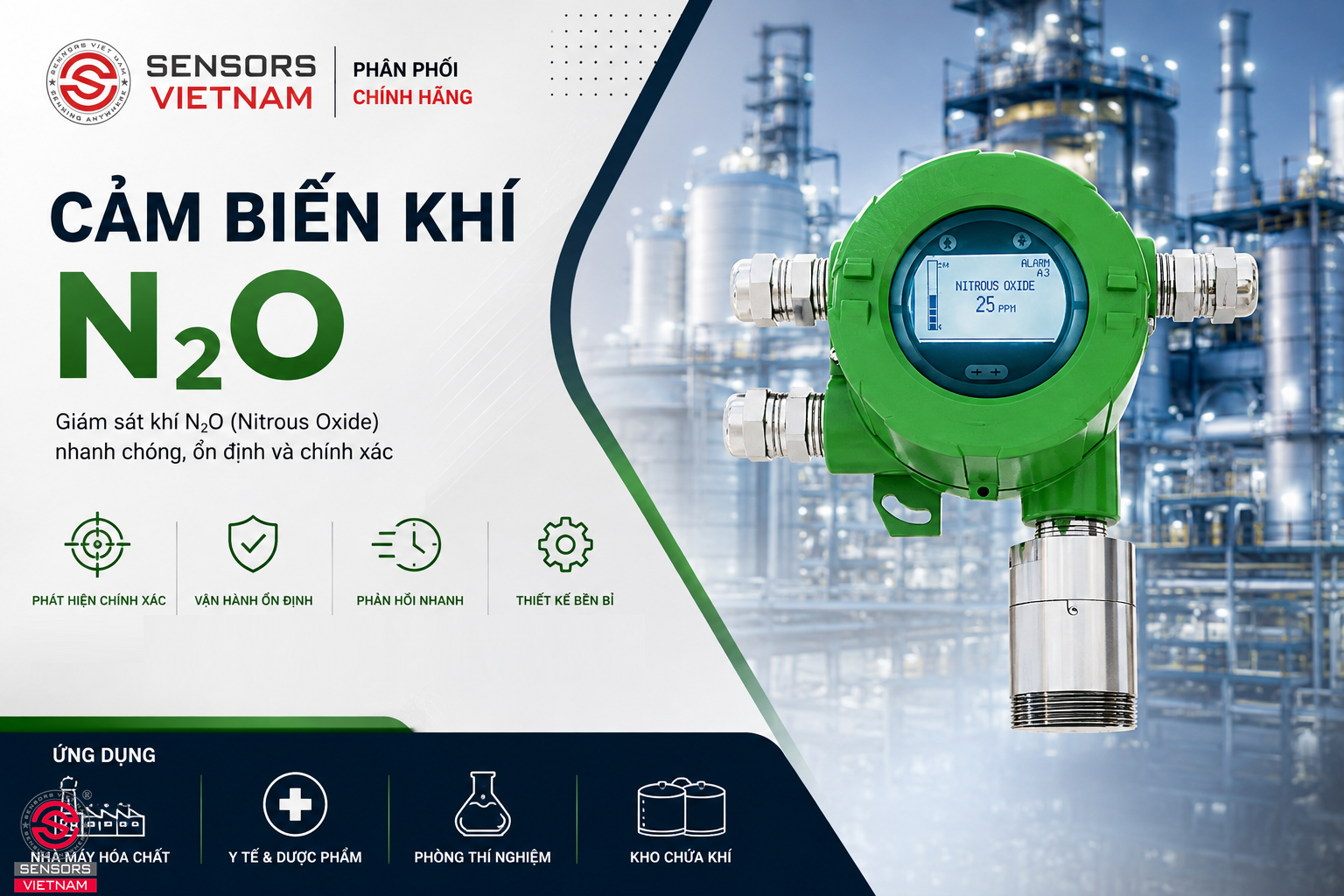
Many people know N2O by its nickname "laughing gas," but few realize it is also a strong oxidizer, found across the food industry, aerospace and even high performance engines. This wide range of applications is exactly why N2O needs to be closely controlled with dedicated gas detectors across many different work environments. Let's take a closer look at N2O gas detectors in industry with Sensors Vietnam.
WHAT IS N2O (NITROUS OXIDE) GAS, AND WHY DOES IT NEED CLOSE MANAGEMENT?
N2O, chemically known as nitrous oxide, is a colorless gas with a slightly sweet taste and odor, widely known for its mild anesthetic effect when inhaled at high concentrations. Beyond its familiar role in medicine, however, N2O carries several characteristics that require close control from both an occupational safety and an environmental standpoint.
Key characteristics of N2O:
- A strong oxidizer that can accelerate the combustion of other materials when present at high concentration
- Prolonged exposure can impair manual dexterity, affect reproductive health, and cause certain neurological disorders
- The occupational exposure limit recommended by NIOSH for N2O is 25 ppm as a time weighted average during anesthetic gas administration
- One of the notable greenhouse gases, also capable of depleting the ozone layer, which is drawing increasing attention in emissions regulations
KEY INFORMATION ABOUT N2O (NITROUS OXIDE) GAS DETECTORS
An N2O gas detector is a dedicated device used to detect the presence and measure the concentration of nitrous oxide gas in the air, typically expressed in ppm. Because N2O is not flammable but carries a cumulative toxicity risk from prolonged exposure, the primary monitoring goal of this detector is to control the concentration of gas released into the work environment, rather than to warn of fire or explosion risk as with many industrial gases.
One point worth noting specifically for N2O is that in medical settings, the detector is often integrated with the anesthetic gas scavenging system, helping to evaluate the effectiveness of waste gas collection and detect leaks from piping or anesthesia masks in operating rooms and dental offices.
APPLICATIONS OF N2O (NITROUS OXIDE) GAS DETECTORS: HEALTHCARE, INDUSTRY AND BEYOND
In the healthcare sector, N2O gas detectors are installed in operating rooms, dental offices and veterinary clinics, where the gas is commonly used as an anesthetic agent. Monitoring the concentration of waste gas helps protect the health of doctors, nurses and support staff who regularly work in environments where anesthetic gas is administered.
N2O is also an oxidizer used in certain high performance engines within motorsports, as well as a stable monopropellant in some aerospace applications thanks to its ability to be stored for long periods without special conditions. At these facilities, N2O gas detectors help monitor storage and filling areas to detect leaks early.
In addition, chemical research laboratories that use N2O as an oxidizer for organic synthesis reactions are also environments that require detectors to protect the safety of technical staff.
THE MOST WIDELY USED TECHNOLOGY IN MODERN N2O GAS DETECTORS
Non-Dispersive Infrared (NDIR) technology is currently the most common choice for N2O gas detectors. The working principle is based on the degree of infrared light absorption at the characteristic wavelength of the N2O molecule: the sensor emits an infrared beam through a measurement chamber containing the air sample, and a detector measures the intensity of the light remaining, calculating the corresponding gas concentration.
NDIR is favored for N2O due to its high stability, low sensitivity to interference from other gases, and suitability for continuous long term monitoring, which is particularly important for medical applications where measurement reliability must be maintained throughout the anesthesia process. Compared with other technologies such as electrochemical sensors, which operate based on an oxidation-reduction reaction at an electrode, NDIR is less prone to sensitivity degradation over time, although its initial investment cost is typically higher.
HOW TO CHOOSE THE RIGHT N2O (NITROUS OXIDE) GAS DETECTOR FOR EACH SYSTEM
Choosing the right N2O detector should start with clearly defining the monitoring purpose, since the technical requirements differ between medical and industrial applications.
For medical environments such as operating rooms or dental offices, priority should be given to detectors with good sensitivity at low ppm ranges, matching the 25 ppm limit recommended by NIOSH, along with the ability to integrate with the facility's existing anesthetic gas scavenging system.
For industrial applications such as N2O storage areas in food production or chemical laboratories, additional consideration should be given to resistance to interference from other gases present in the same environment, as well as the durability of the device under actual operating conditions.
Beyond these measurement-related factors, the sensor's signal output, including analog, relay or RS485 Modbus, should be checked to ensure smooth integration with the facility's existing monitoring system, along with the calibration cycle required to maintain long term accuracy.
SENSORS VIETNAM - THE LEADING DISTRIBUTOR OF N2O SENSORS IN VIETNAM
Sensors Vietnam is a provider of advanced measurement, sensing, and automation solutions, including N2O gas detectors. We offer a diverse portfolio of genuine products from leading global manufacturers, fully capable of meeting the full range of customer application needs. For detailed information or to order a N2O gas detector, please contact Sensors Vietnam directly for prompt and dedicated support.
Hot news


SENSORS VIETNAM CO., LTD
VAT CODE: 0313 355 473
Head Office: 03rd Floor, Indochina Tower, 04 Nguyen Dinh Chieu, Tan Dinh Ward, Ho Chi Minh City, Vietnam.
HCM Branch: 92/14/9A Vuon Lai Str., An Phu Dong Ward, Ho Chi Minh City, Vietnam.
Hanoi Branch: S106 Tower, Vinhomes Smart City, Tay Mo Ward, Hanoi City, Vietnam.

® Registered trademark – National Office of Intellectual Property Vietnam
OUR SERVICES
Specializing in the import and distribution of industrial sensors.
Sensors for HVAC/R systems and building automation applications.
Supplying gauges, transmitters, switches, controllers, PLCs, HMIs, and gas detectors.
Providing integrated consulting services for sensor and controller systems.


CONTACT US
Email: sales(at)sensors.vn
Hotline: +84 0911 660 660
Asia Commercial Bank Account (ACB):
VND: 357 246 888 | USD: 1357 246 888
Support Online ZALO Official Account
(From 8:00 am to 5:00 pm)





SENSORS VIETNAM CO., LTD
- Specialized in the import and distribution of sensors and controllers.
- Integrated data acquisition systems and industrial communication solutions.
- Design and installation of smart home systems and industrial equipment.
- Stack lights, signal beacons, LED warning horns, and RGB warning lights.