





CUSTOMER SERVICE
www.sensors.vn
Admin@sensors.vn
www.cambien.com.vn
0-10V vs 4-20mA SIGNAL: THE DIFFERENCE
Date 02/Oct/2026 at 11:09 AM - View: 11
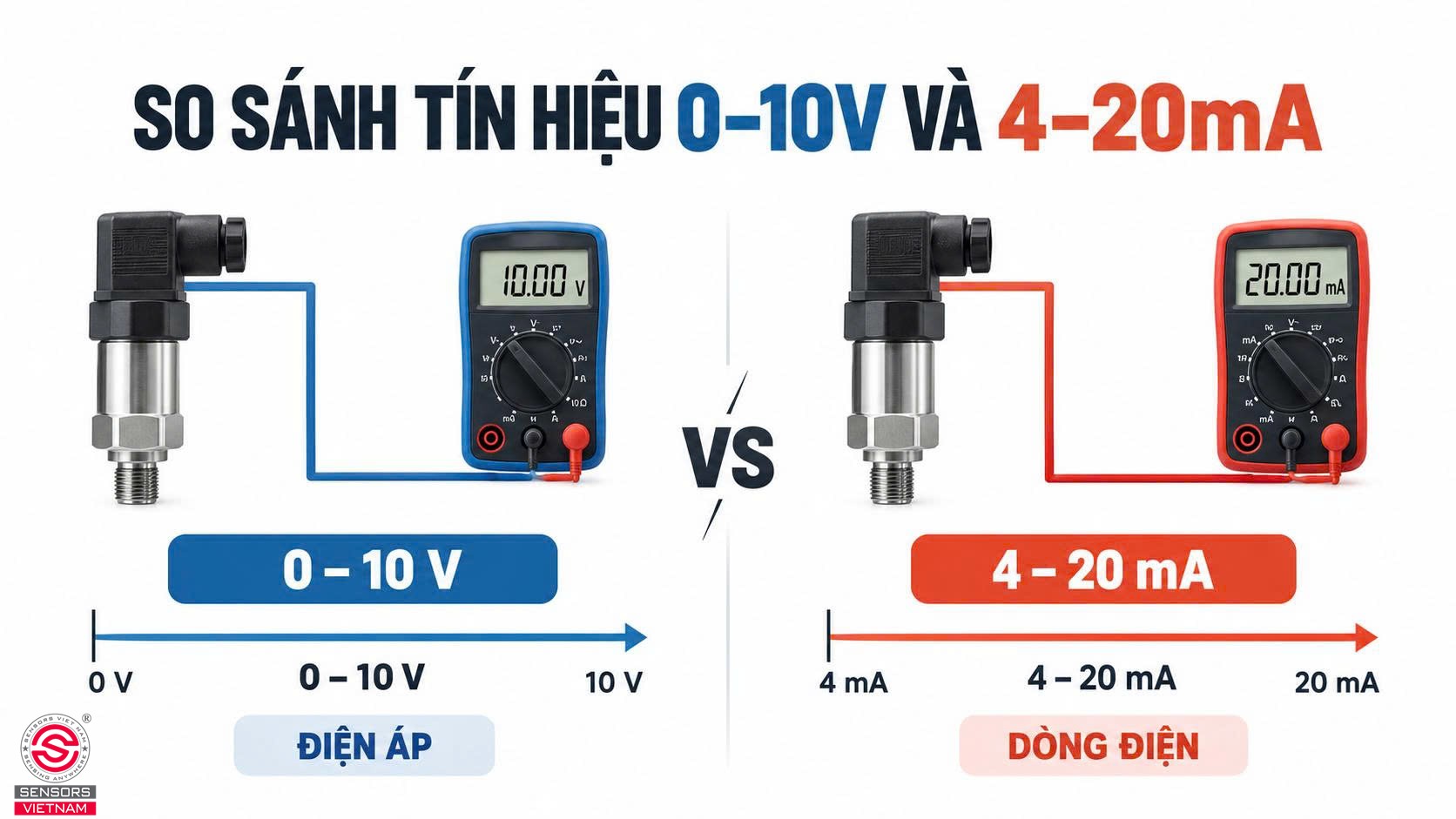
In a modern HVAC system, temperature, humidity, pressure, or CO2 sensors measure operating conditions and send the results to a controller, which then determines fan speed, valve position, or compressor capacity. Most of this communication is carried out through analog signals, meaning the signal changes continuously according to the measured value rather than having only two states, such as ON or OFF. The two most common analog standards are 0-10V and 4-20mA signals.
Understanding these two signal standards correctly helps you select the right sensor, wire the controller correctly, and avoid time consuming commissioning problems.
0-10V SIGNAL: WHAT IS IT?
A 0-10V signal is a voltage based analog signal. The measured or controlled value is represented by a DC voltage ranging from 0V to 10V. For example, a 0-10V temperature sensor configured for a measurement range of 0 to 50°C outputs 0V at 0°C, 5V at 25°C, and 10V at 50°C. This relationship is linear, so the controller only needs to read the voltage and convert it back into the corresponding physical value.
A key characteristic of this standard is that the measuring circuit has high input impedance, so only a very small current flows through the signal circuit. This makes the circuit simple, cost effective, and easy to test using a multimeter in DC voltage measurement mode.
In practice, 0-10V signals are used in two directions. The first is the output of a 0-10V sensor sent to the controller. The second is the 0-10V output from a controller sent to an actuator such as a variable frequency drive, a control valve with a servo actuator, or an EC motor to command speed or position.
4-20MA SIGNAL: WHAT IS IT?
A 4-20mA signal is a current based analog signal. Instead of using voltage levels, the measured value is represented by the current flowing through the circuit, from 4mA to 20mA. Using the same temperature range of 0 to 50°C, a 4-20mA temperature sensor outputs 4mA at 0°C, 12mA at 25°C, and 20mA at 50°C.
Many people wonder why the minimum signal level is 4mA rather than 0mA. This is intentional and is commonly referred to as "live zero". When the signal drops to 0mA, the controller can immediately identify that the circuit is open or that the sensor has lost power, rather than interpreting the signal as a true zero measurement. With a 0-10V signal, 0V can represent an actual measured value but can also indicate a broken signal wire, making fault detection more difficult.
The current in a closed circuit has the same magnitude at every point, so cable resistance does not significantly change the transmitted value. This is why 4-20mA sensors are widely used where signal cables are long or where the environment contains significant electrical interference. Many 4-20mA sensors also operate in a two wire configuration, using the same pair of wires for both power supply and signal transmission, which helps reduce cabling requirements. At the receiving end, a 4-20mA controller input may use a shunt resistor, such as a 250 ohm resistor, to convert the current into a 1 to 5V voltage signal before processing it.
HOW ARE 0-10V AND 4-20MA SIGNALS DIFFERENT?
The most obvious difference is the physical quantity carrying the information: 0-10V uses voltage, while 4-20mA uses current. This leads to several practical differences:
Noise immunity
A current loop has low circuit impedance, so induced electrical noise is less likely to change the transmitted current value. A voltage circuit has higher impedance and is more susceptible to interference, especially when signal cables run parallel to power cables or variable frequency drive cables. Therefore, 4-20mA control signals are generally more stable in industrial plants and facilities with large power equipment.
Transmission distance
With a 0-10V signal, cable resistance causes voltage drop, so the cable length should generally be kept relatively short, typically within the same control panel area or technical room. A 4-20mA signal can generally be transmitted over significantly longer distances without a significant loss of measurement accuracy.
Fault detection capability
Because 4mA represents the live zero point, a 4-20mA signal allows the controller to detect an open circuit or sensor failure. A 0-10V signal does not inherently provide the same fault detection capability, so additional monitoring or configuration may be required.
Wiring and testing
A 0-10V signal has a simple wiring arrangement and can be checked with a voltmeter. A 4-20mA signal requires current measurement, meaning the multimeter must be connected in series with the circuit or a dedicated mA clamp meter must be used, making the testing process slightly more complex.
One signal, multiple devices
Multiple 0-10V inputs can be connected in parallel to the same signal source, provided that the output is capable of driving the combined input load. With 4-20mA, receiving devices are connected in series within the current loop, so the total loop resistance increases as more devices are added.
An important wiring consideration is that many sensors and controllers support both standards through a jumper or software configuration. If the wrong signal mode is selected, the controller may display an entirely incorrect value even when the wiring is correct. Always verify the sensor output type against the controller input type before applying power.
WHEN SHOULD YOU CHOOSE A 0-10V SIGNAL?
A 0-10V signal is suitable when the distance between the sensor and controller is short, the electrical environment is relatively clean, and project cost needs to be considered. It is a practical choice for commercial HVAC systems in office buildings, shopping centers, schools, and similar facilities where equipment is typically located within the same technical area.
In addition, if the commissioning team needs to configure and test the system quickly using only a multimeter, 0-10V signals are convenient to troubleshoot. For small retrofit projects and new installations, this signal standard can help simplify and shorten installation and commissioning time.
A 0-10V signal should be avoided when signal cables are very long, when cables must run close to strong sources of electrical interference, or when open circuit fault detection is mandatory but the system does not provide an alternative fault monitoring method.
WHEN SHOULD YOU CHOOSE A 4-20MA SIGNAL?
A 4-20mA signal is suitable in several typical situations, such as long cable runs, equipment installed in different areas of a facility, or signal cables that must run close to variable frequency drives, high power motors, and electrical power panels.
Systems requiring safety monitoring or alarm functions can also benefit from 4-20mA sensors. When the current falls below 4mA, a 4-20mA controller can trigger a sensor fault alarm or place the equipment into a predefined safe operating mode instead of continuing operation based on an invalid measurement.
Industrial environments, cleanrooms, pharmaceutical manufacturing facilities, large data centers, and industrial refrigeration systems commonly use this standard because they require long term signal stability. The 4-20mA standard is also widely used in instrumentation and industrial automation, making it easy to integrate sensors with PLCs and BMS systems from different manufacturers.
APPLICATIONS OF 0-10V AND 4-20MA SIGNALS
Applications of 0-10V signals
In HVAC systems, 0-10V signals are commonly used for actuator control. A 0-10V controller sends a command to a variable frequency drive to adjust the speed of supply air fans, return air fans, or chilled water pumps, helping reduce energy consumption compared with fixed speed operation. For EC motors, the 0-10V signal can directly control motor speed.
In VAV systems, the 0-10V signal controls damper position according to the demand of each zone. Chilled water or hot water control valves equipped with 0-10V servo actuators regulate water flow in a similar way, helping maintain stable room temperature.
On the sensor side, room temperature and humidity sensors with 0-10V outputs are commonly used to transmit measurements to controllers. 0-10V CO2 sensors are used for demand controlled ventilation, increasing outdoor air flow when indoor CO2 concentration rises due to increased occupancy. 0-10V differential pressure sensors are also widely used to monitor filter pressure drop or room pressure.
Outside HVAC applications, 0-10V signals are also used for dimming LED lighting systems in commercial buildings.
Applications of 4-20mA signals
4-20mA sensors are widely used when accurate and stable measurement is required over long distances. In chilled water systems, 4-20mA pressure sensors monitor pipe pressure and provide signals to a 4-20mA controller or PLC to control a variable frequency drive pump and maintain constant pressure. 4-20mA temperature sensors installed on chilled water supply and return lines are also common because these measurement points may be located far from the control room.
In industrial refrigeration systems and cold storage facilities, 4-20mA temperature and pressure sensors send measurement data to PLCs for compressor control, electronic expansion valve control, and defrost sequences. In factories, cleanrooms, and laboratories, 4-20mA humidity and differential pressure sensors help maintain strict environmental conditions while providing immediate fault detection when problems occur in the measurement circuit.
4-20mA signals are also used as output signals from controllers to certain types of control valves, valve positioners, and other actuators in industrial systems and thermal power plants.
→ There is no universally "better" signal standard. Choose according to cable length, electrical interference level, fault monitoring requirements, and the type of input supported by your equipment.
Industrial analog signal transmitter solutions from Sensors Vietnam
Sensors Vietnam provides industrial analog signal transmitter solutions for common measurement requirements, including pressure, differential pressure, temperature, humidity, CO2, and flow. Equipment is selected and recommended according to each specific application, from monitoring chilled water pipe pressure and cleanroom differential pressure to measuring air duct temperature and liquid level in storage tanks.
Technical specifications of the EE10-M1A3D1 room temperature and humidity sensor
- Model: EE10-M1A3D1
- Function: Temperature and humidity measurement
- Temperature measurement range: 0 to 50°C
- Humidity measurement range: 0 to 100%RH
- Output: 0-10V
- Integrated display
- Origin: Austria
- Warranty: 12 months, one to one replacement
- CO/CQ: Fully available.
Technical specifications of the HTS201-M1A6D1 room temperature and humidity sensor
- Temperature measurement range: 0 to 50°C
- Humidity measurement range: 0 to 100%RH, non condensing
- Humidity accuracy: ±(2 + 0.003 × mv) %RH (mv = measured value)
- Temperature accuracy: ±0.38°C
- Output: 2 × 4-20mA (independent RH and T outputs), load <500 Ω
- Integrated LCD display
- Power supply: 10 to 35 VDC, typically 24 VDC
- Sensor protection: E+E coating for protection against dust, chemicals, and corrosion
- Certifications: CE, FCC, traceable calibration according to DIN EN ISO/IEC 17025
- Origin: E+E Elektronik, Austria
For detailed consultation on 0-10V signals or to order sensors with analog outputs, please contact Sensors Vietnam directly via hotline 0911 660 660 or visit the websites https://cambien.com.vn/ and https://www.sensors.vn/.
Hot news


SENSORS VIETNAM CO., LTD
VAT CODE: 0313 355 473
Head Office: 03rd Floor, Indochina Tower, 04 Nguyen Dinh Chieu, Tan Dinh Ward, Ho Chi Minh City, Vietnam.
HCM Branch: 92/14/9A Vuon Lai Str., An Phu Dong Ward, Ho Chi Minh City, Vietnam.
Hanoi Branch: S106 Tower, Vinhomes Smart City, Tay Mo Ward, Hanoi City, Vietnam.

® Registered trademark – National Office of Intellectual Property Vietnam
OUR SERVICES
Specializing in the import and distribution of industrial sensors.
Sensors for HVAC/R systems and building automation applications.
Supplying gauges, transmitters, switches, controllers, PLCs, HMIs, and gas detectors.
Providing integrated consulting services for sensor and controller systems.


CONTACT US
Email: sales(at)sensors.vn
Hotline: +84 0911 660 660
Asia Commercial Bank Account (ACB):
VND: 357 246 888 | USD: 1357 246 888
Support Online ZALO Official Account
(From 8:00 am to 5:00 pm)





SENSORS VIETNAM CO., LTD
- Specialized in the import and distribution of sensors and controllers.
- Integrated data acquisition systems and industrial communication solutions.
- Design and installation of smart home systems and industrial equipment.
- Stack lights, signal beacons, LED warning horns, and RGB warning lights.