





CUSTOMER SERVICE
www.sensors.vn
Admin@sensors.vn
www.cambien.com.vn
24VAC/DC AND 230VAC DAMPER ACTUATOR
Date 18/Sep/2026 at 04:53 PM - View: 12
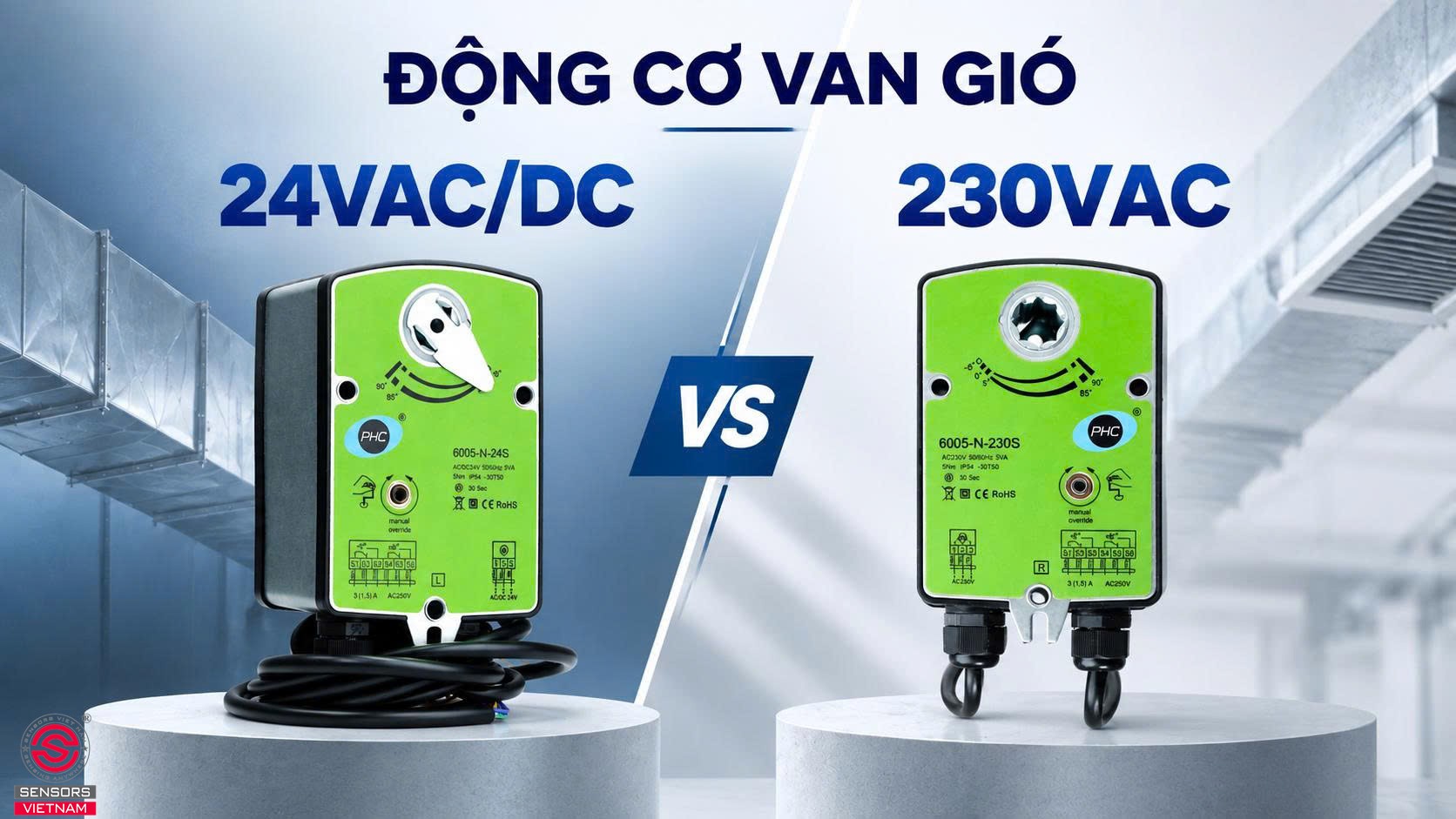
If you are familiar with HVAC systems, you have probably come across two common types of equipment: the 24VAC/DC damper actuator and the 230VAC damper actuator. Both devices are designed to control the opening and closing of air dampers in air conditioning, ventilation, and building HVAC systems. Although they serve the same basic function, these two types of damper actuators differ considerably in terms of power supply, installation requirements, control signals, safety, and overall system cost.
WHAT IS A 24VAC/DC DAMPER ACTUATOR?
A 24VAC/DC damper actuator, also known as a 24VAC/DC air damper actuator, 24VAC/DC damper motor, or 24VAC/DC damper controller, is a device designed to operate at a 24V power supply. It can operate on both alternating current (AC) and direct current (DC), providing greater flexibility during electrical installation and system integration.
The 24V damper actuator is widely used in modern HVAC systems. Most AHU, FCU, and BMS control panels already provide a 24V power supply, so a dedicated step-down transformer may not be required when installing a 24VAC/DC actuator.
Another major advantage of a 24VAC/DC damper actuator is its compatibility with a wide range of control signals, including ON/OFF, Floating 3-point, proportional, and Modbus RTU control. It also offers relatively low power consumption, typically around 1–3W during operation and less than 1W when maintaining its position.
WHAT IS A 230VAC DAMPER ACTUATOR?
A 230VAC damper actuator, also known as a 230VAC air damper actuator, 230VAC damper motor, or 230VAC damper controller, is designed to operate directly from a standard mains power supply, typically within a range of 198V to 264V. In Vietnam, this is commonly referred to as a 220V power supply.
A 230V damper actuator can be powered directly from an electrical distribution panel without requiring an additional voltage conversion stage. This makes the wiring diagram considerably simpler, particularly in projects where a 230VAC power supply is already available at the damper installation location.
In terms of functionality, a 230VAC damper actuator can provide many of the same basic functions as a 24V model. One notable difference is the electrical insulation class. Because it operates directly at a higher voltage, a 230VAC actuator is generally designed to meet Class II insulation requirements, with enhanced insulation protection to reduce the risk of electrical leakage and improve operator safety.
WHAT IS THE DIFFERENCE BETWEEN A 24VAC/DC DAMPER ACTUATOR AND A 230VAC DAMPER ACTUATOR?
To better understand the difference between these two types of HVAC damper actuators, several key factors should be considered.
Power supply
A 24VAC/DC damper actuator operates on both 24VAC and 24VDC, while a 230VAC damper actuator operates on 230VAC only.
For a 24V actuator, a suitable power supply or transformer may be required when the available source is 230VAC. In contrast, a 230VAC actuator can be connected directly to the mains power supply without an additional step-down transformer.
Installation and electrical safety
Because a 24VAC/DC damper actuator operates at low voltage, installation and commissioning are generally easier to manage from an electrical safety perspective.
A 230VAC damper actuator, on the other hand, operates directly at mains voltage. Installation, wiring, and maintenance therefore require stricter compliance with electrical safety procedures.
Insulation class
24V damper actuators are commonly designed with Class III protection, while 230V damper actuators generally require Class II insulation to provide appropriate protection when operating at higher voltage.
Power consumption and cable requirements
A 24VAC/DC damper actuator generally offers low power consumption compared with many 230VAC models. However, when wiring over long distances, the required cable cross-section may need to be larger because the lower voltage results in higher current for the same power level.
A 230VAC damper actuator can use a smaller cable cross-section for the same power level and is generally more suitable for longer cable runs, because the higher operating voltage results in lower current.
Control signals
24VAC/DC damper actuators are available with a wider range of control options, including ON/OFF, Floating 3-point, proportional control, and Modbus RTU.
In comparison, 230VAC damper actuators are more commonly used with simple ON/OFF control, although specific models may support other control configurations.
Investment cost
A 24V damper actuator may have a lower unit price, but the overall system may require an additional power supply or transformer depending on the existing electrical infrastructure.
A 230VAC damper actuator may have a higher unit price, but it can be connected directly to the available mains supply without an additional step-down transformer. Therefore, when the total system installation cost is considered, the difference between the two solutions may not be significant.
Applications
24VAC/DC damper actuators are commonly used in building HVAC systems, BMS applications, and projects where low-voltage control is already available.
230VAC damper actuators are commonly used in factories, industrial facilities, and other projects where 230VAC power is readily available and advanced control functions are not required.
WHEN SHOULD YOU CHOOSE A 24VAC/DC DAMPER ACTUATOR OR A 230VAC DAMPER ACTUATOR?
If your project already has a BMS or HVAC control panel using a 24V power supply, a 24VAC/DC damper actuator is generally a suitable choice. Installation can be simplified because the actuator can be integrated directly with the existing low-voltage control system. It also provides greater flexibility for system integration, monitoring, and future control expansion.
This type of actuator is commonly used in office buildings, shopping malls, hospitals, and other commercial buildings where low-voltage control and system integration are important considerations.
In contrast, if your project is a factory, industrial plant, or warehouse with an existing 230VAC power supply, or if the distance between the electrical panel and damper is relatively long, a 230VAC damper actuator can be a practical solution.
Using a 230VAC actuator can eliminate the need for additional step-down transformers for individual groups of devices. For systems that only require simple ON/OFF damper control, direct 230VAC operation can also simplify the wiring configuration and reduce the number of intermediate components.
WHERE ARE 24VAC/DC AND 230VAC DAMPER ACTUATORS USED?
Both 24VAC/DC damper actuators and 230VAC damper actuators are widely used in HVAC, ventilation, and building automation systems. However, each type is better suited to different system configurations and installation requirements.
AHU Systems
In Air Handling Unit (AHU) systems, 24V damper actuators are commonly used to control fresh air dampers, return air dampers, exhaust air dampers, and mixing dampers, particularly when the HVAC control panel already operates with a low-voltage power supply.
FCU Systems
In Fan Coil Unit (FCU) systems, damper actuators can also be used to control air distribution components and related air-handling mechanisms within individual zones or rooms.
BMS Systems
In Building Management Systems (BMS), 24VAC/DC damper actuators are widely used because they can be easily integrated with controllers, sensors, and other low-voltage building automation devices.
Industrial ventilation systems
In factory, warehouse, and commercial ventilation systems, 230VAC damper actuators can be a suitable option when 230VAC power is already available at the damper installation location and the control requirements are relatively simple.
Fire damper and smoke damper systems
Both 24V and 230V damper actuators can be used in Fire Damper, Smoke Damper, and Fire & Smoke Damper applications.
For these specialized applications, the power supply voltage is only one of several factors that must be considered. Other important parameters include damper operating time, electric fail-safe or spring-return function, operating temperature, and relevant technical certifications and approvals to ensure compliance with fire safety requirements.
TYPES OF 24VAC/DC AND 230VAC DAMPER ACTUATORS
When classified according to the control signal, 24VAC/DC damper actuators and 230VAC damper actuators can generally be divided into four main types.
ON/OFF DAMPER ACTUATOR
The ON/OFF damper actuator is one of the most common types of damper actuators used today. It is designed for systems that only require two damper positions: fully open or fully closed.
This type of ON/OFF damper actuator is suitable for applications where airflow needs to be switched on or off according to a schedule, operating condition, or simple control signal without requiring precise airflow modulation.
FLOATING 3-POINT DAMPER ACTUATOR
A Floating 3-point damper actuator uses two control wires to command the actuator in the opening or closing direction. This allows the damper to be fully closed, fully open, or stopped at any intermediate position within its operating range.
Floating 3-point damper actuators are suitable for applications that require more flexible airflow control than a basic ON/OFF actuator but do not require highly precise proportional modulation.
MODULATING DAMPER ACTUATOR
A modulating damper actuator receives an analog control signal such as 0-10V, 2-10V, or 4-20mA to accurately adjust the damper position.
This type of actuator allows the airflow to be modulated according to the required opening percentage and may also provide a position feedback signal. This enables operators or the BMS to monitor the actual damper position more accurately.
MODBUS RTU RS485 DAMPER ACTUATOR
Some advanced 24VAC/DC and 230VAC damper actuators support Modbus RTU RS485 communication.
This communication protocol allows the damper actuator to be integrated directly into a BMS or building automation system for remote monitoring and control. A single RS485 communication network can be used for data transmission, reducing the need for separate analog signal wiring.
It should be noted that all four control types can be found among both 24VAC/DC damper actuators and 230VAC damper actuators. However, in practical applications, 24V damper actuators generally offer a wider selection of modulating and Modbus-enabled models than 230V actuators.
BUY GENUINE DAMPER ACTUATORS AT THE BEST PRICE FROM SENSORS VIETNAM
At Sensors Vietnam, we carry the full range of genuine damper actuators and damper controllers from trusted brands, complete with CO/CQ certification, competitive pricing, fast nationwide delivery, a reliable 12 to 24 month warranty, and free expert consultation.
The technical team at Sensors Vietnam will help you select the right model, the right torque rating, the right control signal type, and any advanced configuration your project specifically requires, avoiding the wrong purchase while ensuring long-term operating performance.
For consultation or to order a damper actuator, please contact our hotline at 0911 660 660 or visit https://cambien.com.vn/ | https://www.sensors.vn/ for the fastest support.
Hot news


SENSORS VIETNAM CO., LTD
VAT CODE: 0313 355 473
Head Office: 03rd Floor, Indochina Tower, 04 Nguyen Dinh Chieu, Tan Dinh Ward, Ho Chi Minh City, Vietnam.
HCM Branch: 92/14/9A Vuon Lai Str., An Phu Dong Ward, Ho Chi Minh City, Vietnam.
Hanoi Branch: S106 Tower, Vinhomes Smart City, Tay Mo Ward, Hanoi City, Vietnam.

® Registered trademark – National Office of Intellectual Property Vietnam
OUR SERVICES
Specializing in the import and distribution of industrial sensors.
Sensors for HVAC/R systems and building automation applications.
Supplying gauges, transmitters, switches, controllers, PLCs, HMIs, and gas detectors.
Providing integrated consulting services for sensor and controller systems.


CONTACT US
Email: sales(at)sensors.vn
Hotline: +84 0911 660 660
Asia Commercial Bank Account (ACB):
VND: 357 246 888 | USD: 1357 246 888
Support Online ZALO Official Account
(From 8:00 am to 5:00 pm)





SENSORS VIETNAM CO., LTD
- Specialized in the import and distribution of sensors and controllers.
- Integrated data acquisition systems and industrial communication solutions.
- Design and installation of smart home systems and industrial equipment.
- Stack lights, signal beacons, LED warning horns, and RGB warning lights.