





CUSTOMER SERVICE
www.sensors.vn
Admin@sensors.vn
www.cambien.com.vn
AN INTRODUCTION TO R32 SENSOR
Date 05/Aug/2026 at 04:15 PM - View: 5
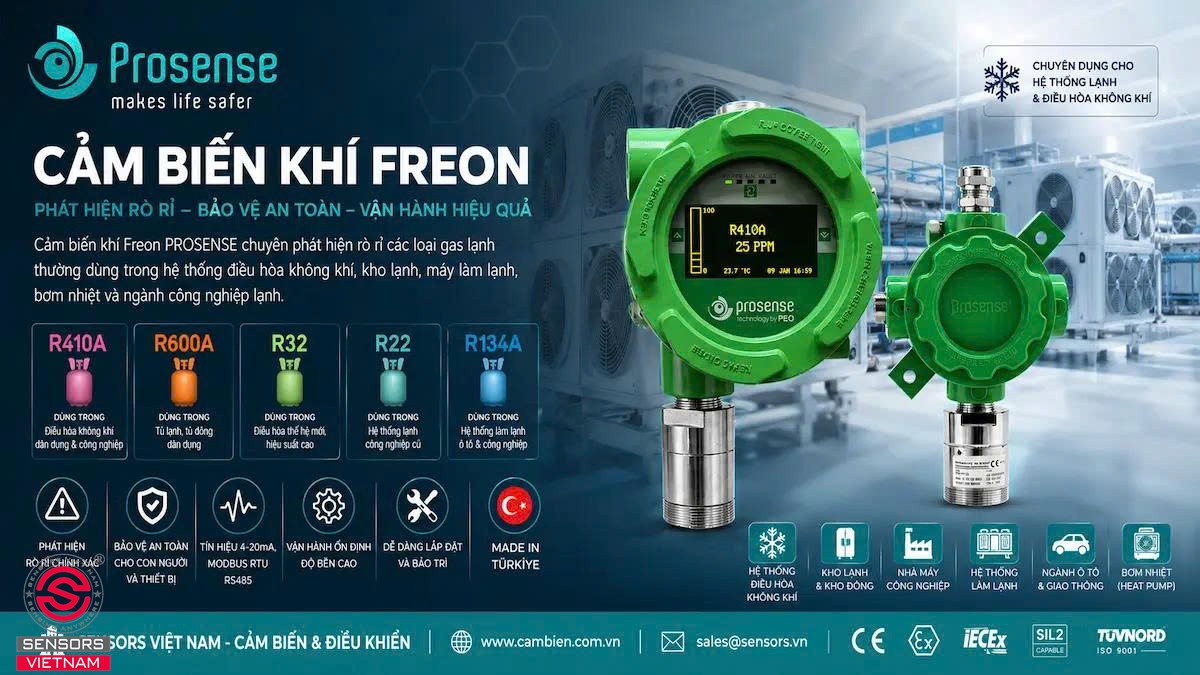
R32 refrigerant is becoming a common choice in modern air conditioning and refrigeration systems thanks to its high heat transfer efficiency and lower environmental impact compared with earlier generations of refrigerant. However, R32 belongs to the group of mildly flammable refrigerants, which makes leak monitoring a mandatory requirement in system design and operation. The R32 gas detector is the device responsible for this task.
Overview of R32 refrigerant
R32 is the trade name for difluoromethane, a chemical compound with the formula CH2F2, belonging to the hydrofluorocarbon (HFC) refrigerant group. R32 offers high heat transfer efficiency, allowing systems to achieve better cooling and heating performance with a smaller refrigerant charge than R410A at the same capacity. R32 is increasingly chosen by air conditioning and heat pump manufacturers as a replacement for R410A across residential and commercial product lines, particularly in markets with tightening GWP regulations for new refrigeration equipment.
What is an R32 gas detector?
An R32 gas detector, also known as an R32 gas sensor, is a dedicated device used to detect the presence and concentration of R32 gas in the air around the area where a refrigeration system is installed.
In terms of basic working principle, the R32 gas detector continuously samples the air in the monitored area, analyzes the gas composition through a dedicated sensor, and converts the detection signal into an electrical signal proportional to the measured gas concentration, triggering an alarm once the concentration exceeds the configured threshold.
Monitoring R32 leaks is essential for two main reasons. First, R32 belongs to the A2L category and is mildly flammable, so when its concentration in an enclosed space reaches the lower flammability limit and encounters an ignition source, a fire hazard can occur, particularly in plant rooms or technical rooms with limited ventilation. Second, when a leak accumulates at high concentration in an enclosed space, R32 can reduce the oxygen concentration in the air, creating a risk of asphyxiation for personnel working in that area.
In actual installations, R32 gas detectors are typically integrated into building monitoring and control systems through several connection methods, depending on the requirements of each project. Common methods include:
- Analog output signal to continuously transmit the gas concentration value to the central controller
- Relay output to directly trigger a horn, warning light or ventilation fan when the threshold is exceeded
- RS485 Modbus communication protocol for integration with the building BMS or PLC
- Multi level alarm function to distinguish between early warning and emergency alarm levels
- Interlock with the ventilation management system to automatically activate exhaust fans upon leak detection
Where R32 gas detectors are typically applied
R32 gas detectors are installed across many types of facilities, wherever a system using R32 refrigerant operates in an enclosed or semi enclosed space. Typical examples include:
- HVAC plant rooms, refrigeration equipment rooms and technical rooms
- Central chiller stations and heat pump systems
- VRF and VRV systems
- Cold storage warehouses
- Data centers
- Food processing plants, pharmaceutical plants and electronics manufacturing plants
- Supermarkets, commercial buildings, hotels and hospitals with central air conditioning systems
NDIR technology in modern R32 gas detectors
NDIR stands for non-dispersive-infrared sensing. The working principle is fairly straightforward: the sensor emits an infrared beam through a measurement chamber containing the air sample, and a detector measures the intensity of the light remaining after passing through the gas. When R32 gas is present in the chamber, part of the infrared energy is absorbed at the characteristic wavelength of the molecule, reducing the intensity of the received signal. The processing unit then calculates the gas concentration according to the Beer-Lambert law of light absorption. Because the molecular structure of R32 absorbs infrared light, similar to many other HFC based refrigerants, NDIR is well suited for quantitative detection of this gas.
Advantages of NDIR technology for continuous refrigerant leak monitoring applications:
- High stability with minimal signal drift over time
- Long service life, with significantly lower maintenance and calibration needs compared with other technologies
- Good selectivity, since measurement occurs at the target gas absorption wavelength, reducing cross sensitivity to other gases
- Low sensitivity to humidity in the air
- High accuracy, suitable for continuous monitoring in industrial environments
As a result, NDIR is becoming the leading technology choice for R32 gas detectors in modern HVAC systems.
Purchase genuine R32 gas detectors at Sensors Vietnam
Sensors Vietnam is a provider of advanced measurement, sensing and automation solutions, including R32 (refrigerant) gas detectors. We offer a diverse portfolio of genuine products from leading global manufacturers, fully capable of meeting the full range of customer application needs.
For detailed information or to order an R32 (refrigerant) gas detector, please contact Sensors Vietnam directly for prompt and dedicated support.
Hot news


SENSORS VIETNAM CO., LTD
VAT CODE: 0313 355 473
Head Office: 03rd Floor, Indochina Tower, 04 Nguyen Dinh Chieu, Tan Dinh Ward, Ho Chi Minh City, Vietnam.
HCM Branch: 92/14/9A Vuon Lai Str., An Phu Dong Ward, Ho Chi Minh City, Vietnam.
Hanoi Branch: S106 Tower, Vinhomes Smart City, Tay Mo Ward, Hanoi City, Vietnam.

® Registered trademark – National Office of Intellectual Property Vietnam
OUR SERVICES
Specializing in the import and distribution of industrial sensors.
Sensors for HVAC/R systems and building automation applications.
Supplying gauges, transmitters, switches, controllers, PLCs, HMIs, and gas detectors.
Providing integrated consulting services for sensor and controller systems.


CONTACT US
Email: sales(at)sensors.vn
Hotline: +84 0911 660 660
Asia Commercial Bank Account (ACB):
VND: 357 246 888 | USD: 1357 246 888
Support Online ZALO Official Account
(From 8:00 am to 5:00 pm)





SENSORS VIETNAM CO., LTD
- Specialized in the import and distribution of sensors and controllers.
- Integrated data acquisition systems and industrial communication solutions.
- Design and installation of smart home systems and industrial equipment.
- Stack lights, signal beacons, LED warning horns, and RGB warning lights.