





CUSTOMER SERVICE
www.sensors.vn
Admin@sensors.vn
www.cambien.com.vn
ANALOG SENSOR vs. DIGITAL SENSOR
Date 28/Sep/2026 at 12:44 PM - View: 19
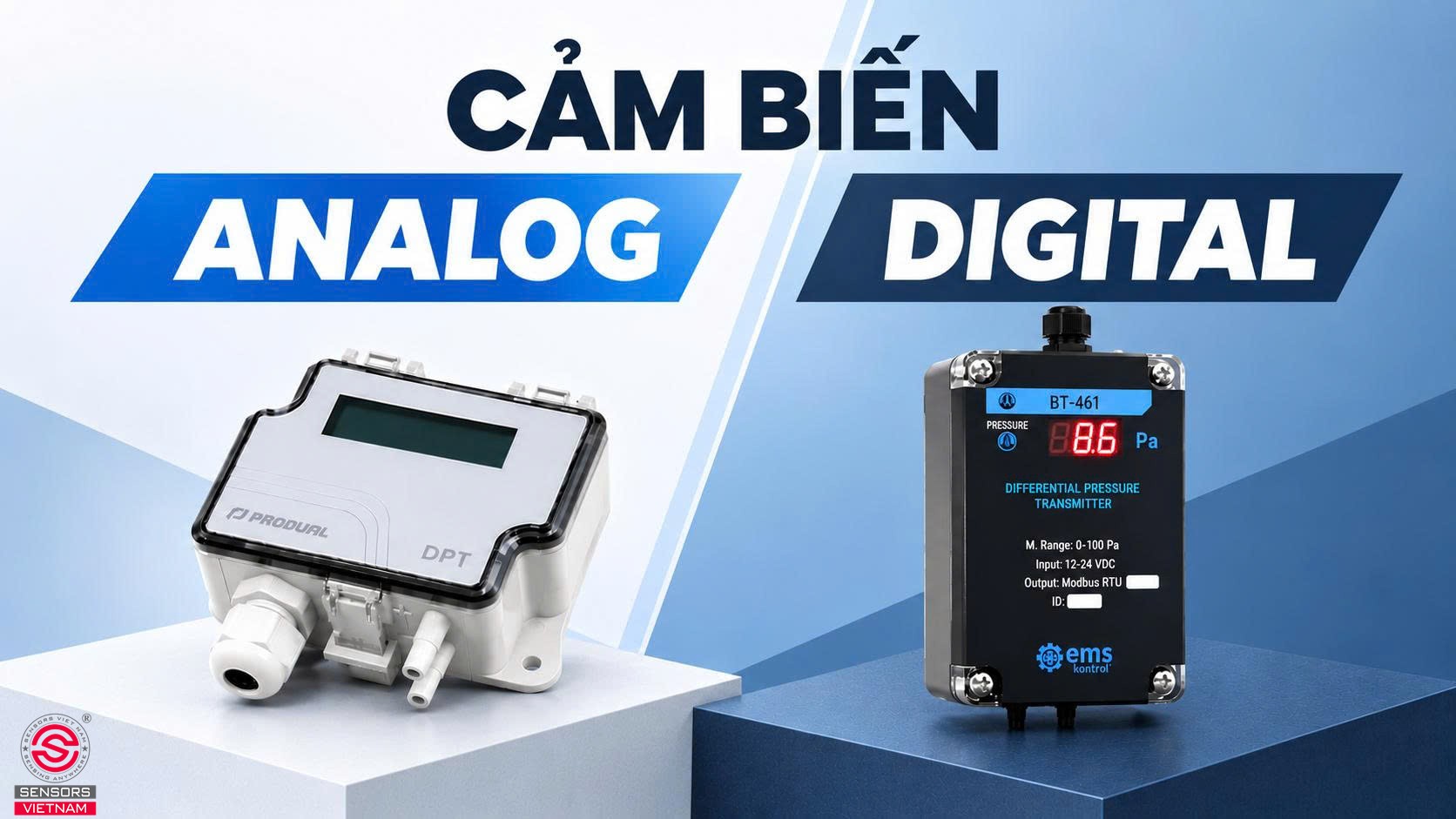
In automation, IoT, and industrial measurement systems, sensors act as the "senses" that help systems collect data from the real world. However, not all sensors provide the same type of signal: analog sensors generate continuous signals, while digital sensors generate digital signals. This article helps you understand the differences between these two types of sensors, their applications, and how to choose the right sensor for your system.
What is an analog sensor?
An analog sensor is a device that measures and converts a physical or chemical quantity such as temperature, humidity, pressure, or flow rate into an electrical signal that varies continuously in real time, typically in a linear relationship with the measured quantity. In theory, this signal can take an infinite number of values within a specified range.
For example, an analog temperature sensor may output a voltage from 0V to 5V corresponding to a measurement range of 0°C to 100°C. When the temperature is 50°C, the output voltage will be approximately 2.5V.
How does an analog sensor work?
Inside the sensor, the sensing element responds to the measured quantity. For example, in a thermistor, the resistance changes according to temperature; in a strain sensor, the resistance changes when a force is applied. This change is converted into a voltage or current signal, which then passes through amplification, noise filtering, and linearization circuits to provide a standardized output signal.
Because PLCs and microcontrollers process digital data, an analog signal must pass through an ADC (Analog-to-Digital Converter) before it can be read. The ADC resolution determines the measurement granularity: a 10-bit ADC divides the measurement range into 1,024 levels, a 12-bit ADC into 4,096 levels, and a 16-bit ADC into 65,536 levels.
Common analog sensor signals
4-20mA Analog sensors
A 4-20mA analog sensor uses a current-based transmission standard, in which the measured value is represented by the current flowing through the circuit. A current of 4mA corresponds to the lower end of the measurement range (0%), while 20mA corresponds to the upper end (100%). This is the most widely used industrial standard for process measurement and control.
In principle, the transmitter and 24VDC power supply are connected in series with the receiving device, such as a PLC, DCS, or display unit, to form a current loop. The transmitter acts as a regulated current source, continuously adjusting the loop current to represent the measured value, while the supply voltage may vary within the permitted range without significantly affecting the current. At the receiving end, the current passes through a measurement resistor and is converted into a 1-5V voltage signal for the ADC to read. The measured value is calculated using a linear equation. For example, if a pressure sensor with a 0-10 bar range outputs 12mA, the actual pressure is 5 bar.
4-20mA analog sensors provide excellent noise immunity and are less affected by voltage drop along the cable, allowing signals to be transmitted over long distances, potentially hundreds of meters or more depending on cable resistance and supply voltage.
4-20mA analog signal sensors are widely used in pressure, level, flow, and temperature transmitters in water treatment plants, chemical plants, oil and gas facilities, food processing plants, and thermal power plants. 4-20mA analog signals are also used to control modulating valves, valve positioners, and actuators in DCS and SCADA systems.
0-10V Analog sensors
A 0-10V analog sensor uses a voltage-based transmission standard, in which the measured value is represented by a DC voltage level from 0V to 10V. A 0V signal corresponds to the lower end of the measurement range, while 10V corresponds to the upper end. This is a common signal standard in building automation and speed control applications.
0-10V analog sensors are simple to wire, easy to test with a multimeter, and generally cost-effective. However, 0-10V analog signals are more susceptible to voltage drop and electromagnetic interference over long cable runs and do not provide the same open-circuit detection capability as 4-20mA. Therefore, 0-10V is most suitable for short distances and low-noise environments.
0-10V analog signal sensors are commonly found in HVAC systems for controlling dampers and water valves, as well as temperature, humidity, and CO2 sensors, variable frequency drive speed control, LED dimming, and other control devices in electrical control panels.
In addition to the two standards above, other analog signals include 1-5V voltage, 0-20mA current, millivolt signals, and resistance signals.
What is a digital sensor?
A digital sensor is a type of sensor that outputs data in digital form rather than as a continuous signal. In practice, digital sensors can be divided into two types:
- ON/OFF digital sensors: these sensors have only two voltage levels, high and low, corresponding to logic states 0 and 1. This is the most common type in machine automation.
- Digital sensors with encoded data transmission: data is organized into packets according to industrial communication protocols such as Modbus RTU RS485, also known as Modbus RTU RS485 sensors.
How does a digital sensor work?
Unlike analog sensors, digital sensors have an integrated internal microprocessor that digitizes the measured value directly inside the sensor. The process consists of three steps:
- Sensing the measured quantity: the sensing element detects a physical value in the same way as an analog sensor.
- On-board digitization: the internal converter and microprocessor convert the signal into digital data and may also perform calibration or include additional device information.
- Data transmission: the data is transmitted to a PLC, microcontroller, or SCADA system through a digital communication interface without requiring additional signal-processing equipment.
The major advantage of digital sensors is their ability to transmit data over long distances with excellent noise immunity, making the measurement less susceptible to distortion compared with analog signals. In addition, Modbus RS485 requires only a single communication cable to connect and manage dozens of sensors, significantly reducing wiring costs compared with running separate analog signal cables for each device.
Digital sensors with modbus protocol
In industrial applications, Modbus is one of the most widely used communication protocols for digital sensors. Modbus operates using a master-slave model, in which one master device sends requests and multiple slave devices respond. Measurement data such as temperature, humidity, and electrical energy is stored in registers that the master device reads by address.
The most common configuration for sensors is Modbus RTU over an RS485 communication line. This differential communication interface provides good noise immunity and can reach distances of approximately 1,200 m, using only one twisted pair of wires to connect multiple devices.
Modbus is widely used in energy meters, environmental sensors, variable frequency drives, solar power inverters, and BMS and SCADA systems.
How are analog and digital sensors different?
Signal Type
Analog sensors provide continuous signals, while digital sensors provide logic levels or encoded bit streams.
Signal Processing
Analog sensors require a controller with an analog input or an ADC. Digital sensors have already digitized the measured value, allowing the controller to read the data directly.
Noise Immunity
Analog voltage signals are more susceptible to noise and voltage drop over long cable runs, while 4-20mA current signals provide excellent noise immunity. Digital signals have clearly defined logic thresholds and may include error checking, making them generally more stable. However, short-range interfaces such as I2C and SPI should only be used with short cables.
Accuracy
For analog sensors, accuracy depends on signal quality and the ADC performance of the controller. Digital sensors are often factory-calibrated and provide stable measurements, but their resolution is limited by the internal ADC.
Wiring and Scalability
Each analog sensor typically requires a dedicated input channel. Digital sensors using a bus communication architecture can connect multiple devices through the same communication line.
Configuration and Diagnostics
Analog sensors generally provide only a measured value. Digital sensors can also support parameter configuration, status monitoring, and remote fault diagnostics.
Cost
Analog sensors are generally simple and cost-effective, but additional costs may arise from ADCs, signal converters, and noise protection. Digital sensors may have a higher initial cost but can reduce circuit design and calibration requirements.
Analog sensor - Applications
Analog sensors, including 4-20mA sensors and 0-10V sensors, are preferred for applications requiring continuous and real-time monitoring, such as:
- Temperature sensors in industrial furnaces
- Water level sensors in storage tanks
- Pressure sensors on gas pipelines
- Force sensors in compressors and electronic weighing systems
In HVAC systems, AHU and FCU control panels are also designed to receive analog signals from temperature and humidity sensors. This allows the control panel to precisely regulate damper opening based on a percentage rather than simply switching the damper fully closed or fully open.
Digital sensor - Applications
Digital sensors, particularly Modbus RTU RS485 sensors, are well suited for applications that require clearly defined states or long-distance data transmission with multiple measurement points. Typical applications include:
- Proximity sensors for detecting objects on conveyor systems
- Environmental monitoring stations transmitting data to a central monitoring system via Modbus
- Photoelectric sensors for detecting full conditions in tanks, reservoirs, and storage areas
- Temperature and humidity sensor systems in office buildings
In many modern industrial plants and large-scale buildings, digital sensors with integrated RS485 communication are preferred to reduce the number of PLC input modules while simplifying programming, monitoring, and control.
When should you use an analog sensor?
Analog sensors are suitable for applications that require continuous monitoring and flexible control across multiple levels, rather than simple fully ON or fully OFF operation. Specifically:
- Variable frequency drive control over a 0-50Hz frequency range
- Flexible damper control based on percentage opening
- Real-time monitoring of pressure in gas pipelines
When purchasing an analog sensor, users should consider several factors. First, distinguish between 2-wire and 4-wire sensors. A 2-wire sensor is typically powered through the signal current loop, while a 4-wire sensor requires a separate power supply. Therefore, the power supply requirements and wiring methods for these two types are different in actual installations. Selecting the wrong type may cause the device to malfunction or result in inaccurate measurement signals.
The second consideration is the signal standard. If the signal needs to be transmitted over a long distance, a 4-20mA analog sensor should be selected because it provides better noise immunity than 0-10V, as voltage signals are more susceptible to voltage drop over long transmission distances. Users should also verify that the controller or input module supports the sensor's signal standard to avoid the need for additional signal conversion equipment.
When should you use a digital sensor?
Digital sensors are suitable for large systems with multiple measurement points that require centralized monitoring and control. They are also suitable for demanding industrial environments with numerous motors and variable frequency drives that generate electromagnetic interference, where high noise immunity is required.
When purchasing a digital sensor, users should consider the following:
- Check the communication protocol: the device must support the communication standard required by the system, with Modbus RTU RS485 being one of the most common options.
- Confirm the slave address and baud rate: these two parameters must be compatible with the control system.
For both types of sensors, it is recommended to prioritize products from reputable suppliers with complete certificates of origin, clear calibration certificates, and official warranty coverage. The measurement range, sensitivity, and accuracy should also match the requirements of the application.
BUY GENUINE SENSOR AT SENSORS VIETNAM
At Sensors Vietnam, we carry the full range of genuine industrial sensors from trusted brands, complete with CO/CQ certification, competitive pricing, fast nationwide delivery, a reliable 12 to 24 month warranty, and free expert consultation.
The technical team at Sensors Vietnam will help you select the right model, the right torque rating, the right control signal type, and any advanced configuration your project specifically requires, avoiding the wrong purchase while ensuring long-term operating performance.
For consultation or more information, please contact us through our hotline at 0911 660 660 or visit https://cambien.com.vn/ | https://www.sensors.vn/ for the fastest support.
Hot news


SENSORS VIETNAM CO., LTD
VAT CODE: 0313 355 473
Head Office: 03rd Floor, Indochina Tower, 04 Nguyen Dinh Chieu, Tan Dinh Ward, Ho Chi Minh City, Vietnam.
HCM Branch: 92/14/9A Vuon Lai Str., An Phu Dong Ward, Ho Chi Minh City, Vietnam.
Hanoi Branch: S106 Tower, Vinhomes Smart City, Tay Mo Ward, Hanoi City, Vietnam.

® Registered trademark – National Office of Intellectual Property Vietnam
OUR SERVICES
Specializing in the import and distribution of industrial sensors.
Sensors for HVAC/R systems and building automation applications.
Supplying gauges, transmitters, switches, controllers, PLCs, HMIs, and gas detectors.
Providing integrated consulting services for sensor and controller systems.


CONTACT US
Email: sales(at)sensors.vn
Hotline: +84 0911 660 660
Asia Commercial Bank Account (ACB):
VND: 357 246 888 | USD: 1357 246 888
Support Online ZALO Official Account
(From 8:00 am to 5:00 pm)





SENSORS VIETNAM CO., LTD
- Specialized in the import and distribution of sensors and controllers.
- Integrated data acquisition systems and industrial communication solutions.
- Design and installation of smart home systems and industrial equipment.
- Stack lights, signal beacons, LED warning horns, and RGB warning lights.