





CUSTOMER SERVICE
www.sensors.vn
Admin@sensors.vn
www.cambien.com.vn
EXPLORE CO2 SENSOR IN DETAIL
Date 30/Mar/2026 at 04:43 PM - View: 86
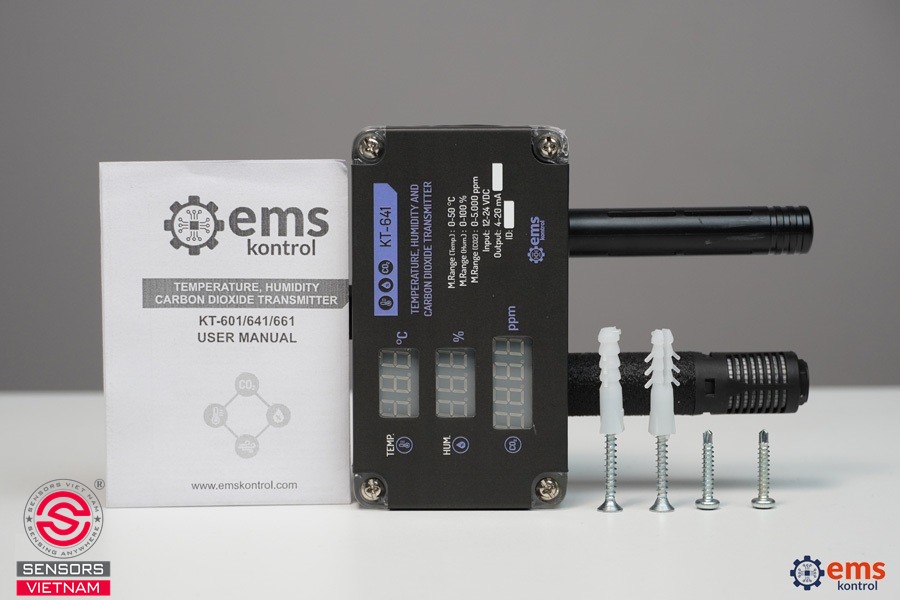
In enclosed environments such as offices, classrooms, factories, or greenhouses, CO2 concentration is a critical indicator of indoor air quality. Unlike many toxic gases, CO2 is colorless and almost odorless, making it impossible to detect by human senses. However, elevated CO2 levels can directly impact human concentration, physiological conditions, and overall system performance.
In this context, monitoring and controlling CO2 is no longer an optional feature but a standard requirement in modern HVAC and environmental control systems. A CO2 sensor acts as an input device, providing real-time data that enables systems to make accurate and efficient control decisions.
What is a CO2 sensor?
A CO2 sensor is a device designed to measure the concentration of carbon dioxide in the air and convert that value into an electrical signal. However, viewing it merely as a measuring device does not fully reflect its actual role.
In modern systems, CO2 sensors function as input elements within control systems. The measured data is not only displayed locally but also transmitted to controllers such as PLC, BMS, or SCADA for processing. Based on this data, the system can automatically adjust airflow, activate ventilation fans, or trigger alarms when CO2 levels exceed predefined thresholds.
Therefore, the true value of a CO2 sensor lies not just in measuring ppm levels, but in its ability to integrate seamlessly and support real-time system control.
 How sensors detect CO2 concentration
Most CO2 sensors today use Non-Dispersive Infrared (NDIR) technology, which is based on the physical property of CO2 absorbing infrared radiation at a specific wavelength.
Inside the sensor, an infrared light source emits radiation through a measurement chamber toward a detector. In the absence of CO2, the infrared signal reaches the detector with minimal attenuation. When CO2 is present, part of the infrared energy is absorbed, resulting in a reduced signal at the detector. This reduction is then processed to calculate the CO2 concentration.
NDIR technology offers several advantages, including high accuracy, minimal cross-sensitivity to other gases, and long-term stability. However, sensor drift may occur over time. To address this, modern sensors often incorporate Automatic Baseline Correction (ABC), which continuously recalibrates the sensor to maintain measurement accuracy.
In addition to NDIR, other sensing technologies such as semiconductor or electrochemical sensors exist. However, these are typically less accurate and more susceptible to environmental interference, making them suitable mainly for low-cost or less demanding applications.
 Importance of CO2 sensors in HVAC and industrial applications
In indoor environments, CO2 sensors play a vital role in maintaining air quality at safe levels. When CO2 concentration exceeds approximately 1000 ppm, it begins to affect human comfort and cognitive performance. By using real-time sensor data, ventilation systems can automatically increase fresh air intake only when needed, instead of operating continuously and wasting energy.
In modern HVAC systems, especially in smart buildings, CO2 sensors are a key component of demand controlled ventilation (DCV). The system dynamically adjusts airflow based on occupancy levels, significantly improving energy efficiency.
In agriculture, CO2 is a critical factor influencing photosynthesis. Maintaining optimal CO2 levels in greenhouses enhances plant growth and productivity. In livestock environments, CO2 monitoring helps detect poor ventilation conditions and improve animal welfare.
In industrial applications, particularly in beverage production, cold storage, and gas handling systems, CO2 sensors are essential for early leak detection, ensuring both operational safety and system reliability.
 Key criteria for selecting a CO2 sensor
Choosing the right CO2 sensor requires careful consideration of application-specific conditions rather than relying solely on price or brand.
- Measurement range: For offices, classrooms, and residential applications, a range of 0-2000 ppm is typically sufficient. Industrial environments often require higher ranges, such as 0-5000 ppm or above.
- Installation location: Wall-mounted sensors are suitable for general indoor air quality monitoring, while duct-mounted sensors are used within HVAC systems. Harsh environments require industrial-grade sensors.
- Output signal: Ensure compatibility with the existing control system. Analog outputs (4-20 mA) are ideal for noise-resistant transmission, while Modbus RS485 is preferred for centralized data communication.
- Sensing technology: NDIR sensors are recommended due to their high accuracy, stability, and long lifespan.
- Environmental conditions: For dusty, humid, or corrosive environments, sensors with appropriate IP protection ratings should be selected to ensure durability.

A CO2 sensor is not just a measurement device but a critical component of modern environmental control systems. Understanding its operating principles, functional role, and selection criteria allows users to optimize system performance, ensure safety, and reduce energy consumption.
Sensors Vietnam provides a wide range of CO2 sensing solutions for both residential and industrial applications, with strong technical support and system integration capabilities.
If you are looking for a reliable CO2 sensing solution, contact Sensors Vietnam for expert consultation and tailored recommendations for your project.
Hot news


SENSORS VIETNAM CO., LTD
VAT CODE: 0313 355 473
Head Office: 03rd Floor, Indochina Tower, 04 Nguyen Dinh Chieu, Tan Dinh Ward, Ho Chi Minh City, Vietnam.
HCM Branch: 92/14/9A Vuon Lai Str., An Phu Dong Ward, Ho Chi Minh City, Vietnam.
Hanoi Branch: S106 Tower, Vinhomes Smart City, Tay Mo Ward, Hanoi City, Vietnam.

® Registered trademark – National Office of Intellectual Property Vietnam
OUR SERVICES
Specializing in the import and distribution of industrial sensors.
Sensors for HVAC/R systems and building automation applications.
Supplying gauges, transmitters, switches, controllers, PLCs, HMIs, and gas detectors.
Providing integrated consulting services for sensor and controller systems.


CONTACT US
Email: sales(at)sensors.vn
Hotline: +84 0911 660 660
Asia Commercial Bank Account (ACB):
VND: 357 246 888 | USD: 1357 246 888
Support Online ZALO Official Account
(From 8:00 am to 5:00 pm)





SENSORS VIETNAM CO., LTD
- Specialized in the import and distribution of sensors and controllers.
- Integrated data acquisition systems and industrial communication solutions.
- Design and installation of smart home systems and industrial equipment.
- Stack lights, signal beacons, LED warning horns, and RGB warning lights.