




CUSTOMER SERVICE
www.sensors.vn
Admin@sensors.vn
www.cambien.com.vn
INTRODUCTION TO ULTRASONIC SENSOR
Date 02/Apr/2026 at 11:32 AM - View: 125
.jpg)
In HVAC systems, water treatment, industrial automation, and technical facilities, the need to measure distance and monitor liquid levels without direct contact has become increasingly important. Accurate measurement in these environments is essential to ensure hygiene, maintain equipment durability, and prevent operational failures.
Ultrasonic sensors provide an intelligent monitoring solution by utilizing the principle of sound wave reflection to calculate distance quickly and accurately.
Unlike optical sensors, which may struggle with transparent objects such as glass, plastic, or liquid surfaces, ultrasonic sensors deliver reliable data regardless of color or surface characteristics. This article provides a detailed analysis of the structure, working principle, and real-world applications that make ultrasonic sensors an essential component in the Industry 4.0 era.
WHAT IS AN ULTRASONIC SENSOR?
An ultrasonic sensor is a non-contact measuring device that operates by transmitting and receiving high-frequency sound waves (above 20 kHz) to determine the distance, position of objects, or liquid levels in tanks.
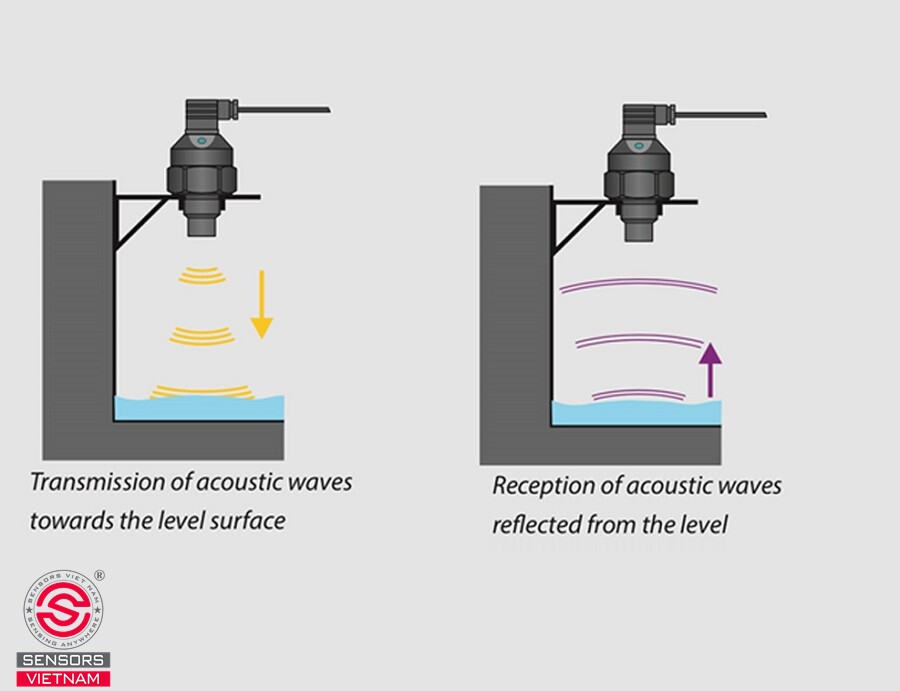
The basic operating principle involves emitting ultrasonic waves toward a target and receiving the reflected signals to calculate the distance based on the time of flight. From this measured distance, the system can accurately determine the liquid level or object position.
Since no direct contact with the medium is required, ultrasonic sensors are particularly suitable for applications such as:
- Liquid level measurement in water and wastewater
- Chemical level monitoring
- Condensate level monitoring in HVAC systems
- Distance measurement in dusty, humid, or corrosive environments
This non-contact capability minimizes equipment wear and reduces maintenance costs over long-term operation.
BASIC STRUCTURE OF AN ULTRASONIC SENSOR
A typical industrial ultrasonic sensor consists of three main components, each playing a critical role in the measurement process.
The ultrasonic transducer is the core element responsible for both transmitting and receiving ultrasonic waves. When activated, it emits sound pulses toward the target medium and captures the reflected signals.
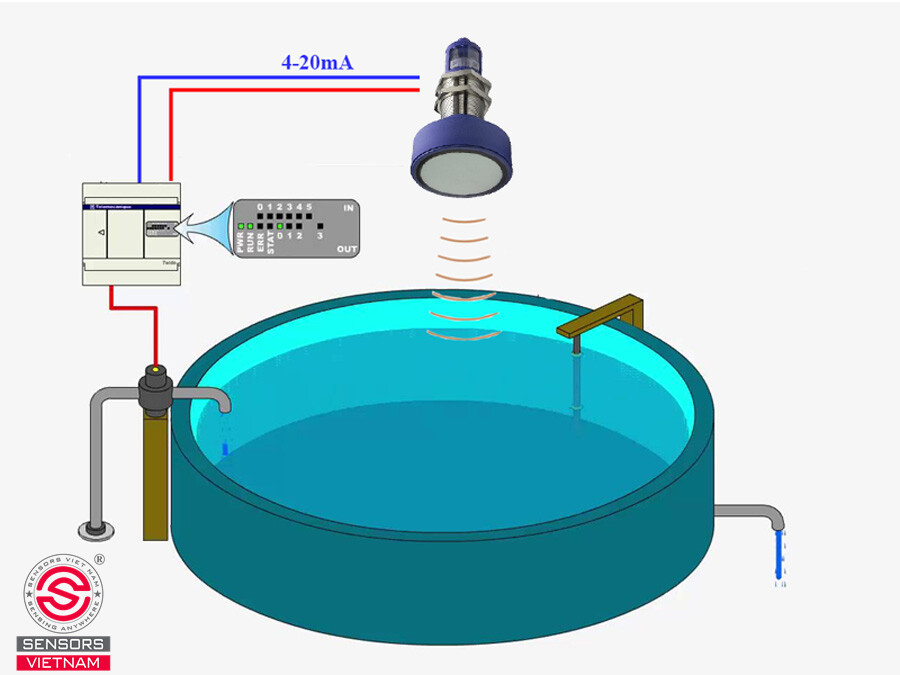
The electronic processing unit analyzes the received signals, calculates the time of flight, and converts it into distance or level measurements. The output is then transmitted as analog signals such as 4-20 mA, 0-10 V, or digital signals for integration with control systems like PLC or BMS.
The protective housing is typically made of engineered plastic or metal, designed to resist dust, moisture, and harsh environmental conditions commonly found in industrial and HVAC applications, ensuring long-term operational stability.
COMMON TYPES OF ULTRASONIC SENSORS
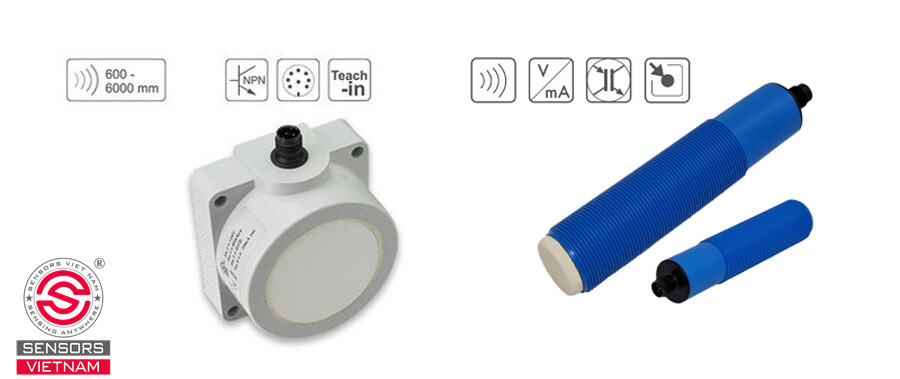
In practice, ultrasonic sensors are widely used across various applications. Based on their function and installation environment, they can be categorized into several main types.
Ultrasonic distance sensors are the most widely used type, designed to measure the distance to objects. These sensors are commonly applied in automation systems, robotics, obstacle detection, position control, and spatial measurements in technical environments.
Ultrasonic level sensors are specifically designed for liquid level measurement in tanks and reservoirs. Installed at the top, they measure the distance to the liquid surface to determine the level. Their non-contact nature makes them ideal for HVAC systems, water treatment, and chemical storage.
Industrial ultrasonic sensors are high-precision devices with a wide measuring range and stable performance under continuous operation. These sensors typically support multiple output signals such as 4-20 mA, 0-10 V, or communication protocols like Modbus for seamless integration into control systems.
Compact ultrasonic sensors are commonly used in OEM equipment and commercial or residential applications. Despite their small size, they effectively perform short- to medium-range distance measurements.
WORKING PRINCIPLE OF ULTRASONIC SENSORS
The operating principle of ultrasonic sensors is based on the time-of-flight method. The sensor emits an ultrasonic pulse toward the target. When the wave reaches the object or liquid surface, it is reflected back to the sensor.
The processing unit measures the time between transmission and reception and calculates the distance using the following formula:
- Distance = (Time × Speed of Sound) / 2
To maintain accuracy under varying environmental conditions, modern ultrasonic sensors are equipped with features such as temperature compensation, signal noise filtering, and intelligent processing algorithms, which enhance stability and minimize measurement errors.
These improvements help reduce the impact of factors such as vapor, vibration, and ambient temperature fluctuations, thereby increasing measurement reliability.
APPLICATIONS OF ULTRASONIC SENSORS
Thanks to their non-contact measurement capability and high stability, ultrasonic sensors are widely used across multiple industries.
- In industrial and HVAC systems, they are used to measure liquid levels in water tanks, chilled water systems, AHU condensate tanks, and chemical storage. The non-contact approach helps prevent corrosion and scaling, thereby extending equipment lifespan.
- In automation, ultrasonic sensors play a key role in obstacle detection, position control, distance measurement, and product counting in production lines.
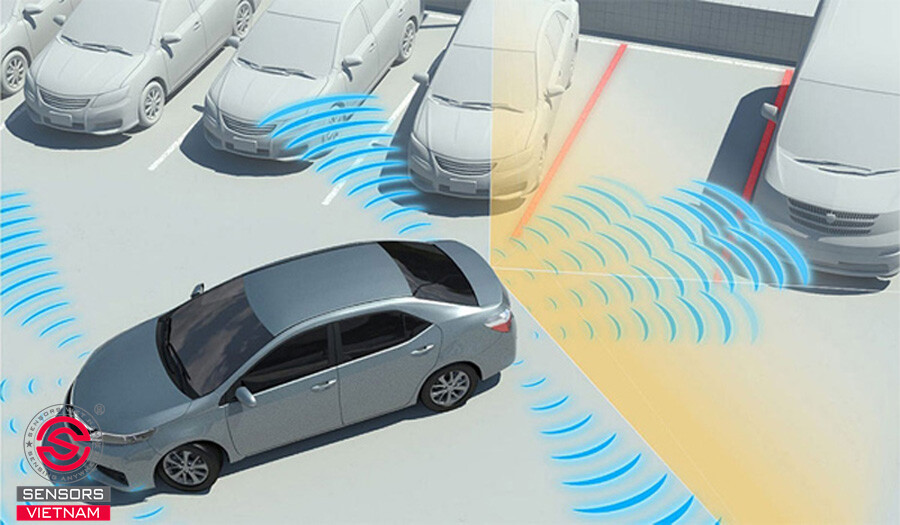
- In automotive and motion systems, they are used for parking assistance, short-range obstacle detection, and low-speed collision warning.
- In medical applications, ultrasonic technology is widely used in non-invasive imaging systems, enabling safe observation of soft tissues and monitoring of biological parameters.
- In agriculture, ultrasonic sensors are used for water level monitoring, irrigation control, and resource optimization.
- In residential applications, they are commonly found in robotic vacuum cleaners, automatic doors, smart lighting systems, and various smart devices, enhancing convenience and safety.
- Additionally, ultrasonic technology is used in specialized applications such as depth measurement, hydrographic surveys, and underwater positioning systems.
 IMPORTANT CONSIDERATIONS WHEN SELECTING ULTRASONIC SENSORS
To ensure optimal performance, sensor selection should be based on actual system requirements.
- Required measuring range
- Surface characteristics of the object or liquid
- Environmental conditions such as vapor, dust, or high temperature
- Installation space and sensing angle
Some limitations should also be considered:
- Ultrasonic waves may be affected by heavy vapor or foam
- Unstable surfaces can lead to measurement errors
- Not suitable for vacuum environments
Proper evaluation of operating conditions will help ensure accurate measurement and long-term reliability.
PURCHASE ULTRASONIC SENSORS FOR HVAC AND INDUSTRIAL APPLICATIONS AT SENSORS VIET NAM
Sensors Viet Nam provides high-quality ultrasonic sensors for distance and level measurement, suitable for HVAC systems, water treatment, and industrial automation.
Contact Sensors Viet Nam today for expert consultation and to select the most suitable ultrasonic sensor solution, ensuring safe, stable, and efficient system operation over the long term.
Hot news


SENSORS VIETNAM CO., LTD
VAT CODE: 0313 355 473
Head Office: 03rd Floor, Indochina Tower, 04 Nguyen Dinh Chieu, Tan Dinh Ward, Ho Chi Minh City, Vietnam.
HCM Branch: 92/14/9A Vuon Lai Str., An Phu Dong Ward, Ho Chi Minh City, Vietnam.
Hanoi Branch: S106 Tower, Vinhomes Smart City, Tay Mo Ward, Hanoi City, Vietnam.

® Registered trademark – National Office of Intellectual Property Vietnam
OUR SERVICES
Specializing in the import and distribution of industrial sensors.
Sensors for HVAC/R systems and building automation applications.
Supplying gauges, transmitters, switches, controllers, PLCs, HMIs, and gas detectors.
Providing integrated consulting services for sensor and controller systems.


CONTACT US
Email: sales(at)sensors.vn
Hotline: +84 0911 660 660
Asia Commercial Bank Account (ACB):
VND: 357 246 888 | USD: 1357 246 888
Support Online ZALO Official Account
(From 8:00 am to 5:00 pm)





SENSORS VIETNAM CO., LTD
- Specialized in the import and distribution of sensors and controllers.
- Integrated data acquisition systems and industrial communication solutions.
- Design and installation of smart home systems and industrial equipment.
- Stack lights, signal beacons, LED warning horns, and RGB warning lights.