






CUSTOMER SERVICE
www.sensors.vn
Admin@sensors.vn
www.cambien.com.vn
NON-DISPERSIVE INFRARED CO2 SENSOR
Date 25/Oct/2025 at 10:49 AM - View: 425
In the modern world, CO2 sensors play a vital role in various industries, from HVAC systems to agricultural and industrial safety. Among the various technologies for measuring carbon dioxide concentrations , the Non-Dispersive Infrared (NDIR) sensor is one of the most widely used sensors because of its accuracy and reliability.
What is NDIR CO2 sensor?
AN NDIR CO2 Sensor is a type of gas sensor that measures the concentration of carbon dioxide in the air using infrared light. “Non-dispersive” means that the infrared light is not scattered or dispersed in the process, resulting in a more accurate CO2 concentration measurement.
NDIR sensors are widely used in indoor air quality monitoring, HVAC systems, environmental monitoring, and many industrial applications. Their main advantages are accuracy, long-term stability, and the ability to operate in a wide range of environmental conditions.
Working principle of non-dispersive infrared CO2 sensor
Non-Dispersive Infrared (NDIR) This principle is based on the fact that gases, such as CO2, absorb infrared (IR) light at specific wavelengths. The term “non-dispersive” refers to the fact that the infrared light is not split into different wavelengths, unlike dispersive methods such as prisms. Instead, a wavelength of light, characteristic of the gas being measured, is separated by filters.
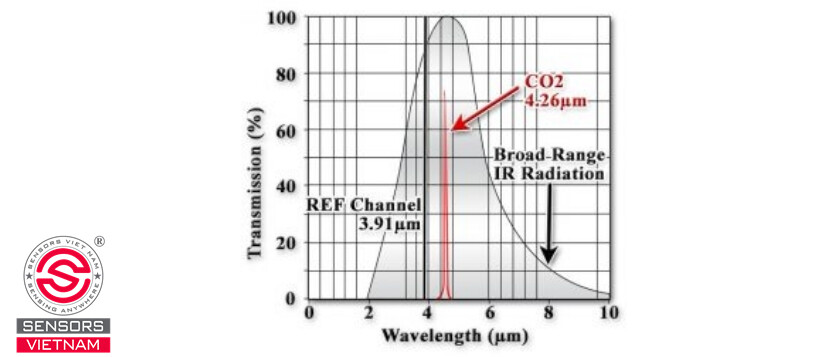
In the case of CO2 detection, the main principle is that CO2 molecules absorb infrared light at a wavelength of about 4.26 microns. This absorption reduces the amount of infrared light reaching the detector, and the degree of this reduction corresponds to the concentration of CO2 in the air. By measuring the amount of absorbed light, the sensor can accurately determine the concentration of the gas.
How does the NDIR CO2 sensor work?
The NDIR CO2 sensor works on the principle of infrared light absorption. Here is a step-by-step breakdown of how the technology works:
Infrared light source
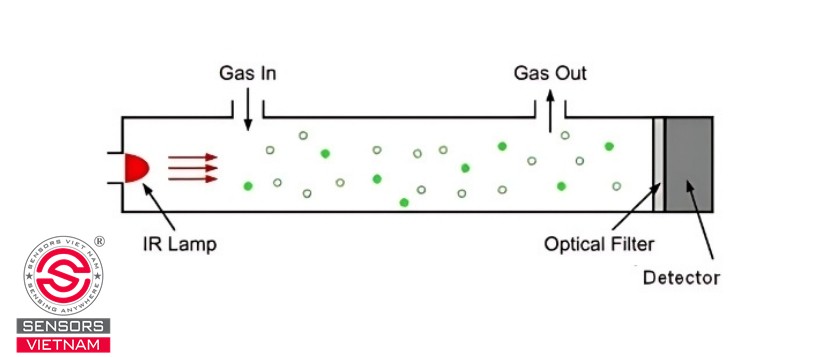
The sensor contains an infrared light source, usually a small lamp or LED, that emits infrared light. This light is passed through an air sample containing CO2.
Gas sampling chamber
The air sample to be tested is introduced into the gas sample chamber inside the sensor. This chamber is designed so that infrared light passes through it efficiently, allowing the gas to interact with the light.
Infrared absorption by CO2
As infrared light passes through the gas sample, CO2 molecules in the air absorb light at a specific wavelength (about 4.26 microns). This absorption reduces the intensity of the light reaching the detector. The amount of light absorbed is directly proportional to the CO2 concentration in the air.
Optical filters
An optical filter is placed between the light source and the detector. This filter only allows infrared light of a specific wavelength (wavelength absorbed by CO2) to pass through, ensuring that the sensor only measures CO2 levels and not other gases or substances in the air.
Infrared detector
The remaining infrared light that is not absorbed by the CO2 reaches the detector. The detector measures the intensity of this light. By comparing the initial intensity of the light (before it enters the chamber) with the detected light, the sensor calculates the amount of light absorbed.
Microprocessor and signal processing
The sensor's electronics analyze the amount of light absorbed and convert this information into a CO2 concentration value. This value is usually expressed in parts per million (ppm), the standard unit of measurement for gas concentration.
Output and display
Finally, the CO2 concentration is output by the sensor and can be displayed on a screen, transmitted to a central system, or used to trigger an alarm if the level exceeds a certain threshold.
Why is NDIR technology used for CO2 sensing?
NDIR sensors are highly regarded for their accuracy, reliability, and longevity in CO2 sensing. Here are some of the reasons why NDIR technology is preferred:
High accuracy
NDIR sensors provide accurate and reliable measurements of CO2 levels. Because CO2 absorbs infrared light at a specific wavelength, NDIR technology can accurately measure concentrations without interference from other gases.
Non-consumable
Unlike chemical sensors, NDIR sensors do not consume the gas they measure. This means they have a longer operating life and require less frequent calibration.
Low maintenance
NDIR sensors require less maintenance than other types of CO2 sensors. They are rugged and their components, such as the infrared light source, typically have a long lifespan.
Stable over time
NDIR sensors maintain accuracy and stability over long periods of time. This long-term stability makes them suitable for applications requiring consistent monitoring.
Wide range of applications
NDIR CO2 sensors can operate in a variety of environments, making them versatile for use in HVAC systems, greenhouses, industrial safety, and the automotive industry.
Common applications of CO2 NDIR sensors
Indoor air quality monitoring
NDIR CO2 sensors are commonly used in smart homes, offices, schools, and public buildings to monitor indoor air quality. High CO2 concentrations in confined spaces can lead to poor concentration, headaches, and discomfort, making these sensors important in ensuring a healthy living environment.
HVAC system
Heating, ventilation and air conditioning (HVAC) systems use NDIR CO2 sensors to monitor airflow and ensure CO2 levels remain within acceptable limits. This improves energy efficiency while maintaining good air quality.
Greenhouses and Agriculture
In greenhouses, CO2 concentrations are often artificially increased to promote plant growth. The NDIR CO2 sensor helps monitor and control CO2 concentrations, ensuring the environment is optimized for plant health.
Automobiles and Transportation
NDIR sensors are used in the automotive industry to monitor cabin air quality and ensure passengers are not exposed to high CO2 concentrations, especially in electric or autonomous vehicles where air recirculation is common.
Industrial safety
In industries such as brewing, food processing and firefighting, monitoring CO2 concentrations is essential to ensure worker safety. NDIR sensors are used in gas detection systems to prevent dangerous CO2 build-up in confined spaces.
Sensors Vietnam is a leading importer of sensors and industrial equipment in Vietnam. If you are looking for CO2 gas sensors, please contact Sensors Vietnam for consultation and a quotation.
For more details: https://cambien.com.vn/cam-bien-khi-co2
Hot news


SENSORS VIETNAM CO., LTD
VAT CODE: 0313 355 473
Head Office: 03rd Floor, Indochina Tower, 04 Nguyen Dinh Chieu, Tan Dinh Ward, Ho Chi Minh City, Vietnam.
HCM Branch: 92/14/9A Vuon Lai Str., An Phu Dong Ward, Ho Chi Minh City, Vietnam.
Hanoi Branch: S106 Tower, Vinhomes Smart City, Tay Mo Ward, Hanoi City, Vietnam.

® Registered trademark – National Office of Intellectual Property Vietnam
OUR SERVICES
Specializing in the import and distribution of industrial sensors.
Sensors for HVAC/R systems and building automation applications.
Supplying gauges, transmitters, switches, controllers, PLCs, HMIs, and gas detectors.
Providing integrated consulting services for sensor and controller systems.


CONTACT US
Email: sales(at)sensors.vn
Hotline: +84 0911 660 660
Asia Commercial Bank Account (ACB):
VND: 357 246 888 | USD: 1357 246 888
Support Online ZALO Official Account
(From 8:00 am to 5:00 pm)





SENSORS VIETNAM CO., LTD
- Specialized in the import and distribution of sensors and controllers.
- Integrated data acquisition systems and industrial communication solutions.
- Design and installation of smart home systems and industrial equipment.
- Stack lights, signal beacons, LED warning horns, and RGB warning lights.