





CUSTOMER SERVICE
www.sensors.vn
Admin@sensors.vn
www.cambien.com.vn
PRESSURE GAUGE 20 BAR
Date 02/Aug/2025 at 09:32 AM - View: 77
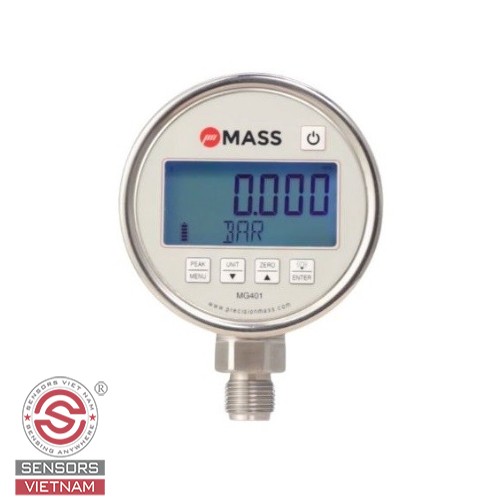
Pressure gauge 20 bar, Pressure meter 20 bar, Pressure gauge is a device used to measure and display the pressure level of gases or liquids in a closed system such as pipelines, tanks, boilers, air compressors, and pressure vessels. It helps operators monitor current pressure levels and ensures that the system operates safely, stably, and efficiently.
1. Definition of a pressure gauge
A pressure gauge is a device used to measure and display the pressure of a liquid or gas in a closed system. It is an essential component in industrial systems, HVAC, hydraulics, pneumatics, water treatment, chemicals, and many other fields.
2. Common Types of Pressure Gauges
- Analog pressure gauge: Uses a Bourdon tube mechanism, pointer, and dial.
- Digital pressure gauge: Digital display, high accuracy, often with signal outputs (4–20 mA, RS485, Modbus, etc.).
- Vacuum gauge: Measures negative pressure below atmospheric pressure.
- Differential pressure gauge: Measures the pressure difference between two points.
3. Basic Components of a Pressure Gauge
- Bourdon tube (or diaphragm/sensing element): Deforms under pressure.
- Shaft and gears: Transmit mechanical movement from the sensing element to the pointer.
- Dial and pointer: Display the pressure reading.
- Protective case: Usually stainless steel or engineering plastic.
- Connection port: Standard threads (G1/2", NPT, etc.).
4. Working Principle of a Pressure Gauge
Most analog gauges use a Bourdon tube. When pressure is applied, the tube bends or expands, and this movement is transmitted through gears to rotate the pointer on the dial. Digital gauges use pressure sensors and display readings numerically.
5. Technical Specifications of a Pressure Gauge
- Measuring range: e.g., 0–10 bar, 0–10000 bar.
- Accuracy: ±1%, ±0.5%, according to EN837 or ASME B40.100 standards.
- Units: bar, psi, kPa, MPa, etc.
- Dial sizes: 63 mm, 100 mm, 160 mm.
Operating temperature: Typically -20°C to 60°C, or higher for special designs.
6. Practical Applications of Pressure Gauges
- Pneumatic systems: Monitoring compressed air pressure in pipelines.
- Water systems: Checking pump or water supply line pressure.
- Chemical industry: Ensuring operation does not exceed safe pressure limits.
- Food, medical, and energy industries.
7. Usage and Maintenance Notes
- Choose the correct measuring range: Working pressure should be 30–70% of the full scale.
- Regular inspection: Prevent errors due to damage or loss of calibration.
- Install correctly: Avoid vibration, high temperatures, or corrosive environments.
- Use glycerin filling to protect the pointer in high-vibration environments.
8. Popular Pressure Gauge Types
8.1. Analog Pressure Gauge
- Features: Most common type, uses a dial pointer.
- Principle: Bourdon tube mechanism deforms under pressure, moving the pointer.
- Advantages: Durable, easy to use, no power supply needed.
- Applications: Pneumatics, water, HVAC, hydraulics, pumps.
8.2. Digital Pressure Gauge
- Features: Digital display, high accuracy.
- Integration: May include 4–20 mA, RS485, Modbus output.
- Advantages: Easy to read, high precision, easy system integration.
- Applications: Automation systems, factories, laboratories, production lines.
8.3. Vacuum Gauge
- Function: Measures pressure below atmospheric pressure.
- Common types: Mechanical (mmHg, negative kPa) or electronic.
- Applications: Vacuum pumps, cooling systems, medical equipment.
8.4. Differential Pressure Gauge
- Function: Measures pressure difference between two points.
- Display: Mechanical or electronic.
- Applications: Monitoring filters, fans, pipelines, HVAC systems.
8.5. Liquid-filled Pressure Gauge
- Features: Dial filled with glycerin or silicone oil.
- Purpose: Reduces vibration, protects the pointer and internal mechanism.
- Applications: High-vibration environments like machinery and engines.
8.6. Diaphragm Pressure Gauge
- Principle: Uses an elastic diaphragm to measure pressure, suitable for viscous, corrosive, or particulate fluids.
- Applications: Food, chemical, and pharmaceutical industries.
8.7. Electrical Contact Pressure Gauge
- Integration: Contact switches to open/close an electrical circuit when pressure reaches a set threshold.
- Applications: Alarm and automation systems.
8.8. Pressure Transmitter / Transducer
- Function: Measures pressure and transmits an electrical signal (voltage, current) to a PLC or control system.
- Applications: Automated production lines, SCADA, large plants.
A pressure gauge is an indispensable device for monitoring and controlling technical systems. Choosing the right type for each application ensures safety, cost efficiency, and optimal system performance.
Sensors Vietnam is an official distributor of high-quality pressure gauges with long-term warranty. For inquiries and quotations, please contact us.
Hot news


SENSORS VIETNAM CO., LTD
VAT CODE: 0313 355 473
Head Office: 03rd Floor, Indochina Tower, 04 Nguyen Dinh Chieu, Tan Dinh Ward, Ho Chi Minh City, Vietnam.
HCM Branch: 92/14/9A Vuon Lai Str., An Phu Dong Ward, Ho Chi Minh City, Vietnam.
Hanoi Branch: S106 Tower, Vinhomes Smart City, Tay Mo Ward, Hanoi City, Vietnam.

® Registered trademark – National Office of Intellectual Property Vietnam
OUR SERVICES
Specializing in the import and distribution of industrial sensors.
Sensors for HVAC/R systems and building automation applications.
Supplying gauges, transmitters, switches, controllers, PLCs, HMIs, and gas detectors.
Providing integrated consulting services for sensor and controller systems.


CONTACT US
Email: sales(at)sensors.vn
Hotline: +84 0911 660 660
Asia Commercial Bank Account (ACB):
VND: 357 246 888 | USD: 1357 246 888
Support Online ZALO Official Account
(From 8:00 am to 5:00 pm)





SENSORS VIETNAM CO., LTD
- Specialized in the import and distribution of sensors and controllers.
- Integrated data acquisition systems and industrial communication solutions.
- Design and installation of smart home systems and industrial equipment.
- Stack lights, signal beacons, LED warning horns, and RGB warning lights.