






CUSTOMER SERVICE
www.sensors.vn
Admin@sensors.vn
www.cambien.com.vn
PT100 SENSOR
Date 14/Oct/2026 at 03:42 PM - View: 31

A PT100 sensor is a type of resistance temperature detector (RTD) that uses platinum as its sensing element and has a nominal resistance of 100 Ω at 0°C. Thanks to its good accuracy, high stability and excellent repeatability, the PT100 temperature sensor is widely used in HVAC systems, chillers, AHUs, cold storage facilities, food production lines, pharmaceutical applications and industrial temperature measurement.
In temperature measurement and control systems, sensor accuracy directly affects the performance of the entire system. From monitoring chilled water temperature in chillers to controlling temperatures on production lines, PT100 sensors provide data that controllers use to process information and make the necessary adjustments. Understanding the characteristics and correct use of PT100 temperature sensors helps users select suitable equipment, minimize measurement errors and improve operational reliability.
WHAT IS A PT100 SENSOR?
A PT100 sensor is a type of resistance temperature detector (RTD) that uses platinum as its sensing material. It operates based on changes in the electrical resistance of platinum as temperature changes. By measuring resistance and converting this value into temperature, the system can monitor the temperature of air, water, liquids or other environments that require temperature control.
The most important characteristic of a PT100 temperature sensor is its nominal resistance of 100 Ω at 0°C. As temperature increases, the resistance of the platinum element increases according to a standardized relationship. This allows the PT100 to provide stable measurements for a wide range of industrial applications.
In a control system, the PT100 sensor measures temperature and supplies the corresponding data. Functions such as comparing the measured temperature with the setpoint, controlling compressors, adjusting valves and regulating heating power are performed by a temperature controller, PLC or DDC. Therefore, selecting the correct sensor and installing it properly are essential for efficient system operation.
The PT100 designation consists of two parts. “PT” commonly refers to platinum, while “100” indicates a nominal resistance of 100 Ω at 0°C. Platinum is used because of its good chemical stability, predictable resistance temperature characteristics and ability to maintain its measurement properties over an extended period.
In addition to PT100 sensors, users may encounter other RTD temperature sensors, such as PT500 and PT1000. PT500 has a nominal resistance of 500 Ω, while PT1000 has a nominal resistance of 1,000 Ω at 0°C.
KEY FEATURES OF PT100 TEMPERATURE SENSORS
One of the main advantages of a PT100 temperature sensor is its long term stability and good measurement repeatability. When properly selected, installed and operated under suitable conditions, the sensor can maintain stable measurement characteristics over an extended period. This is particularly important for processes requiring continuous temperature monitoring or strict quality control.
Another characteristic of the PT100 is that its resistance changes by approximately 0.385 Ω for every 1°C change near 0°C. Although this resistance change is sufficient for temperature measurement, the resistance of the connecting wires can also affect the measurement result. Therefore, the choice of two-wire, three-wire or four-wire configuration must be appropriate for the installation distance and required accuracy.
A PT100 is generally a passive sensing element. It does not generate a standard voltage or current signal by itself. The measuring instrument or controller supplies a small excitation current to determine the resistance of the sensing element and then converts the measured resistance into a temperature value.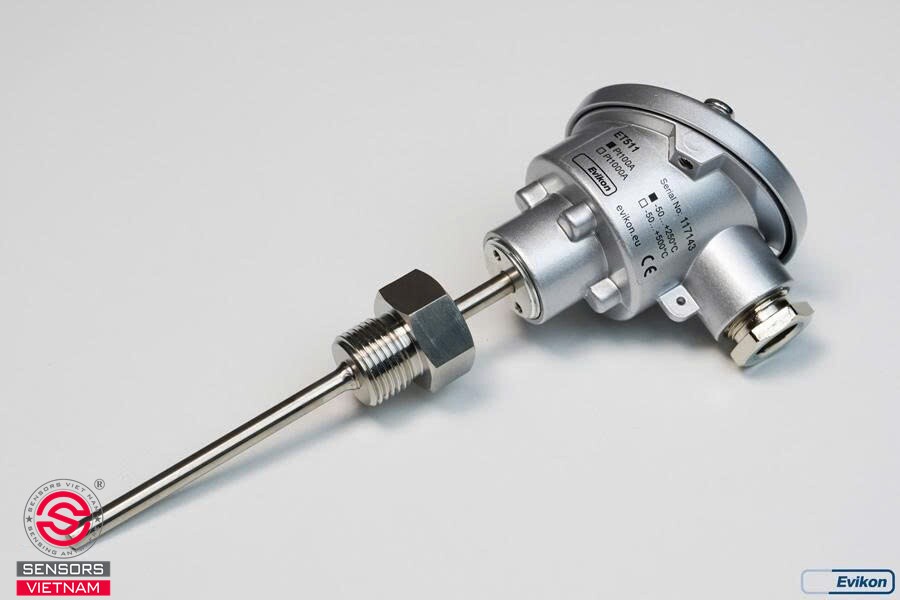
PT100 TEMPERATURE SENSOR CONSTRUCTION
Platinum resistance sensing element
The platinum sensing element is the component that directly detects temperature changes in a PT100 sensor. Depending on the manufacturing technology, the element is generally available in two main designs: wire wound elements and thin film elements.
Wire-wound elements use a fine platinum wire wound around a core or positioned within a suitable protective structure. Depending on the specific design, this construction can meet requirements for high stability and a wide operating temperature range.
The platinum element is relatively small and needs protection against mechanical damage and environmental exposure. For this reason, PT100 temperature probes typically feature a metal housing, commonly made of stainless steel, combined with suitable electrical insulation and heat transfer materials.
Protective housing and temperature sensor thermowells
The housing material, probe diameter and probe length affect the sensor's durability, corrosion resistance and response time. When selecting a PT100 sensor for pipelines, tanks or environments containing chemicals, users should verify that the material is compatible with the actual process medium.
In applications involving high pressure or requiring convenient maintenance, the sensor can be installed with a temperature thermowell. This component provides a protective barrier between the probe and the process medium, allowing the sensor to be inspected or replaced in suitably designed systems without necessarily disconnecting the entire process connection. However, a thermowell can increase the temperature response time.
Signal wiring and connection terminals
The connecting wires transmit the electrical resistance signal from the PT100 element to the measuring instrument or controller. Depending on the design, the sensor can use a two-wire, three-wire or four-wire configuration.
Cable insulation materials such as PVC, silicone, PTFE or fiberglass are selected according to the operating temperature and installation conditions. Some PT100 temperature probes come with an integrated connecting cable, while others use a connector or a terminal head mounted on the sensor.
Temperature signal transmitter
In some systems, a PT100 sensor is combined with a temperature signal transmitter. The transmitter receives the resistance signal from the PT100 and converts it into an industrial signal, such as 4 to 20 mA or 0 to 10 V, depending on the model.
The transmitter can be installed inside the sensor head or inside an electrical control panel. This solution is useful when temperature data must be transmitted to a remote control location or when the receiving system uses an analog input instead of a direct RTD input.
COMMON TYPES OF PT100 TEMPERATURE SENSORS
Two wire PT100 temperature sensor
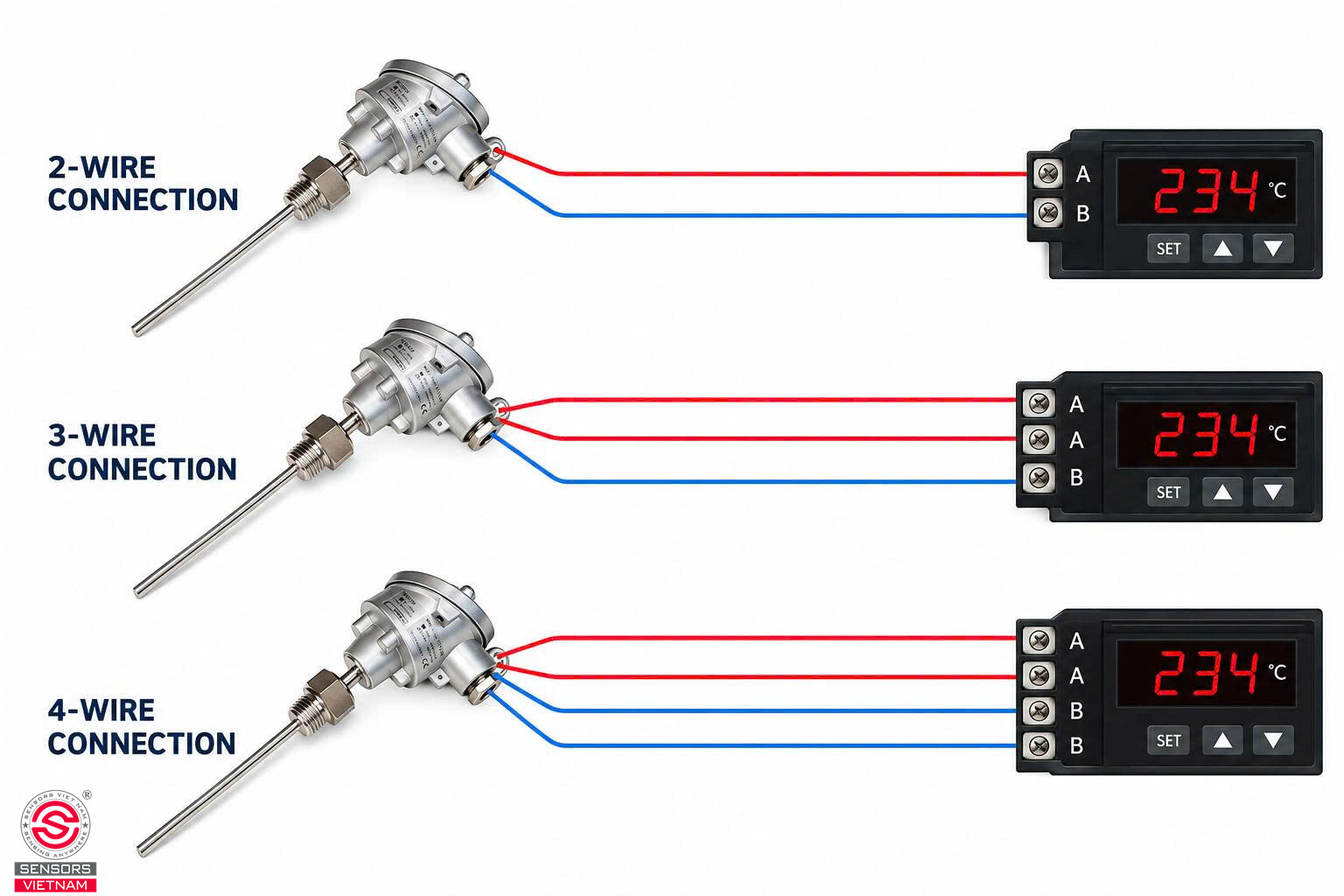
A two-wire PT100 sensor has a simple construction and connection method, using only two wires connected to the sensing element. This configuration is generally a low cost option suitable for short cable runs or applications that do not require very high accuracy. Its main limitation is that the measuring instrument cannot distinguish between the resistance of the sensing element and the resistance of the connecting wires. As a result, the total lead wire resistance can introduce significant measurement errors, particularly when long cables are used.
Three-wire PT100 temperature sensor
The three-wire PT100 sensor is widely used in industrial applications and HVAC systems. Compared with the two-wire version, this configuration allows the measuring instrument to compensate for the effects of lead wire resistance, improving accuracy when the sensor is installed some distance from the controller.
Three-wire compensation works effectively when the wires have equivalent materials, lengths and resistance values. Therefore, suitable cables must be used and the wiring must follow the instrument manufacturer's diagram. The three-wire PT100 offers a practical balance between cost and accuracy for applications such as chilled water temperature measurement, pipeline monitoring, tank temperature measurement and industrial production processes.
Four-wire PT100 temperature sensor
A four-wire PT100 sensor uses two wires to supply current and two separate wires to measure voltage. This configuration is based on the Kelvin measurement principle and can eliminate almost all the effects of lead wire resistance under suitable measurement conditions. Because it minimizes wiring related errors, the four-wire PT100 is commonly used in laboratories, calibration equipment and processes requiring high measurement accuracy.
However, to obtain the full benefits of this configuration, the measuring instrument or controller must support a four-wire RTD input. If the receiving device is incompatible, using a four-wire sensor does not automatically guarantee more accurate measurements.
 PT100 TEMPERATURE SENSOR APPLICATIONS
PT100 sensor applications in the food and beverage industry
In the food and beverage industry, PT100 temperature sensors are used to monitor and control temperatures during processing, heating, cooling and product storage. Common applications include industrial cooking vessels, milk pasteurization equipment, sterilization systems, ingredient storage tanks, beverage production lines and food cold storage facilities.
Industrial PT100 sensors help monitor temperatures during production, maintain the required operating conditions and prevent excessive heating or insufficient cooling. For applications with strict hygiene requirements, stainless steel PT100 temperature probes with suitable hygienic connections are commonly selected to meet installation and cleaning requirements. When connected to a temperature controller or data logging system, the sensor also supports continuous monitoring and temperature record keeping for product quality control.
PT100 sensor applications in the pharmaceutical industry
In pharmaceutical manufacturing and storage, PT100 temperature sensors are used to control temperatures in areas and equipment that require stable environmental conditions. Typical applications include vaccine refrigerators, medicine storage cabinets, cleanrooms, incubators, drying ovens and sterilization autoclaves.
Thanks to their stable measurement characteristics and good repeatability, PT100 temperature sensors help monitor temperature variations during operation. When integrated with a controller, monitoring device or alarm system, the sensor can help detect temperatures exceeding configured limits so that operators can respond promptly. For processes requiring strict quality control, selecting the correct accuracy class and performing periodic calibration help improve measurement data reliability.
PT100 sensor applications in HVAC systems and water treatment
In HVAC systems, PT100 sensors are used to measure chilled water, cooling water and air temperatures in central air conditioning equipment. Common installation locations include chiller chilled water supply and return lines, cooling water lines connected to cooling towers, hot water pipelines and air handling units (AHUs).
PT100 HVAC temperature sensors provide data that controllers use to monitor system operation and adjust cooling or heating processes according to requirements. For example, chilled water supply and return temperatures can be evaluated together with water flow rates to assess the system cooling load. In pipelines and heat exchangers, PT100 probes help track temperature variations and identify abnormal operating conditions.
In water treatment systems, PT100 sensors can also be installed in storage tanks, pipelines, heating equipment and heat exchangers to control water temperature according to operational requirements. Depending on the installation location, users can select probe type PT100 sensors, threaded versions or models fitted with thermowells to suit operating conditions.
PT100 sensor applications in industrial machinery and production lines
In factories and automated production lines, PT100 sensors are used to monitor the temperatures of machinery, heating equipment and process media. Common applications include measuring the temperatures of motors, bearings, gearboxes, mixing tanks, storage tanks, pipelines and thermal oil heating systems.
Installing industrial PT100 temperature probes at monitoring points allows operators to track temperature changes and detect potential problems at an early stage. In heating processes, the sensors provide data that helps maintain the required setpoint and improve production process stability.
PT100 sensor signals can be connected directly to a PID temperature controller or an RTD input module on a PLC. The data can then be processed and displayed on an HMI for operator monitoring. For systems requiring long distance signal transmission or analog inputs, a PT100 sensor can be combined with a temperature signal transmitter to provide a 4 to 20 mA or 0 to 10 V output, depending on the device configuration.
When should you use a PT100 sensor?
A PT100 sensor is suitable for applications requiring good stability and accuracy within the sensor's operating temperature range. Typical examples include:
- Measuring chilled water supply and return temperatures in chiller systems.
- Monitoring pipeline and equipment temperatures in HVAC systems.
- Controlling temperatures in food and pharmaceutical production lines.
- Measuring temperatures in cleanrooms and controlled storage areas.
- Monitoring the temperatures of storage tanks, heat exchangers and production lines.
If the main requirement is low-cost temperature measurement in residential air conditioning equipment, an NTC thermistor may be a suitable choice. For furnace applications or environments involving very high temperatures, a thermocouple should be considered.
Temperature sensor selection should be based on the actual application requirements rather than the product name or price alone.
HOW TO WIRE A PT100 TEMPERATURE SENSOR CORRECTLY
Two-wire, three-wire, and four-wire PT100 wiring diagrams
The correct PT100 wiring method depends on the probe configuration and the type of input supported by the controller.
For a two-wire PT100, the two wires connect to the two ends of the sensing element. This is the simplest connection method, but lead wire resistance can increase measurement errors.
For a three-wire PT100, two wires are typically connected to one side of the sensing element, while the remaining wire connects to the opposite side. This configuration allows the measuring instrument to compensate for lead wire resistance when the wiring arrangement and wire resistance meet the required conditions. However, users should refer to the manufacturer's wiring diagram because terminal labels and wire colors may vary.
For a four-wire PT100, two wires supply current and the other two measure voltage. This connection method minimizes the influence of lead wire resistance and is suitable for measuring instruments that support four-wire measurement.
Before wiring, identify the number of wires, check the sensor technical documentation and verify the RTD input wiring diagram on the controller. Do not rely on wire colors alone to identify terminals unless the manufacturer has provided the relevant information.
How to connect a PT100 to a temperature controller or PLC
There are two common methods for connecting a PT100 sensor to a control system.
The first method is to connect the sensor directly to the RTD input of a temperature controller or PLC module. In this case, the correct PT100 sensor type and corresponding two-wire, three-wire or four-wire configuration must be selected in the device settings.
The second method is to use a temperature signal transmitter. The PT100 sensor connects to the transmitter input, and the transmitter sends an output signal such as 4 to 20 mA or 0 to 10 V to a PLC, DDC or controller with a compatible input.
Using a transmitter can be beneficial when signals must be transmitted over long distances or when the system does not support a direct RTD input. The appropriate solution should be selected according to the transmission distance, environmental conditions and existing equipment configuration.
 RECOMMENDED PT100 TEMPERATURE MEASUREMENT RANGES FOR DIFFERENT APPLICATIONS
When selecting a PT100 temperature sensor, the measurement range must be considered alongside accuracy and wiring configuration to ensure that the device suits the actual operating conditions. Depending on the application, from cold storage facilities and HVAC systems to drying ovens and industrial heating lines, users can refer to the following suggested PT100 measurement ranges.
- PT100 temperature sensor with a measurement range of minus 40°C to 50°C: Suitable for consideration in cold storage rooms, freezers and food storage systems requiring low temperature monitoring.
- PT100 temperature sensor with a measurement range of 0°C to 50°C: Can be used for monitoring temperatures in cleanrooms, pharmaceutical storage facilities and areas requiring stable temperature conditions.
- PT100 temperature sensor with a measurement range of minus 20°C to 120°C: Suitable for many HVAC applications, including chilled water, hot water and air temperature monitoring in AHU systems.
- PT100 temperature sensor with a measurement range of 0°C to 300°C: Intended for heating applications such as drying ovens and industrial heating cabinets, provided that the probe construction can withstand the operating temperature.
- PT100 temperature sensor with a measurement range of minus 20°C to 250°C: Can be considered for chemical processes and reactors when the operating temperature remains within the permitted limits of the sensor and its contact materials.
- PT100 temperature sensor with a measurement range of 0°C to 250°C: Suitable for consideration in thermal pipeline systems and certain hot steam related applications, provided that the actual temperature and pressure conditions comply with the design specifications.
- PT100 temperature sensor with a measurement range of 0°C to 200°C: Can be used to monitor thermal oil, heated liquids and heat exchanger equipment.
- PT100 temperature sensor with a measurement range of minus 50°C to 200°C: Suitable for certain laboratory measurement and calibration applications, depending on the required accuracy and the performance of the equipment.
Selecting a suitable measurement range requires more than knowing the normal operating temperature. The minimum temperature, maximum temperature and possible fluctuations during operation must also be considered. Users should select a sensor whose operating range covers the entire temperature interval to be measured and verify the temperature limits of the sensing element, protective housing, cable and connection terminals.
For industrial applications, additional factors include probe material, insertion length, installation method, pressure and process medium properties. In particular, when measuring hot steam or working with chemical environments, the sensor construction and thermowell must be suitable for the actual operating conditions.
Hot news


SENSORS VIETNAM CO., LTD
VAT CODE: 0313 355 473
Head Office: 03rd Floor, Indochina Tower, 04 Nguyen Dinh Chieu, Tan Dinh Ward, Ho Chi Minh City, Vietnam.
HCM Branch: 92/14/9A Vuon Lai Str., An Phu Dong Ward, Ho Chi Minh City, Vietnam.
Hanoi Branch: S106 Tower, Vinhomes Smart City, Tay Mo Ward, Hanoi City, Vietnam.

® Registered trademark – National Office of Intellectual Property Vietnam
OUR SERVICES
Specializing in the import and distribution of industrial sensors.
Sensors for HVAC/R systems and building automation applications.
Supplying gauges, transmitters, switches, controllers, PLCs, HMIs, and gas detectors.
Providing integrated consulting services for sensor and controller systems.


CONTACT US
Email: sales(at)sensors.vn
Hotline: +84 0911 660 660
Asia Commercial Bank Account (ACB):
VND: 357 246 888 | USD: 1357 246 888
Support Online ZALO Official Account
(From 8:00 am to 5:00 pm)





SENSORS VIETNAM CO., LTD
- Specialized in the import and distribution of sensors and controllers.
- Integrated data acquisition systems and industrial communication solutions.
- Design and installation of smart home systems and industrial equipment.
- Stack lights, signal beacons, LED warning horns, and RGB warning lights.