






CUSTOMER SERVICE
www.sensors.vn
Admin@sensors.vn
www.cambien.com.vn
PUMP VIBRATION SENSORS
Date 18/May/2026 at 09:06 AM - View: 112
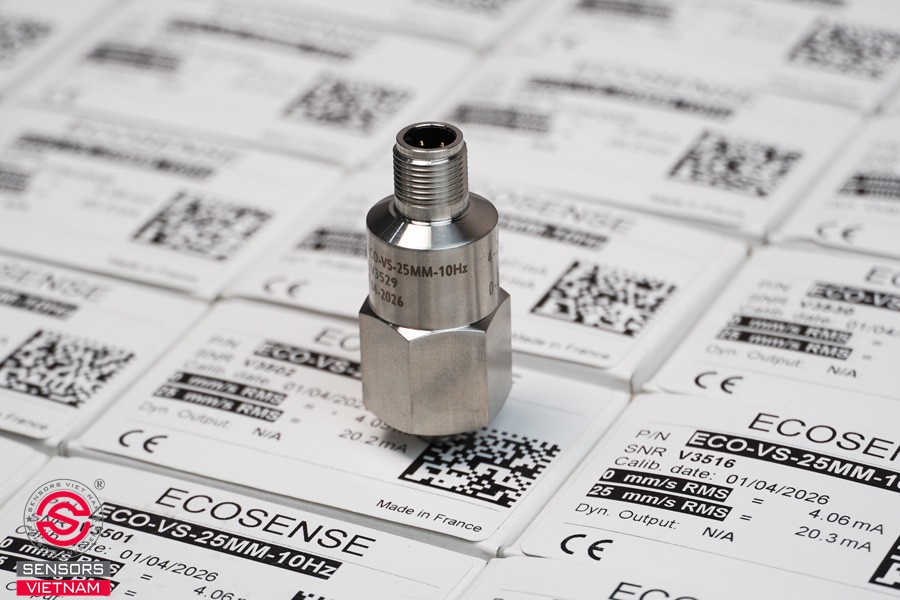
In this article, Sensors Vietnam provides a comprehensive overview of pump vibration sensors, including their definition, importance, working principle, operational benefits, and guidelines for selecting the appropriate measuring range for different industrial pump applications. Follow along to gain practical insights into industrial vibration monitoring solutions.
WHY IS PUMP VIBRATION MONITORING IMPORTANT?
Pumps are among the most common and essential mechanical devices used in industrial facilities. They are widely applied across various industries for fluid transfer, pressure boosting, and liquid circulation within industrial systems. Pumps play a critical role in oil & gas production, chemical processing, water supply, wastewater treatment, cooling systems, and many other industrial processes.
Routine pump maintenance is necessary to ensure long-term operational reliability and to prevent production downtime. In pump maintenance programs, vibration monitoring, especially for rotating and reciprocating components, is considered one of the highest priorities.
Monitoring and controlling abnormal vibration levels allows maintenance engineers to take corrective action before severe mechanical damage occurs.
So, what exactly does pump maintenance involve?
Pump maintenance mainly focuses on identifying and analyzing forces acting on the pump to ensure smooth coordination between all mechanical components.
-
When problems such as bearing wear, shaft misalignment, cavitation, or other mechanical faults occur, abnormal vibration patterns will appear.
-
Vibration monitoring involves comparing the “actual vibration level” with the established baseline condition to detect when problems begin and resolve them at an early stage. Instead of reacting after equipment failure occurs, technicians can use pump vibration sensors to proactively control equipment conditions before faults become critical.
 → See more: Vibration sensors and the 4 most common types
HOW BENEFICIAL ARE PUMP VIBRATION SENSORS?
Pump vibration sensors are indirect maintenance devices that help extend pump service life. These sensors can detect abnormal vibration conditions and provide accurate data for diagnosing existing or potential failures such as imbalance or shaft misalignment. Over time, such abnormal vibrations may damage pumps and related components, reducing efficiency and shortening equipment lifespan.
By continuously monitoring pump vibration levels during operation, vibration sensors can alert operators to abnormal conditions, allowing corrective action before problems become severe. These corrective actions may include:
-
Adjusting shaft alignment or balancing
-
Tightening loose components
-
Replacing worn parts
As a result, additional damage can be prevented while extending the operational lifespan of the pump system.
In addition to fault detection, vibration sensors are also used to optimize pump performance. Through vibration data analysis, engineers can identify areas requiring adjustment to improve operational efficiency and minimize mechanical wear.
In summary, pump vibration sensors are essential devices for extending pump lifespan, optimizing performance, and detecting early signs of mechanical failure.
 → See more: Vibration sensors and applications in industrial automation
STRUCTURE AND WORKING PRINCIPLE OF PUMP VIBRATION SENSORS
Basic structure of a pump vibration sensor
-
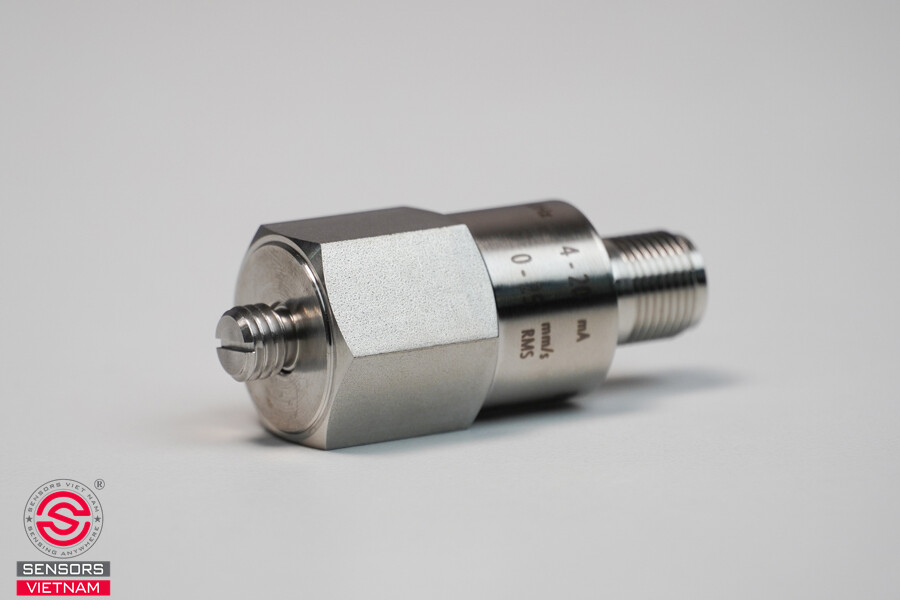
Sensing Element: Typically piezoelectric crystals or MEMS (Micro-Electro-Mechanical Systems) sensors.
-
Signal Amplification Circuit: Converts micro-volt signals from the piezoelectric element into standard 4-20 mA industrial output signals for long-distance transmission without significant signal loss.
-
Protective Housing: Usually made of high-grade stainless steel with excellent heat and moisture resistance, commonly rated IP67 or higher.
-
Connection Interface: Standard M8 mounting thread for secure installation on the pump body and M12 cable connector for signal output.
Operating principle of a pump vibration sensor
The operating process of a pump vibration sensor occurs continuously through the following stages:
-
Step 1: Vibration from the pump body is transmitted directly to the sensing element through the mounting surface.
-
Step 2: The piezoelectric crystal deforms according to the vibration frequency and generates a voltage proportional to the vibration amplitude.
-
Step 3: The integrated signal processing circuit amplifies and converts the signal into a linear 4-20 mA analog output.
-
Step 4: The signal is transmitted to PLC, BMS, or SCADA systems for threshold analysis and alarm activation if necessary.
ECO-VS PUMP VIBRATION SENSOR: A TRUSTED SOLUTION FOR INDUSTRIAL APPLICATIONS
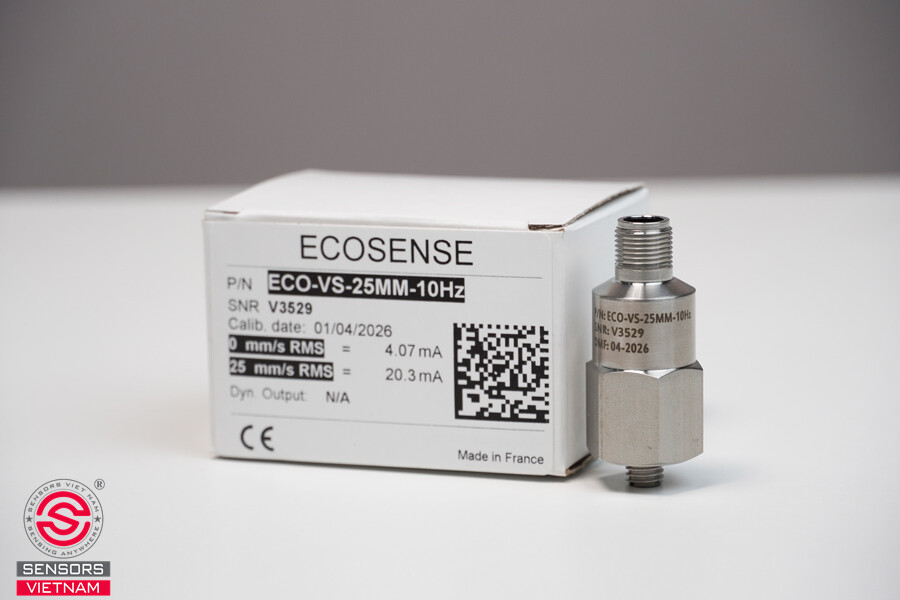
Currently, the ECO-VS series vibration sensors from ECOSENSE, officially distributed by Sensors Vietnam, are widely trusted by automation engineers thanks to their combination of measurement accuracy and flexible system integration capability.
The ECO-VS series is available in four measuring ranges suitable for different industrial applications:
-
ECO-VS-10MM-10HZ (0-10 mm/s RMS) → Small pumps, dosing pumps, and high-sensitivity applications.
-
ECO-VS-25MM-10HZ (0-25 mm/s RMS) → Residential centrifugal pumps and light industrial pumps.
-
ECO-VS-50MM-10HZ (0-50 mm/s RMS) → Medium industrial pumps, fans, and electric motors.
-
ECO-VS-100MM-10HZ (0-100 mm/s RMS) → Large pumps, compressors, and high-vibration machinery.
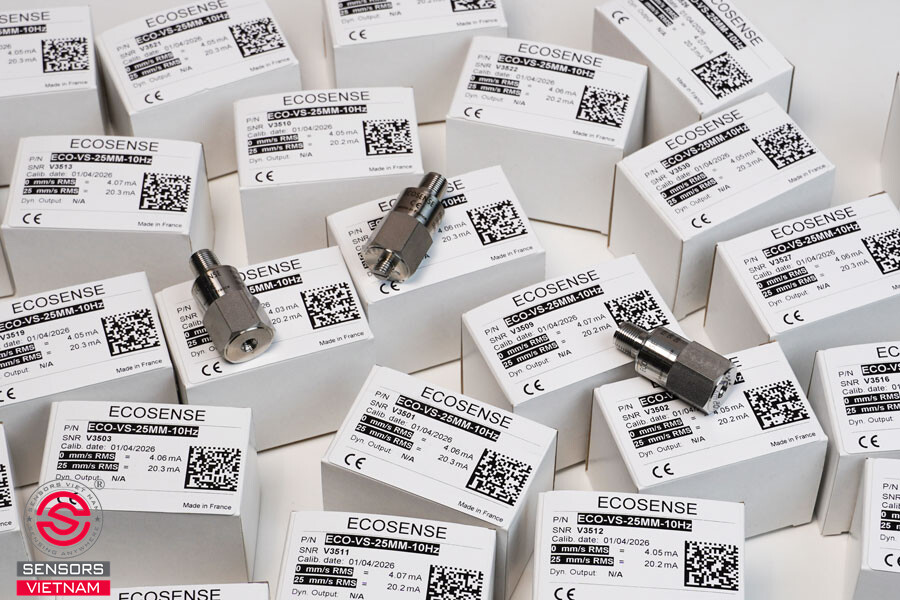 → See more: ECO-VS vibration sensors
HOW TO SELECT THE APPROPRIATE MEASURING RANGE FOR PUMP VIBRATION SENSORS
Below are important considerations when selecting industrial vibration sensors for pump monitoring applications:
-
Choose a measuring range where the actual vibration level falls within approximately 20-60% of the sensor range. This ensures both high measurement resolution and sufficient margin for alarm conditions. For example, if a pump normally operates around 8 mm/s, selecting the ECO-VS-25MM (0-25 mm/s) is preferable to the ECO-VS-100MM, avoiding unnecessary range oversizing and reduced measurement accuracy.
-
For applications with high shock vibration environments such as piston pumps or high-pressure dosing pumps, it is recommended to select a sensor with a measuring range 1-2 levels higher to prevent signal saturation.
Sensors Vietnam hopes this article has provided useful information regarding pump vibration sensors. If you need technical consultation or product support, please contact us directly for the most dedicated assistance.
Hot news


SENSORS VIETNAM CO., LTD
VAT CODE: 0313 355 473
Head Office: 03rd Floor, Indochina Tower, 04 Nguyen Dinh Chieu, Tan Dinh Ward, Ho Chi Minh City, Vietnam.
HCM Branch: 92/14/9A Vuon Lai Str., An Phu Dong Ward, Ho Chi Minh City, Vietnam.
Hanoi Branch: S106 Tower, Vinhomes Smart City, Tay Mo Ward, Hanoi City, Vietnam.

® Registered trademark – National Office of Intellectual Property Vietnam
OUR SERVICES
Specializing in the import and distribution of industrial sensors.
Sensors for HVAC/R systems and building automation applications.
Supplying gauges, transmitters, switches, controllers, PLCs, HMIs, and gas detectors.
Providing integrated consulting services for sensor and controller systems.


CONTACT US
Email: sales(at)sensors.vn
Hotline: +84 0911 660 660
Asia Commercial Bank Account (ACB):
VND: 357 246 888 | USD: 1357 246 888
Support Online ZALO Official Account
(From 8:00 am to 5:00 pm)





SENSORS VIETNAM CO., LTD
- Specialized in the import and distribution of sensors and controllers.
- Integrated data acquisition systems and industrial communication solutions.
- Design and installation of smart home systems and industrial equipment.
- Stack lights, signal beacons, LED warning horns, and RGB warning lights.