






CUSTOMER SERVICE
www.sensors.vn
Admin@sensors.vn
www.cambien.com.vn
WHAT IS A THERMOCOUPLE?
Date 25/Aug/2021 at 09:48 AM - View: 11298

What is a Thermocouple?
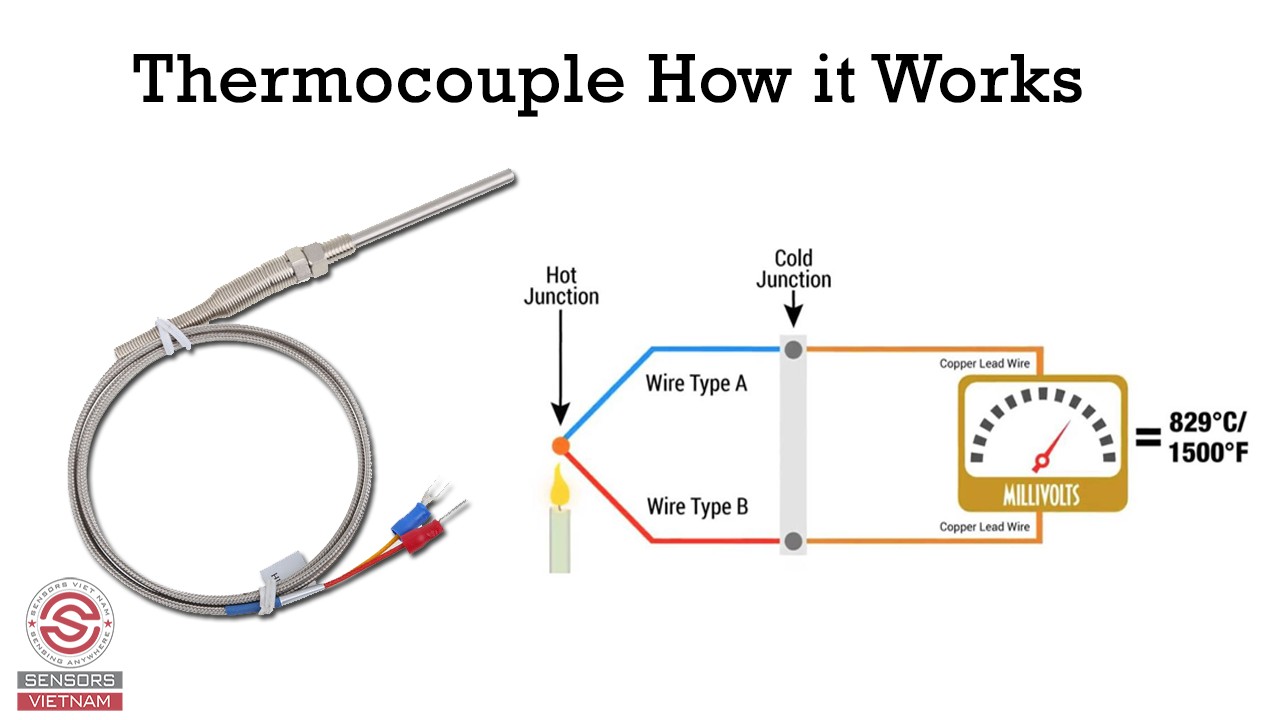
The thermocouple is the most popular temperature sensor overall due to its relatively low cost and reliability. Thermocouples are based on the Seebeck effect, which demonstrates that when a pair of dissimilar metals in contact with each other at each end are subjected to changes in temperature, they create a small voltage potential.
Pairing different kinds of metals give us a variety of measuring ranges. These are called “types.” A very popular one is Type K, which pairs chromel and alumel, resulting in a wide measuring range of −200 °C to +1350 °C (−330 °F to +2460 °F). Other popular types are J, T, E, R, S, B, N and C.
Thermocouple types J, K, T, and E are also known as Base Metal Thermocouples. Types R, S, and B thermocouples are known as Noble Metal Thermocouples, which are used in high-temperature applications
The output from a thermocouple must be linearized by the measuring system.
It must also be referenced using the Cold Junction Compensation (CJC). The “hot junction” is the measuring end of the thermocouple assembly, and the other end is the cold junction, where the reference is typically located. Cold Junction Compensation removes the effect of the voltages generated by these cold junctions for more accurate temperature measurement.
Thermocouple Challenges
Due to the very small microvolt and millivolt output of these sensors, electrical noise and interference can occur when the measuring system is not isolated. Dewesoft modules tackle this head-on with powerful isolation. There is no better way to reject common-mode voltages that get into the signal chain.
Another way to reduce noise is to place the measuring system as close to the sensor as possible. Avoiding long signal lines is a proven strategy for maximizing signal fidelity and reducing costs. Look at our SIRIUS and KRYPTON modular instruments for best-in-breed solutions here.
An inadequate CJC results in wrong readings. This assembly needs to be protected from ambient temperature changes to provide a solid reference. We use a separate CJC chip for each channel in our CJCs, which are milled from a solid block of aluminum, and precisely assembled to achieve the best possible reference.
Hot news





SENSORS VIETNAM CO., LTD
VAT CODE: 0313 355 473
Head Office: 03rd Floor, Indochina Tower, 04 Nguyen Dinh Chieu, Tan Dinh Ward, Ho Chi Minh City, Vietnam.
HCM Branch: 92/14/9A Vuon Lai Str., An Phu Dong Ward, Ho Chi Minh City, Vietnam.
Hanoi Branch: S106 Tower, Vinhomes Smart City, Tay Mo Ward, Hanoi City, Vietnam.

® Registered trademark – National Office of Intellectual Property Vietnam
OUR SERVICES
Specializing in the import and distribution of industrial sensors.
Sensors for HVAC/R systems and building automation applications.
Supplying gauges, transmitters, switches, controllers, PLCs, HMIs, and gas detectors.
Providing integrated consulting services for sensor and controller systems.


CONTACT US
Email: sales(at)sensors.vn
Hotline: +84 0911 660 660
Asia Commercial Bank Account (ACB):
VND: 357 246 888 | USD: 1357 246 888
Support Online ZALO Official Account
(From 8:00 am to 5:00 pm)





SENSORS VIETNAM CO., LTD
- Specialized in the import and distribution of sensors and controllers.
- Integrated data acquisition systems and industrial communication solutions.
- Design and installation of smart home systems and industrial equipment.
- Stack lights, signal beacons, LED warning horns, and RGB warning lights.