





CUSTOMER SERVICE
www.sensors.vn
Admin@sensors.vn
www.cambien.com.vn
WHAT IS HANDHELD TACHOMETER
Date 25/May/2026 at 09:42 AM - View: 15
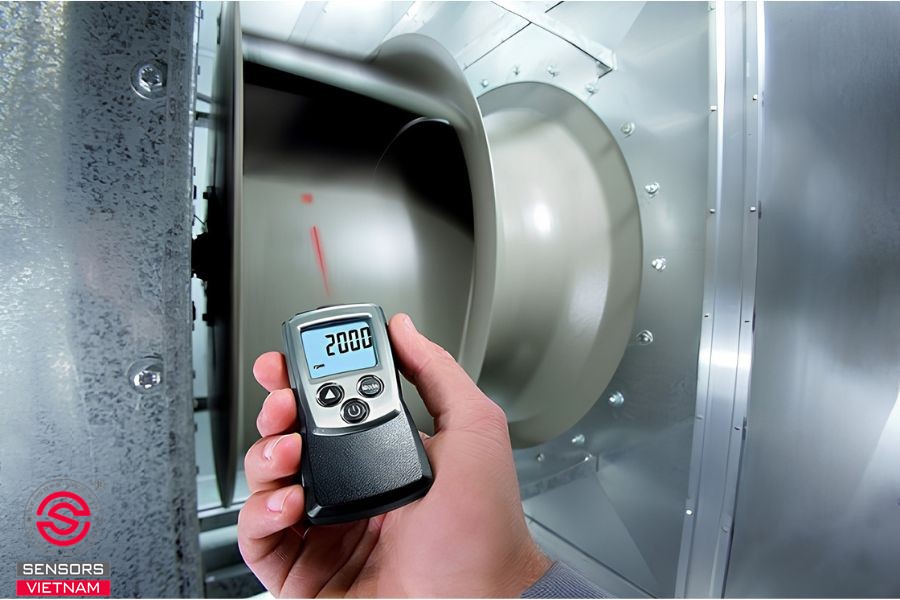
In modern industrial production environments, the rotational speed of motors, drive shafts, and mechanical components must be continuously monitored throughout operation, as even a minor deviation of just a few dozen RPM can lead to equipment failure, reduced productivity, and even workplace safety risks. To address this requirement, engineers commonly utilize handheld tachometers.
WHAT IS A HANDHELD TACHOMETER?
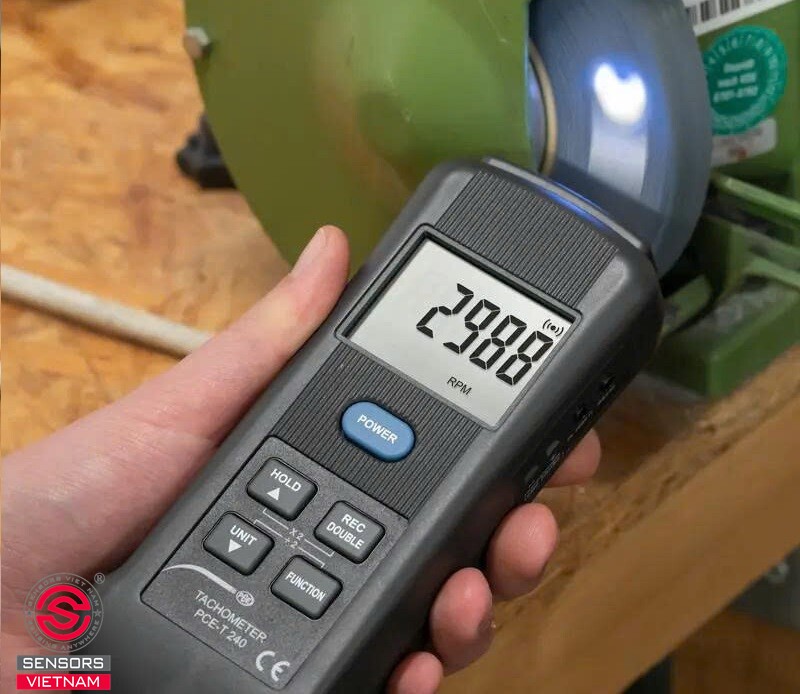
A handheld tachometer is a specialized measuring instrument designed to determine the number of revolutions per minute (RPM) of rotating objects such as electric motors, industrial fans, shafts, gear systems, and various other mechanical components.
Handheld RPM meters feature a compact design and user-friendly operation, allowing technicians to perform direct on-site measurements without stopping the production line or dismantling equipment.
Today, handheld rotational speed meters are generally divided into two main types:
-
Contact tachometer: The probe must physically contact the rotating component to accurately measure rotational speed.
-
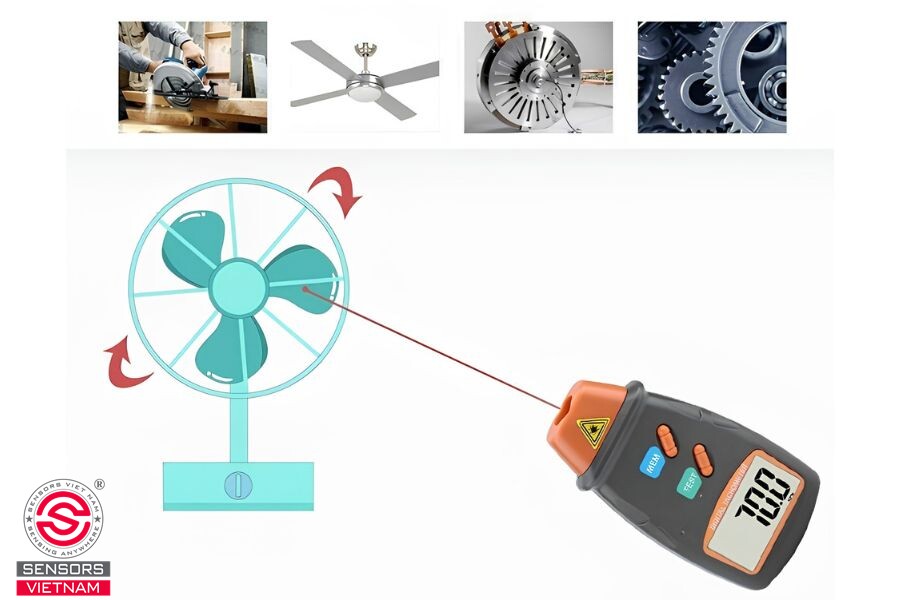
Non-contact tachometer: Uses laser or infrared technology aimed at a reflective surface, enabling safe remote measurement of rotating parts.
Many modern handheld tachometers integrate both contact and non-contact measurement modes into a single device, providing greater flexibility for different industrial applications.
→ See more: Handheld coating thickness gauge
STRUCTURE AND WORKING PRINCIPLE OF HANDHELD TACHOMETERS
Basic structure
A standard handheld tachometer typically consists of the following main components:
-
Device housing: Usually made of ABS plastic or shock-resistant rubber with an ergonomic handheld design.
-
Optical sensor / Contact Probe: Detects rotational signals from moving objects either remotely or through direct contact.
-
Signal processing unit: Converts pulse signals into RPM or linear speed values.
-
Display screen: Clearly displays measurement results and often includes MAX/MIN/LAST memory functions.
-
Power supply: Commonly powered by AA batteries or a 9V battery for extended operation.
→ See more: Handheld Hardness Tester
Operating principle
-
Non-contact handheld tachometer
→ The device emits a laser or infrared beam.
→ The beam reflects off reflective tape attached to the rotating shaft, with each reflection representing one revolution.
→ The processor counts the reflected pulses within a specific time interval and converts them into RPM values.
-
Contact handheld tachometer
→ The contact tip (typically rubber or cone-shaped) physically touches the rotating shaft.
→ Shaft rotation transfers movement to the internal processing mechanism, generating electrical pulses proportional to rotational speed.
→ The device then calculates RPM or linear speed values such as m/min.
Measurement accuracy depends heavily on the quality of the handheld motor tachometer, especially the processor speed and surrounding environmental conditions such as lighting, vibration, and measuring distance.
→ See more: Pump Vibration Sensor
APPLICATIONS OF HANDHELD TACHOMETERS
Handheld tachometers and portable engine RPM meters are widely used across various industries, including:
-
Industrial maintenance: Monitoring the speed of motors, pumps, air compressors, and rotating machinery in factories and industrial plants.
-
Automotive industry: Measuring crankshaft speed, transmission system rotation, and engine tuning applications.
-
HVAC systems: Measuring the rotational speed of ventilation fans, cooling fans, and blower systems.
-
Textile & food processing industry: Controlling conveyor speed, fabric rollers, winding shafts, and production rollers.
-
Renewable energy: Handheld motor tachometers are used to monitor the rotational speed of wind turbines and generators.
-
Laboratories & R&D: Used for measurement, calibration, and equipment testing during research and product development processes.
→ See more: Safety Limit Switch
STANDARD TECHNICAL SPECIFICATIONS OF HANDHELD TACHOMETERS
Below are typical technical specifications of common handheld tachometer models available on the market:
-
Non-Contact Measuring Range: 10 - 99,999 RPM
-
Contact Measuring Range: 0.5 - 19,999 RPM
-
Accuracy: ±0.05%
-
Laser Measuring Distance: 50 - 500 mm (optimal)
-
Sampling Time: 0.5 - 1 second
-
Measurement Units: RPM, m/min, ft/min
-
Resolution: 0.1 RPM (below 1,000 RPM) | 1 RPM (above 1,000 RPM)
-
Display: Digital LCD display
-
Power Supply: 4 × AA batteries or 9V battery
-
Operating Temperature: 0 - 50°C
-
Memory Functions: MAX / MIN / LAST
-
Protection Rating: IP40 - IP54 (depending on manufacturer)

→ See more: PT100 Temperature Sensor
AUTHORIZED DISTRIBUTOR OF HANDHELD TACHOMETERS - SENSORS VIET NAM
Sensors Viet Nam is an authorized distributor of genuine handheld tachometers in Vietnam, supplying a wide range of products from leading global brands.
With an experienced technical team, we support customers throughout the entire process, from product selection consultation and technical support before and after purchase to warranty service, calibration, and professional maintenance.
Whether you require rotational speed measurement devices for factories, maintenance workshops, or laboratories, Sensors Viet Nam can provide the most suitable solution. In addition, we offer highly competitive pricing, full CO/CQ documentation, fast delivery, and complete VAT invoices.
For technical consultation or to request a quotation for genuine handheld tachometers, please contact Sensors Viet Nam today for professional support and free technical advice!
Hot news


SENSORS VIETNAM CO., LTD
VAT CODE: 0313 355 473
Head Office: 03rd Floor, Indochina Tower, 04 Nguyen Dinh Chieu, Tan Dinh Ward, Ho Chi Minh City, Vietnam.
HCM Branch: 92/14/9A Vuon Lai Str., An Phu Dong Ward, Ho Chi Minh City, Vietnam.
Hanoi Branch: S106 Tower, Vinhomes Smart City, Tay Mo Ward, Hanoi City, Vietnam.

® Registered trademark – National Office of Intellectual Property Vietnam
OUR SERVICES
Specializing in the import and distribution of industrial sensors.
Sensors for HVAC/R systems and building automation applications.
Supplying gauges, transmitters, switches, controllers, PLCs, HMIs, and gas detectors.
Providing integrated consulting services for sensor and controller systems.


CONTACT US
Email: sales(at)sensors.vn
Hotline: +84 0911 660 660
Asia Commercial Bank Account (ACB):
VND: 357 246 888 | USD: 1357 246 888
Support Online ZALO Official Account
(From 8:00 am to 5:00 pm)





SENSORS VIETNAM CO., LTD
- Specialized in the import and distribution of sensors and controllers.
- Integrated data acquisition systems and industrial communication solutions.
- Design and installation of smart home systems and industrial equipment.
- Stack lights, signal beacons, LED warning horns, and RGB warning lights.