






CUSTOMER SERVICE
www.sensors.vn
Admin@sensors.vn
www.cambien.com.vn
TEMPERATURE SENSOR PT1000
Date 14/Oct/2026 at 04:44 PM - View: 24
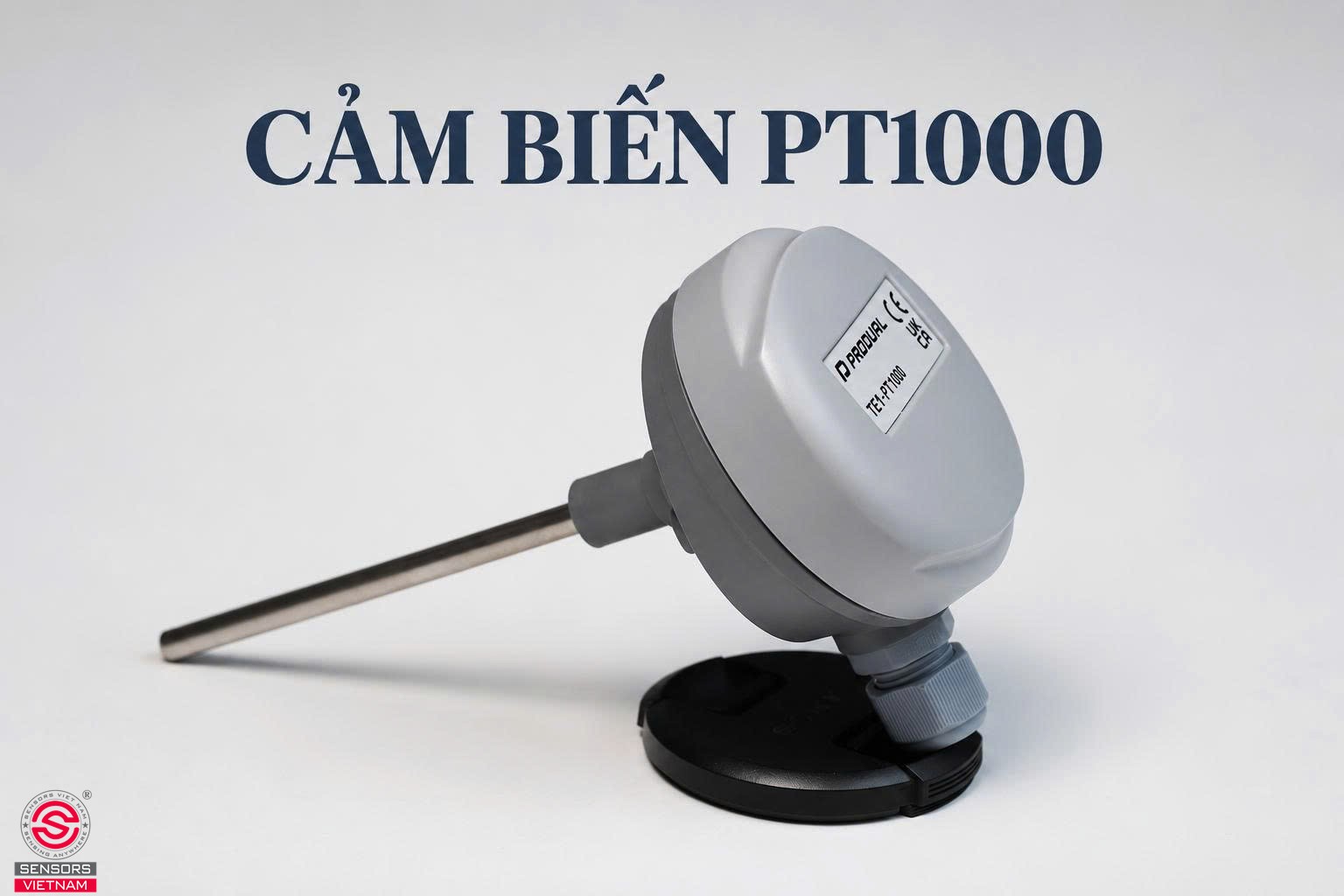
A PT1000 temperature sensor is an RTD temperature probe that uses platinum as its sensing element and has a resistance of 1,000 Ω at 0°C. Thanks to its high accuracy, long term signal stability and relatively low sensitivity to lead wire resistance, the PT1000 temperature sensor is widely used in HVAC systems, chillers, AHUs, heat pumps and modern temperature controllers. This article explains its construction, working principle, applications, purchasing criteria and the differences between two wire, three wire and four wire PT1000 sensors.
PT1000: WHAT IS A PT1000 TEMPERATURE SENSOR?
A PT1000 sensor is a type of resistance temperature detector (RTD). Its sensing element is made of platinum, a metal with a highly predictable and repeatable relationship between electrical resistance and temperature. The name PT1000 indicates a nominal resistance of 1,000 Ω at 0°C. As the temperature increases, the resistance increases, allowing the controller to determine the actual temperature from the measured resistance value.
PT1000 sensors are often compared with PT100 sensors, which have a resistance of 100 Ω at 0°C and belong to the same platinum RTD family. Both types have similar resistance temperature characteristics but different nominal resistance values. The higher resistance of the PT1000 provides a larger resistance change for each degree of temperature change, making it suitable for HVAC controllers, DDC controllers and data loggers with inputs specifically designed for this sensor type.
PT1000 TEMPERATURE SENSOR CONSTRUCTION
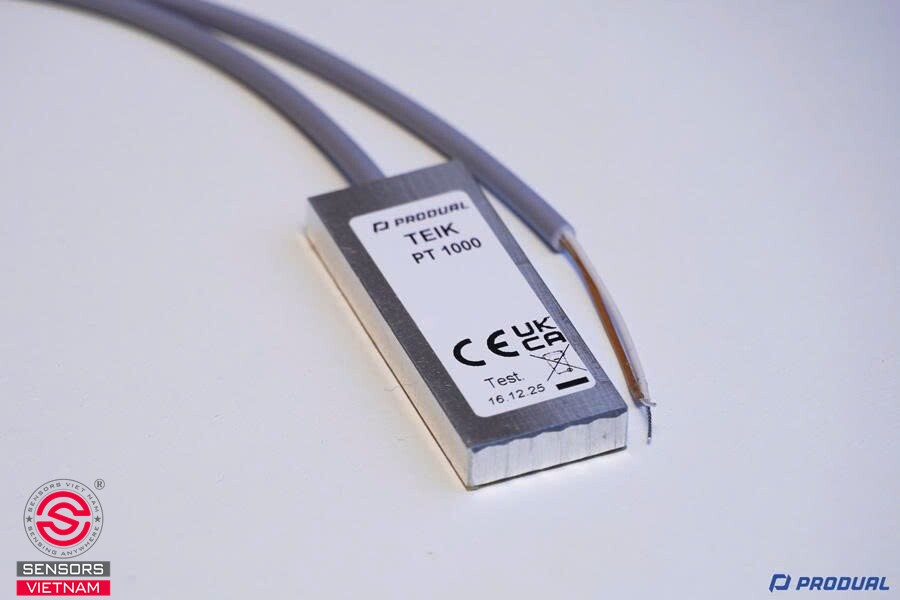
A complete PT1000 temperature probe consists of several main components. The most important is the platinum sensing element, which is generally available in two designs. A thin film element has an extremely thin layer of platinum deposited onto a ceramic substrate, followed by laser trimming to achieve the nominal resistance value. A wire wound element uses platinum wire wound around a ceramic or glass core. In HVAC applications, thin film elements are more common because they are compact, cost effective and offer a fast response.
The sensing element is connected to lead wires, which may be silver plated or nickel plated copper, and insulated with PVC, silicone or PTFE according to the operating temperature range. The outer protective housing is commonly made of stainless steel, such as grade 304 or 316, although brass or engineering plastics may be used for room temperature sensors and duct temperature probes. The space between the sensing element and the housing is filled with materials that provide electrical insulation and thermal conductivity, helping transfer heat efficiently and reduce the effects of vibration.
Depending on the application, the probe body may be designed as an insertion probe, a pipe surface mounted sensor, a wall mounted sensor or a probe with a thermowell. A thermowell allows the sensor to be installed in a pipeline and replaced without draining the system. Some models also incorporate a transmitter to provide a 4 to 20 mA or 0 to 10 V output signal to the controller.
PT1000 TEMPERATURE SENSOR WORKING PRINCIPLE
The PT1000 temperature sensor operates based on the principle that the electrical resistance of a metal changes with temperature. For platinum, this relationship is nearly linear across the normal HVAC operating temperature range and remains highly stable over years of use. This is one reason platinum is widely used as a reference material for industrial temperature measurement.
The controller supplies a small electrical current through the sensor and measures the voltage drop across it. The resistance is then calculated using Ohm's law. The measuring current must remain within the limits recommended by the equipment manufacturer because excessive current can cause self heating of the sensing element and produce a positive measurement error. Thanks to its higher resistance, a PT1000 consumes less power than a PT100 when both are subjected to the same excitation voltage, so self heating is often less pronounced under comparable conditions.
PT1000 TEMPERATURE SENSOR APPLICATIONS
In HVAC systems, PT1000 temperature sensors are used to monitor air temperature, chilled water temperature, hot water temperature and other process media during operation. They can be installed in AHUs, FCUs, water pipelines and heat exchangers to provide data to the controller, helping maintain the required temperature setpoint and optimize system performance.
In AHUs and FCUs, PT1000 sensors can measure supply air, return air and fresh air temperatures, depending on the system design. The measurement data allows the controller to adjust chilled water valves, air dampers and fan speed to maintain the desired indoor temperature conditions. In chiller, boiler and heat pump systems, PT1000 temperature probes can be installed on water inlet and outlet pipes and at heat transfer points to monitor chilled water, hot water or cooling water temperatures.
In refrigeration systems, PT1000 sensors may also be used to monitor suction lines, discharge lines and heat exchangers when the equipment configuration is suitable for the application. Temperature data helps the controller monitor operating conditions, manage defrost cycles and detect abnormal temperature variations.
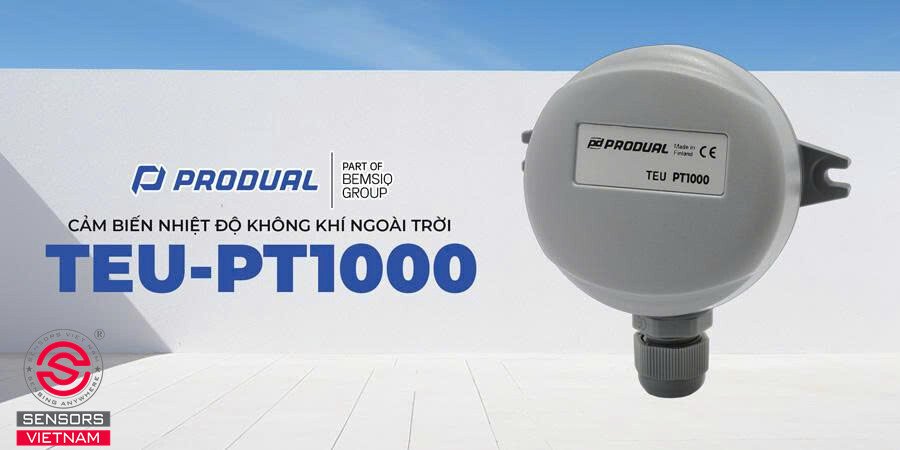
In addition, outdoor PT1000 temperature sensors are used in weather compensation control systems. Based on the outdoor temperature, the controller can adjust the supply water temperature or temperature setpoint to meet heating and cooling requirements while reducing energy consumption. In BMS and DDC systems, PT1000 sensors provide temperature data for centralized monitoring, automatic control and HVAC equipment management.
PT1000 temperature sensor applications in other industries
Beyond HVAC systems, industrial PT1000 temperature sensors are used in many applications requiring temperature monitoring and control. In solar thermal systems, they help monitor collector temperatures, thermal storage tanks and heat transfer pipelines. In thermal energy meters, PT1000 sensors can measure supply and return water temperatures, providing data for thermal energy consumption calculations according to the meter configuration.
In the food and beverage industry, PT1000 temperature probes may be used in storage tanks, heating equipment, cooling systems and storage facilities. In medical equipment, storage cabinets and environmental control systems, these sensors help monitor temperatures according to operating requirements. PT1000 sensors are also used in machinery, electronic equipment and industrial production lines to monitor temperature, support process control and trigger alarms when temperatures exceed configured limits.
FACTORS TO CONSIDER WHEN BUYING A PT1000 SENSOR
The first thing to check is whether your controller or input module supports PT1000 sensors. Many devices only accept PT100, Ni1000 or NTC 10K sensors. Connecting an incompatible sensor can result in completely incorrect temperature readings.
Next, consider the measurement range and accuracy class. Comfort air conditioning systems generally operate within a moderate temperature range. However, probes used on hot steam pipes or discharge lines may need to withstand much higher temperatures, so the cable and housing materials must be checked carefully. If the application requires low measurement error, such as measuring the temperature difference between chilled water supply and return lines to calculate cooling load, Class A is worth considering instead of Class B.
The probe design also affects measurement performance. Air temperature measurement requires a duct temperature probe with sufficient insertion length to reach the airflow. Water temperature measurement generally benefits from a thermowell for easier sensor replacement. For pipe surface measurement, use a surface mounted probe with thermal conductive paste and appropriate thermal insulation. Stainless steel grade 316 may be suitable for humid or chemically aggressive environments, while the IP protection rating must match the installation location.
Finally, consider cable length and wiring practices. Long cables routed alongside power cables can introduce electrical interference and measurement errors, particularly with two wire sensors. Use shielded cables, separate signal wiring from power cables and choose a supplier that provides clear specifications for tolerance, response time and calibration certificates when required by the system.
WHEN SHOULD YOU USE TWO WIRE, THREE WIRE OR FOUR WIRE PT1000 SENSORS?
PT1000 temperature sensors are available in two wire, three wire and four wire configurations, each suited to different temperature measurement requirements. The number of wires affects how the measuring instrument accounts for lead wire resistance, which in turn influences measurement accuracy.
Connecting wires have their own electrical resistance. As the distance between the PT1000 sensor and the controller increases, lead wire resistance can affect the displayed temperature. Because a PT1000 has a higher nominal resistance than a PT100, the relative influence of lead wire resistance is lower under comparable measurement conditions. However, selecting the correct wiring configuration remains important when high accuracy is required or long cables are used.
PT1000 two wire temperature sensor
A two wire PT1000 sensor has a simple design, is easy to install and offers a reasonable cost. The same two wires carry the measuring current and transmit the measurement signal to the controller. Consequently, the resistance of the connecting wires is included in the measured resistance. When the cables are short, the resulting error is generally smaller than when long cables are used.
Two wire PT1000 sensors are commonly used in HVAC systems, air conditioning equipment, room temperature monitoring devices and applications that do not require very high measurement accuracy. For example, when a PT1000 temperature sensor is installed in an air conditioning system or pipeline close to the controller, a two wire configuration may adequately meet the application requirements.
PT1000 three wire temperature sensor
A three wire PT1000 sensor includes an additional wire to support compensation for lead wire resistance. When connected to a compatible controller, the system can reduce errors caused by the connecting wires, improving measurement accuracy compared with a two wire configuration.
This PT1000 sensor type is suitable for industrial applications requiring better measurement accuracy, such as monitoring chilled water and hot water temperatures in chillers, boilers, pipelines and heat exchangers.
The main advantage of a three wire PT1000 is its balance between installation cost and measurement accuracy. However, the effectiveness of lead wire compensation depends on the wires having equivalent resistance and the controller supporting a compatible three wire RTD input. Therefore, the wiring diagram should be checked before selecting the sensor.
PT1000 four wire temperature sensor
A four wire PT1000 sensor uses two wires to supply electrical current and two separate wires to measure the voltage across the sensing element. Under suitable measurement conditions, this configuration can almost completely eliminate the influence of lead wire resistance on the measurement result.
Because it reduces errors caused by connecting wires, the four wire PT1000 is suitable for high accuracy measurement applications, calibration equipment and laboratories. It may also be considered for specialized industrial processes requiring strict temperature control.
However, four wire PT1000 sensors generally cost more and require a measuring instrument that supports a four wire configuration. For typical HVAC systems, two wire or three wire sensors may already meet the requirements, depending on the installation distance and required accuracy.
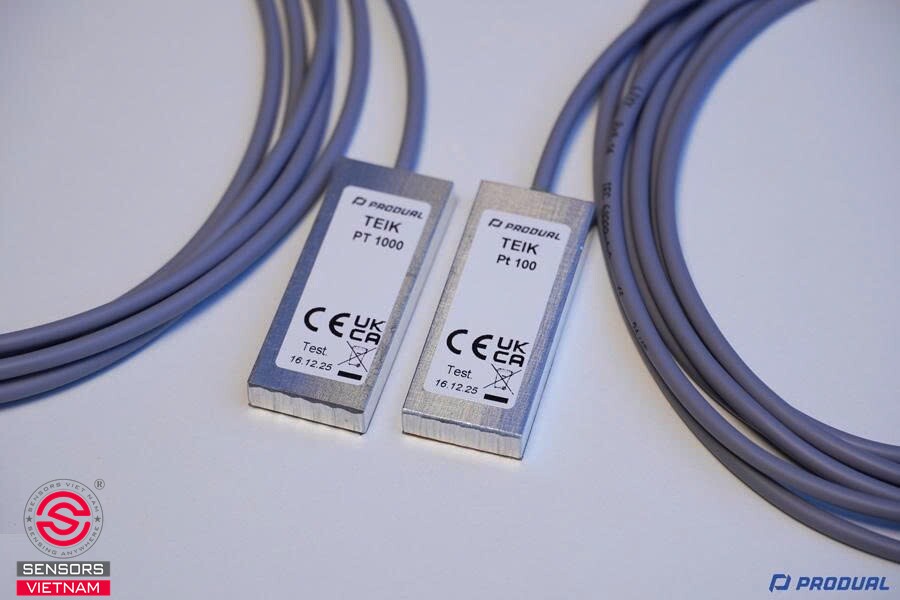 Should you choose a two wire, three wire or four wire PT1000 sensor?
The choice of PT1000 temperature sensor wiring configuration should be based on the installation distance, required measurement accuracy and compatibility with the controller.
- Two wire PT1000 sensors are suitable for systems with short cables, simple wiring requirements and standard measurement needs.
- Three wire PT1000 sensors are suitable when lead wire errors need to be reduced, particularly in industrial and HVAC systems with longer cable runs.
- Four wire PT1000 sensors are intended for high accuracy applications with compatible measuring equipment.
BUY PT1000 TEMPERATURE SENSORS FROM SENSORS VIETNAM
Sensors Vietnam distributes industrial sensors, measurement equipment and products for HVAC systems and building automation. Its product range includes temperature sensors, temperature probes, PT100 sensors, PT1000 sensors, thermocouples, temperature and humidity sensors, and various measuring devices for temperature monitoring and control in industrial applications.
If you are looking for an HVAC temperature sensor, an industrial temperature sensor or a temperature measurement and control solution suited to your system, contact Sensors Vietnam for product recommendations based on your technical requirements and application needs.
For more product information and technical consultation, please visit: https://cambien.com.vn/ | https://www.sensors.vn/. Sensors Vietnam is ready to help you find suitable temperature sensors and measurement equipment for your application.
Hot news


SENSORS VIETNAM CO., LTD
VAT CODE: 0313 355 473
Head Office: 03rd Floor, Indochina Tower, 04 Nguyen Dinh Chieu, Tan Dinh Ward, Ho Chi Minh City, Vietnam.
HCM Branch: 92/14/9A Vuon Lai Str., An Phu Dong Ward, Ho Chi Minh City, Vietnam.
Hanoi Branch: S106 Tower, Vinhomes Smart City, Tay Mo Ward, Hanoi City, Vietnam.

® Registered trademark – National Office of Intellectual Property Vietnam
OUR SERVICES
Specializing in the import and distribution of industrial sensors.
Sensors for HVAC/R systems and building automation applications.
Supplying gauges, transmitters, switches, controllers, PLCs, HMIs, and gas detectors.
Providing integrated consulting services for sensor and controller systems.


CONTACT US
Email: sales(at)sensors.vn
Hotline: +84 0911 660 660
Asia Commercial Bank Account (ACB):
VND: 357 246 888 | USD: 1357 246 888
Support Online ZALO Official Account
(From 8:00 am to 5:00 pm)





SENSORS VIETNAM CO., LTD
- Specialized in the import and distribution of sensors and controllers.
- Integrated data acquisition systems and industrial communication solutions.
- Design and installation of smart home systems and industrial equipment.
- Stack lights, signal beacons, LED warning horns, and RGB warning lights.