




CUSTOMER SERVICE
www.sensors.vn
Admin@sensors.vn
www.cambien.com.vn
THE PRINCIPLES OF LEVEL MEASUREMENT
Date 21/Feb/2016 at 10:39 AM - View: 25549

With the wide variety of approaches to level measurement and as many as 163 suppliers offering one or more types of level-measuring instrument, identifying the right one for your application can be very difficult. In recent years, technologies that capitalized on microprocessor developments have stood out from the pack.

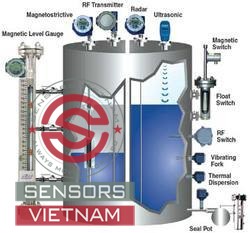
For example, the tried-and-true technique of measuring the head of a liquid has gained new life thanks to “smart” differential pressure (DP) transmitters. Today’s local level-measuring instruments can include diagnostics as well as configuration and process data that can be communicated over a network to remote monitoring and control instrumentation. One model even provides local PID control. Some of the most commonly used liquid-level measurement methods are:
• RF capacitance
• Conductance (conductivity)
• Hydrostatic head/tank gauging
• Radar
• Ultrasonic
Before you can decide which one is right for your application, however, you need to understand how each works and the theory behind it. (Each method has its own abbreviations, so you may find the sidebar, “Abbreviations for Common Flow Sensing Terminology,”, a useful reference during the discussions that follow.)
Hot news


SENSORS VIETNAM CO., LTD
VAT CODE: 0313 355 473
Head Office: 03rd Floor, Indochina Tower, 04 Nguyen Dinh Chieu, Tan Dinh Ward, Ho Chi Minh City, Vietnam.
HCM Branch: 92/14/9A Vuon Lai Str., An Phu Dong Ward, Ho Chi Minh City, Vietnam.
Hanoi Branch: S106 Tower, Vinhomes Smart City, Tay Mo Ward, Hanoi City, Vietnam.

® Registered trademark – National Office of Intellectual Property Vietnam
OUR SERVICES
Specializing in the import and distribution of industrial sensors.
Sensors for HVAC/R systems and building automation applications.
Supplying gauges, transmitters, switches, controllers, PLCs, HMIs, and gas detectors.
Providing integrated consulting services for sensor and controller systems.


CONTACT US
Email: sales(at)sensors.vn
Hotline: +84 0911 660 660
Asia Commercial Bank Account (ACB):
VND: 357 246 888 | USD: 1357 246 888
Support Online ZALO Official Account
(From 8:00 am to 5:00 pm)





SENSORS VIETNAM CO., LTD
- Specialized in the import and distribution of sensors and controllers.
- Integrated data acquisition systems and industrial communication solutions.
- Design and installation of smart home systems and industrial equipment.
- Stack lights, signal beacons, LED warning horns, and RGB warning lights.