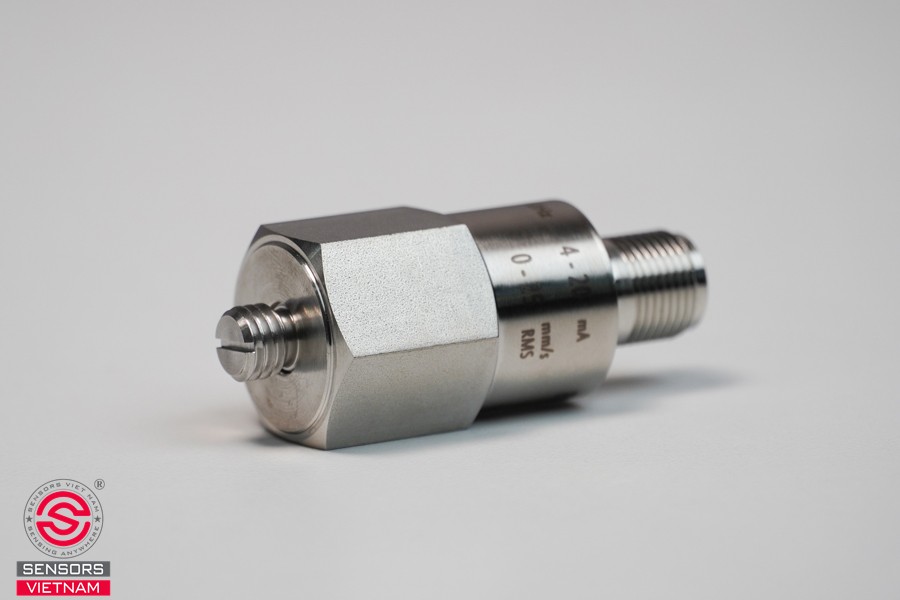
Steam, gas, and hydraulic turbines all operate at extremely high rotational speeds under harsh pressure, temperature, and load conditions. Therefore, even a minor change in vibration characteristics may be the first warning sign of serious mechanical failure. Turbine vibration sensors serve as critical monitoring devices that allow engineers to take corrective action in time to protect the entire system before catastrophic damage occurs.
WHY IS TURBINE VIBRATION MONITORING IMPORTANT?
Turbines are not ordinary rotating machines. They operate at speeds ranging from 1,500 to 30,000 RPM, depending on the application, while maintaining extremely tight mechanical tolerances. At such speeds, even a few grams of mass imbalance on the rotor can generate enormous centrifugal forces, leading to rapidly increasing vibration levels if not detected and corrected promptly.
Common faults that cause abnormal turbine vibration include:
-
Rotor imbalance: The most common fault, typically appearing at the rotational frequency (1×RPM) with vibration amplitude gradually increasing over time.
-
Shaft misalignment: Characterized by strong vibration components at 2×RPM, often accompanied by significant axial vibration.
-
Bearing wear: Usually generates high-frequency vibration signatures (BPFI, BPFO, BSF) and can be detected early through frequency spectrum analysis.
-
Structural resonance: Occurs when excitation frequency matches the natural frequency of the machine structure, causing sudden amplification of vibration even when the original fault is relatively small.
Industrial vibration sensors used for turbine applications must provide a wide frequency range, high measurement accuracy, and stable operation under elevated temperature conditions.
WHAT IS A TURBINE VIBRATION SENSOR?
A turbine vibration sensor is an electronic device specifically designed to monitor, measure, and convert mechanical vibration into electrical signals for analysis and condition monitoring. In turbine applications, vibration sensors are mounted directly on bearing housings or machine casings to continuously collect and transmit vibration data to centralized monitoring systems such as PLC, SCADA, or DCS platforms. Real-time vibration values are used to trigger alarms whenever preset thresholds are exceeded.
Basic structure of a turbine vibration sensor
A typical industrial turbine vibration sensor consists of the following components:
-
Piezoelectric sensing element: Made from quartz crystal or PZT ceramic. When exposed to vibration, the element generates an electrical charge proportional to acceleration.
-
Seismic mass: Amplifies the mechanical force applied to the sensing element, improving sensitivity at lower frequency ranges.
-
Integrated electronic circuit: Converts electrical charge into standard industrial output signals (4-20 mA / 0-10V / Modbus RTU), while also performing filtering and temperature compensation.
-
Stainless steel housing: Designed to withstand high temperatures, severe vibration, and corrosive industrial environments commonly found in turbine applications.
Working principle of a turbine vibration sensor
STAGE 1: During turbine operation, vibration travels from the rotor → bearings → machine housing → sensor mounting location.
STAGE 2: The vibration force acts on the piezoelectric element, generating an electrical charge. The integrated electronic circuit then processes, filters, and converts the signal into a linear output suitable for continuous transmission to PLC or SCADA systems.
STAGE 3: Within the PLC or SCADA system, vibration signals are continuously compared against predefined alarm and trip thresholds. When vibration levels exceed safe operating limits, the system automatically activates alarms or emergency shutdown commands.

→ See more: Fan motor vibration sensors
TURBINE VIBRATION SENSORS PROVIDE SIGNIFICANT ECONOMIC BENEFITS
For operators of power generation, refinery, or wind energy turbine systems, installing industrial vibration monitoring sensors provides several important advantages:
-
Early fault detection (2-8 weeks in advance)
Turbine vibration sensors can detect early-stage bearing wear through characteristic high-frequency vibration signatures. This provides maintenance teams with sufficient time to schedule repairs or replacement activities before critical failures occur.
-
24/7 Continuous monitoring without manual inspection
Instead of relying on periodic handheld vibration measurements, permanently mounted turbine vibration sensors provide continuous real-time monitoring, ensuring abnormal conditions are detected immediately without missing critical events.
-
Easy integration into existing control systems
Standard industrial analog and digital outputs allow direct integration with PLC, DCS, and BMS systems without requiring additional converters or intermediate software.
-
Transition from preventive maintenance to predictive maintenance
Rather than disassembling equipment for scheduled bearing inspections every six months regardless of actual condition, vibration monitoring enables maintenance decisions based on real operational data. This significantly reduces maintenance labor and spare part costs.
-
Protection of high-value equipment
Industrial turbines are extremely valuable assets, often costing from hundreds of thousands to millions of dollars. However, the cost of installing a complete turbine vibration monitoring system typically represents only 0.1-1% of the equipment value. Such a small investment can effectively prevent catastrophic rotor damage and costly unplanned downtime.

→ See more: Vibration sensors and applications in industrial automation
WHICH TURBINE VIBRATION SENSOR SERIES IS MOST TRUSTED TODAY?
When selecting vibration sensors for turbines and other industrial rotating equipment, three key criteria should always be prioritized: wide frequency response, standard industrial output signals, and durability in harsh operating environments.
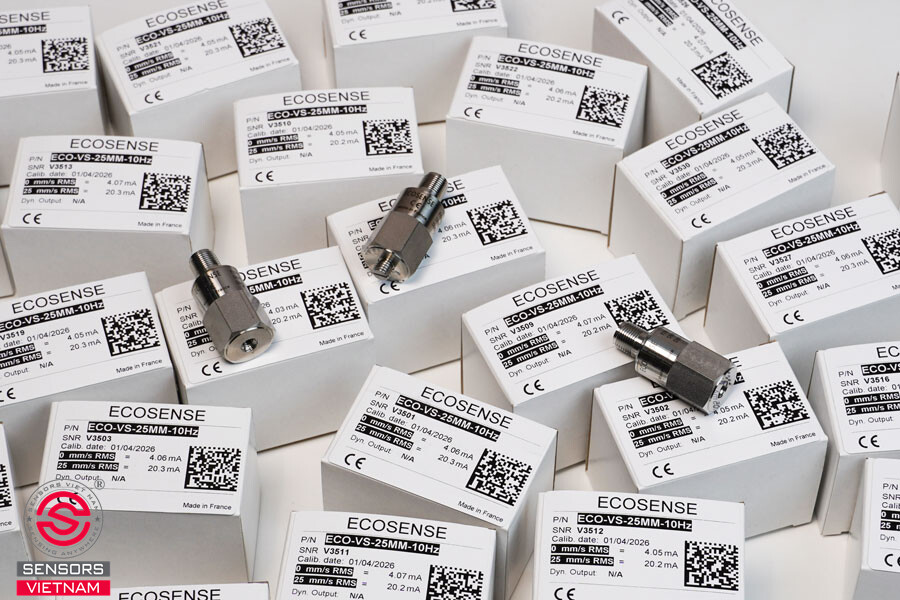
The ECO-VS turbine vibration sensor series from ECOSENSE officially distributed by Sensors Vietnam is widely trusted because it combines all three requirements in a compact, easy-to-install, and cost-effective solution.
The ECO-VS series offers four measuring ranges suitable for different turbine applications:
-
ECO-VS-10MM-10HZ (0-10 mm/s RMS) → Small turbines and mini compressors.
-
ECO-VS-25MM-10HZ (0-25 mm/s RMS) → Small wind turbines and industrial fans.
-
ECO-VS-50MM-10HZ (0-50 mm/s RMS) → Medium steam turbines and centrifugal compressors.
-
ECO-VS-100MM-10HZ (0-100 mm/s RMS) → Gas turbines, large steam turbines, and high-capacity wind turbines.
→ See more: ECO-VS vibration sensors
For additional information about ECO-VS turbine vibration sensors and assistance selecting the most suitable model for your application, please contact the Sensors Vietnam technical support team directly.