






CUSTOMER SERVICE
www.sensors.vn
Admin@sensors.vn
www.cambien.com.vn
COMMON TYPES OF CO2 SENSOR
Date 25/Oct/2025 at 09:57 AM - View: 218

CO2 sensors are essential devices used to measure and monitor carbon dioxide levels in a variety of environments. In this article, we will delve into the workings of CO2 sensors, exploring their purpose, function, and how they work.
What is a CO2 sensor?
A CO2 sensor, also known as a carbon dioxide sensor, is a device designed to detect and measure the concentration of carbon dioxide in ambient air. It provides valuable data for monitoring air quality and ventilation in indoor spaces, industrial processes, and environmental monitoring.
Working principle of CO2 sensor
CO2 sensors operate on a variety of principles, including non-dispersive infrared (NDIR) technology, chemical reactions, or solid-state sensors. The most common type of CO2 sensor is NDIR.
Non-Dispersive Infrared (NDIR) CO2 Sensor
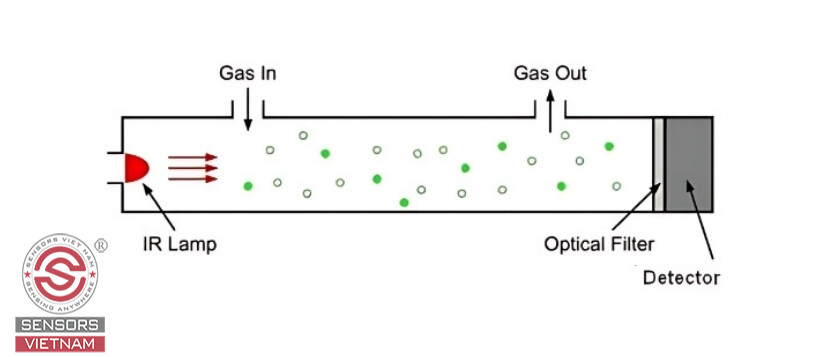
An NDIR sensor consists of an infrared light source, a measurement chamber, and a detector. The infrared light source emits specific wavelengths of light that are absorbed by CO2 molecules. The detector measures the amount of light that passes through the chamber, and the difference in light intensity detected is used to determine the CO2 concentration.
Advantages:
- High Accuracy: NDIR sensors offer high accuracy in measuring carbon dioxide concentrations, making them suitable for critical applications.
- Wide measurement range: These sensors can detect CO2 concentrations over a wide range, from low to high levels.
- Long-term stability: NDIR sensors exhibit excellent long-term stability, ensuring reliable performance over long periods of time.
- Established Technology: NDIR technology has been widely used and proven effective in many different industries.
Disadvantages
- Higher Price: NDIR sensors tend to be more expensive than semiconductor and thermal conduction sensors.
- Power Consumption: These sensors can consume more power during operation, which may limit their use in battery-powered devices.
Semiconductor CO2 sensor
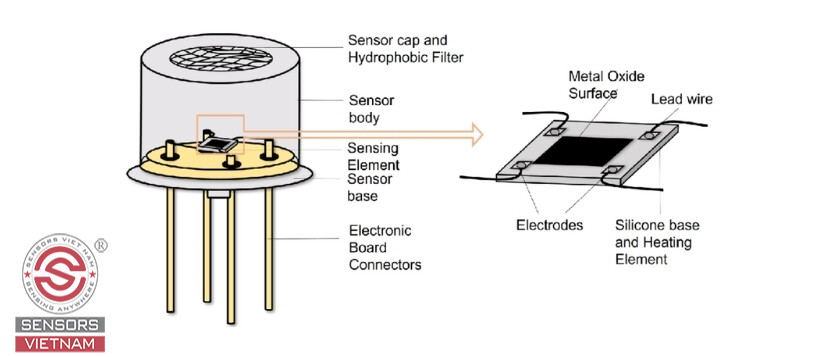
Semiconductor CO2 sensors use a solid-state sensing element to detect carbon dioxide concentrations. The sensing element consists of a thin film of semiconductor material, typically a metal oxide or polymer, which undergoes a change in conductivity when exposed to CO2. This change in conductivity is then measured and converted to CO2 concentration.
Advantages
- Compact size: Semiconductor sensors are compact in size, suitable for portable and space-limited applications.
- Fast Response Time: These sensors have a fast response time, providing real-time data on CO2 levels for immediate action or adjustment.
- Cost-effective: Semiconductor CO2 sensors are relatively more cost-effective than NDIR sensors, allowing for wider adoption.
- Low Power Consumption: These sensors are energy efficient, consuming minimal power during operation, making them suitable for battery-powered devices and IoT applications.
Disadvantages
- Less Accuracy: Semiconductor sensors can have less accuracy than NDIR sensors, especially at lower CO2 concentrations.
- Limited measurement range: These sensors may have a narrower measurement range than NDIR sensors.
- Sensitive to environmental factors: Semiconductor sensors can be sensitive to changes in temperature and humidity, which can affect their performance.
Thermal conductivity CO2 sensor
Thermal conductivity CO2 sensors are based on the principle that carbon dioxide molecules have different thermal conductivity compared to other gases.
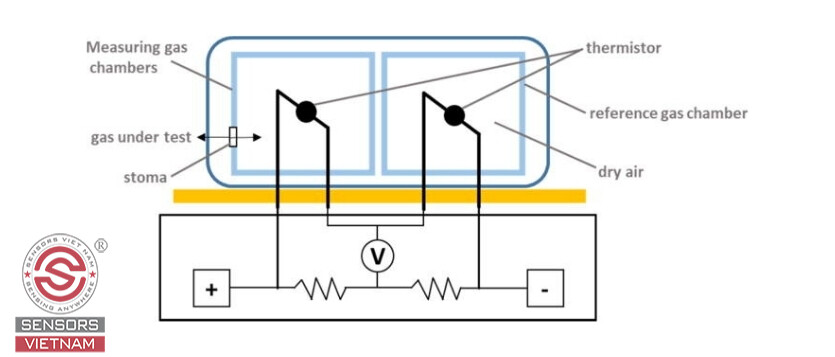
The sensor consists of two components: a reference channel and a measurement channel. Both channels are heated to a specific temperature. The reference channel is exposed to the ambient air, while the measurement channel is exposed to the air sample being tested.
When the air sample contains CO2, the thermal conductivity of the gas in the measuring channel changes. CO2 has a higher thermal conductivity than other gases in the air. As a result, the heat transfer in the measuring channel is different from the reference channel.
By measuring the temperature difference between the two channels, the sensor can determine the CO2 concentration in the air. The change in thermal conductivity is proportional to the CO2 concentration.
Advantages:
- High Accuracy: The thermal conductivity sensor provides high accuracy in detecting carbon dioxide concentration.
- Fast response time: These sensors offer fast response times, allowing real-time monitoring of CO2 concentrations.
- Long-term stability: The thermal conductivity sensor has excellent long-term stability, ensuring stable and reliable performance.
- Low Maintenance: These sensors require minimal maintenance, reducing operating costs.
Disadvantages
- Limited measurement range: Thermal conductivity sensors may have a more limited measurement range than NDIR sensors.
- Larger Size: These sensors can be larger in size than semiconductor sensors, limiting their use in certain applications.
For more details: https://cambien.com.vn/cam-bien-khi-co2
Hot news


SENSORS VIETNAM CO., LTD
VAT CODE: 0313 355 473
Head Office: 03rd Floor, Indochina Tower, 04 Nguyen Dinh Chieu, Tan Dinh Ward, Ho Chi Minh City, Vietnam.
HCM Branch: 92/14/9A Vuon Lai Str., An Phu Dong Ward, Ho Chi Minh City, Vietnam.
Hanoi Branch: S106 Tower, Vinhomes Smart City, Tay Mo Ward, Hanoi City, Vietnam.

® Registered trademark – National Office of Intellectual Property Vietnam
OUR SERVICES
Specializing in the import and distribution of industrial sensors.
Sensors for HVAC/R systems and building automation applications.
Supplying gauges, transmitters, switches, controllers, PLCs, HMIs, and gas detectors.
Providing integrated consulting services for sensor and controller systems.


CONTACT US
Email: sales(at)sensors.vn
Hotline: +84 0911 660 660
Asia Commercial Bank Account (ACB):
VND: 357 246 888 | USD: 1357 246 888
Support Online ZALO Official Account
(From 8:00 am to 5:00 pm)





SENSORS VIETNAM CO., LTD
- Specialized in the import and distribution of sensors and controllers.
- Integrated data acquisition systems and industrial communication solutions.
- Design and installation of smart home systems and industrial equipment.
- Stack lights, signal beacons, LED warning horns, and RGB warning lights.