





CUSTOMER SERVICE
www.sensors.vn
Admin@sensors.vn
www.cambien.com.vn
DUCT CARBON DIOXIDE TRANSMITTERS
Date 21/Aug/2025 at 06:57 AM - View: 165
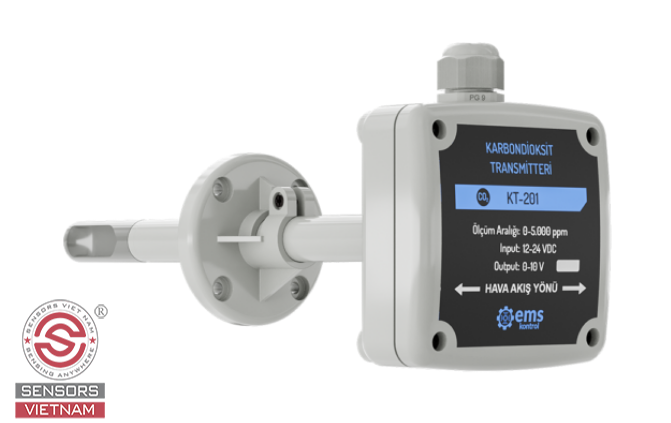
Duct CO2 Sensor – Smart Solution for HVAC and Ventilation Systems
Indoor air quality is one of the most important factors in modern buildings. High levels of carbon dioxide (CO2) can cause fatigue, headaches, and reduced productivity. To maintain a healthy indoor environment and optimize ventilation efficiency, duct CO2 sensors are widely used in HVAC systems.
Unlike wall-mounted CO2 sensors, which measure air directly in occupied spaces, a duct CO2 sensor is installed inside air ducts or AHUs (Air Handling Units) to monitor CO2 levels in the ventilation airflow. This enables the HVAC system to automatically adjust fresh air supply according to real-time CO2 concentration.
1. Introduction to CO2 Sensors
Carbon Dioxide (CO2) is a natural component of the air. However, when CO2 concentration becomes too high in enclosed spaces, it can negatively affect human health – causing headaches, dizziness, reduced concentration, and even dangerous situations if exceeding safe limits.
To ensure healthy indoor air quality in offices, schools, hospitals, factories, and cleanrooms, the CO2 sensor is widely used. This device measures and monitors CO2 concentration in the air, typically in ppm (parts per million), and provides data to HVAC systems or building management systems for ventilation control.
2. Working Principle of CO2 Sensors
Most modern CO2 sensors use NDIR – Non-Dispersive Infrared technology:
CO2 molecules absorb infrared light at a specific wavelength
The sensor measures the reduction in light intensity after it passes through the air sample
Based on the absorption level, the sensor calculates the CO2 concentration in ppm
NDIR sensors are known for high accuracy, long-term stability, and minimal influence from humidity or dust.
3. Common Types of CO2 Sensors
Wall-mounted CO2 sensors – used in offices, classrooms, hospitals, and hotels
Duct CO2 sensors – installed in HVAC and AHU systems for fresh air control
Portable CO2 meters – handheld devices for quick air quality inspection
Multi-functional CO2 sensors – combining CO2, temperature, and humidity measurements for smart buildings and cleanrooms
4. Applications of CO2 Sensors
CO2 sensors are applied in many fields:
Commercial buildings – offices – hotels – shopping malls – monitoring indoor air quality
HVAC and AHU systems – adjusting ventilation based on actual CO2 levels
Schools and hospitals – ensuring safe and healthy indoor environments
Greenhouses – controlling CO2 for better plant growth and photosynthesis
Industrial and cleanroom facilities – maintaining ISO, GMP, LEED, WELL standards
5. Key Advantages of CO2 Sensors
High measurement accuracy – ranges from 0–2000 ppm, 0–5000 ppm, up to 0–10000 ppm
NDIR technology ensures long lifespan and reliable performance
Multiple output options – 0–10V, 4–20mA, RS485 Modbus for BMS integration
Some models include LCD displays for real-time CO2 readings
Easy installation – suitable for wall mounting, duct installation, or portable use
Enable demand-controlled ventilation (DCV) – reducing HVAC energy costs
6. Typical Technical Specifications
Measuring range: 0–2000 ppm, 0–5000 ppm, or 0–10000 ppm
Sensing principle: NDIR infrared
Accuracy: ±50 ppm or ±3% of reading
Power supply: 24VDC, 24VAC, USB, or battery for portable models
Output signals: 0–10V, 4–20mA, RS485 Modbus
Operating temperature: 0…+50°C
7. Benefits of Using CO2 Sensors
Ensure compliance with ASHRAE, WELL, and LEED air quality standards
Improve occupant health, comfort, and productivity
Reduce HVAC operating costs with demand-based ventilation
Suitable for both residential and industrial applications
Support smart building and green building projects
8. Conclusion
The CO2 sensor is an essential device for monitoring indoor air quality, protecting human health, and optimizing HVAC system efficiency. With advanced NDIR technology, versatile connectivity, and high measurement accuracy, CO2 sensors are increasingly adopted across commercial, industrial, and residential projects.
If you are looking for a reliable, durable, and easy-to-integrate CO2 sensor, contact us today for expert consultation and the right model for your project.
Hot news


SENSORS VIETNAM CO., LTD
VAT CODE: 0313 355 473
Head Office: 03rd Floor, Indochina Tower, 04 Nguyen Dinh Chieu, Tan Dinh Ward, Ho Chi Minh City, Vietnam.
HCM Branch: 92/14/9A Vuon Lai Str., An Phu Dong Ward, Ho Chi Minh City, Vietnam.
Hanoi Branch: S106 Tower, Vinhomes Smart City, Tay Mo Ward, Hanoi City, Vietnam.

® Registered trademark – National Office of Intellectual Property Vietnam
OUR SERVICES
Specializing in the import and distribution of industrial sensors.
Sensors for HVAC/R systems and building automation applications.
Supplying gauges, transmitters, switches, controllers, PLCs, HMIs, and gas detectors.
Providing integrated consulting services for sensor and controller systems.


CONTACT US
Email: sales(at)sensors.vn
Hotline: +84 0911 660 660
Asia Commercial Bank Account (ACB):
VND: 357 246 888 | USD: 1357 246 888
Support Online ZALO Official Account
(From 8:00 am to 5:00 pm)





SENSORS VIETNAM CO., LTD
- Specialized in the import and distribution of sensors and controllers.
- Integrated data acquisition systems and industrial communication solutions.
- Design and installation of smart home systems and industrial equipment.
- Stack lights, signal beacons, LED warning horns, and RGB warning lights.