





CUSTOMER SERVICE
www.sensors.vn
Admin@sensors.vn
www.cambien.com.vn
EXPLORE PRESSURE GAUGE IN DETAIL
Date 30/Mar/2026 at 02:46 PM - View: 64
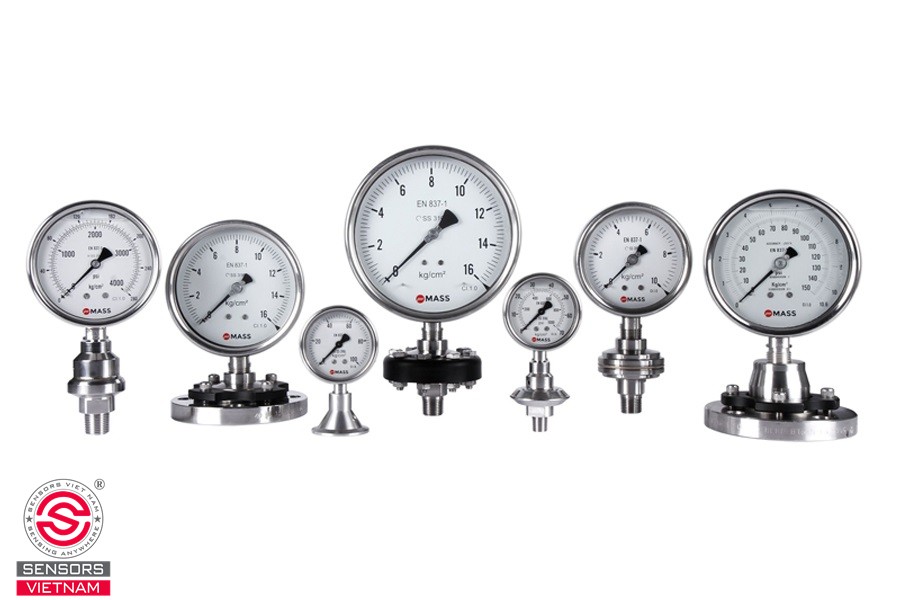
During HVAC system operation, engineers do not evaluate performance based on temperature alone, but rather on a combination of parameters, in which pressure is one of the most critical indicators reflecting actual operating conditions. From pressure readings, it is possible to infer flow rate, fluid state, and overall equipment performance. Therefore, a pressure gauge is not merely a display device, but also an essential “diagnostic tool” within the entire system.
This article provides a comprehensive overview of pressure gauges, including definition, operating principles, usage guidance, and practical applications in HVAC and industrial systems.
What is a pressure gauge?
A pressure gauge is a device used to measure and display the pressure of a medium within a system, such as water, air, steam, refrigerant, or oil. In HVAC systems, pressure gauges are installed at critical points to monitor operating pressure and support overall system performance evaluation.
Depending on the application, pressure gauges can measure positive pressure, vacuum (negative pressure) and differential pressure between two points. The measured value is displayed via a mechanical dial or a digital screen. In automated systems, pressure gauges may also transmit signals to central control systems.

How to read a pressure gauge
Accurate pressure reading allows technicians to quickly detect abnormalities in the system. Pressure gauges are generally classified into two types: mechanical (analog) and electronic (digital), each with different reading methods and accuracy levels.
For analog (mechanical) gauges:
Pressure is determined by the position of the pointer on the dial. The scale may include multiple units such as bar, psi, or kPa, so it is important to identify the correct unit before reading to avoid errors. These gauges are durable, require no power supply, and are widely used in traditional HVAC systems.
For digital gauges:
Pressure values are displayed directly in numerical form, minimizing reading errors. These devices offer higher accuracy and are commonly used in systems requiring continuous monitoring. In addition, they may provide output signals such as 0-10V, 4-20 mA, or Modbus RTU, enabling easy integration with control systems like BMS, PLC, or SCADA.

How does a pressure gauge work?
The operating principle of a pressure gauge depends on its design and measurement technology.
Mechanical pressure gauges:
Operate based on the deformation of elastic elements such as Bourdon tubes, diaphragms, or bellows. When pressure is applied, these elements deform proportionally and transmit motion through a mechanical linkage to rotate the pointer on the dial. This design is simple, requires no power, and offers high durability.
Electronic pressure gauges:
Use pressure sensors to convert pressure into electrical signals. These signals are processed by internal circuitry and converted into digital values displayed on the screen. This technology provides higher accuracy and is suitable for modern HVAC systems requiring continuous monitoring.

Applications of pressure gauges in HVAC and industry
Pressure gauges are widely used across various technical and industrial applications:
- HVAC systems: Monitoring pressure in chillers, AHUs, FCUs, chilled and hot water piping, and compressed air systems to ensure stable operation and energy efficiency.
- Hydraulic systems: Tracking pressure in pumps, cylinders, and control valves to detect leaks or performance degradation.
- Food industry: Used in processing and packaging systems. Devices are typically made from stainless steel 316L to meet hygiene standards and withstand CIP/SIP cleaning processes.
- Oil and gas industry: Installed in pipelines, storage tanks, and processing units to monitor high-pressure conditions and ensure operational safety.
- Chemical industry: Requires corrosion-resistant materials such as stainless steel or coatings like PTFE, Halar, or Tantalum to maintain durability and measurement accuracy in harsh environments.
Thanks to their versatility and critical role, pressure gauges are indispensable components in most modern technical systems.

Key criteria for selecting a pressure gauge
Selecting a pressure gauge involves more than choosing a device that displays pressure values. It requires careful consideration of technical factors to ensure accuracy, durability, and compatibility with the actual operating system.
1. Measurement range
The selected range should exceed the normal operating pressure, typically 1.5 to 2 times higher, to ensure durability and minimize measurement error. A range that is too low may lead to overpressure damage, while an excessively high range reduces reading accuracy.
2. Process medium
Different media such as water, compressed air, steam, refrigerant, or chemicals have varying properties in terms of temperature, corrosion, and viscosity. Therefore, appropriate materials (e.g., brass, stainless steel 304, stainless steel 316L) and internal construction must be selected to prevent corrosion, clogging, or damage.
3. Environmental conditions
Installation conditions directly affect the lifespan of the device. In high-vibration environments, liquid-filled gauges are recommended to stabilize the pointer. For outdoor or high-humidity environments, a suitable protection rating (IP65 or higher) should be selected. Other factors such as ambient temperature, dust, and chemical exposure must also be considered.
4. Accuracy requirements
Accuracy class depends on the application. For standard HVAC systems, class 1.6 or 2.5 is typically sufficient. However, for critical processes or high-precision requirements, higher accuracy instruments or electronic pressure sensors should be used.
5. System integration capability
In modern HVAC and automation systems, pressure gauges often need to transmit signals to control systems. Devices with outputs such as 4-20 mA, 0-10V, or communication protocols like Modbus RTU allow seamless integration with BMS, PLC, or SCADA for centralized monitoring and control.

Purchase pressure gauges at Sensors Vietnam
Sensors Vietnam provides a wide range of pressure gauges, from basic mechanical types to advanced measurement and signal transmission solutions, suitable for HVAC and industrial applications. All products are genuine, supplied with full CO/CQ documentation, and supported by technical consulting services to help select the most suitable solution for each application.
For more information and professional consultation on pressure measurement solutions, please contact Sensors Vietnam to optimize your HVAC system performance.
Hot news


SENSORS VIETNAM CO., LTD
VAT CODE: 0313 355 473
Head Office: 03rd Floor, Indochina Tower, 04 Nguyen Dinh Chieu, Tan Dinh Ward, Ho Chi Minh City, Vietnam.
HCM Branch: 92/14/9A Vuon Lai Str., An Phu Dong Ward, Ho Chi Minh City, Vietnam.
Hanoi Branch: S106 Tower, Vinhomes Smart City, Tay Mo Ward, Hanoi City, Vietnam.

® Registered trademark – National Office of Intellectual Property Vietnam
OUR SERVICES
Specializing in the import and distribution of industrial sensors.
Sensors for HVAC/R systems and building automation applications.
Supplying gauges, transmitters, switches, controllers, PLCs, HMIs, and gas detectors.
Providing integrated consulting services for sensor and controller systems.


CONTACT US
Email: sales(at)sensors.vn
Hotline: +84 0911 660 660
Asia Commercial Bank Account (ACB):
VND: 357 246 888 | USD: 1357 246 888
Support Online ZALO Official Account
(From 8:00 am to 5:00 pm)





SENSORS VIETNAM CO., LTD
- Specialized in the import and distribution of sensors and controllers.
- Integrated data acquisition systems and industrial communication solutions.
- Design and installation of smart home systems and industrial equipment.
- Stack lights, signal beacons, LED warning horns, and RGB warning lights.