






CUSTOMER SERVICE
www.sensors.vn
Admin@sensors.vn
www.cambien.com.vn
HOW TO CHOOSE A VIBRATION SENSOR
Date 20/Oct/2026 at 05:01 PM - View: 13
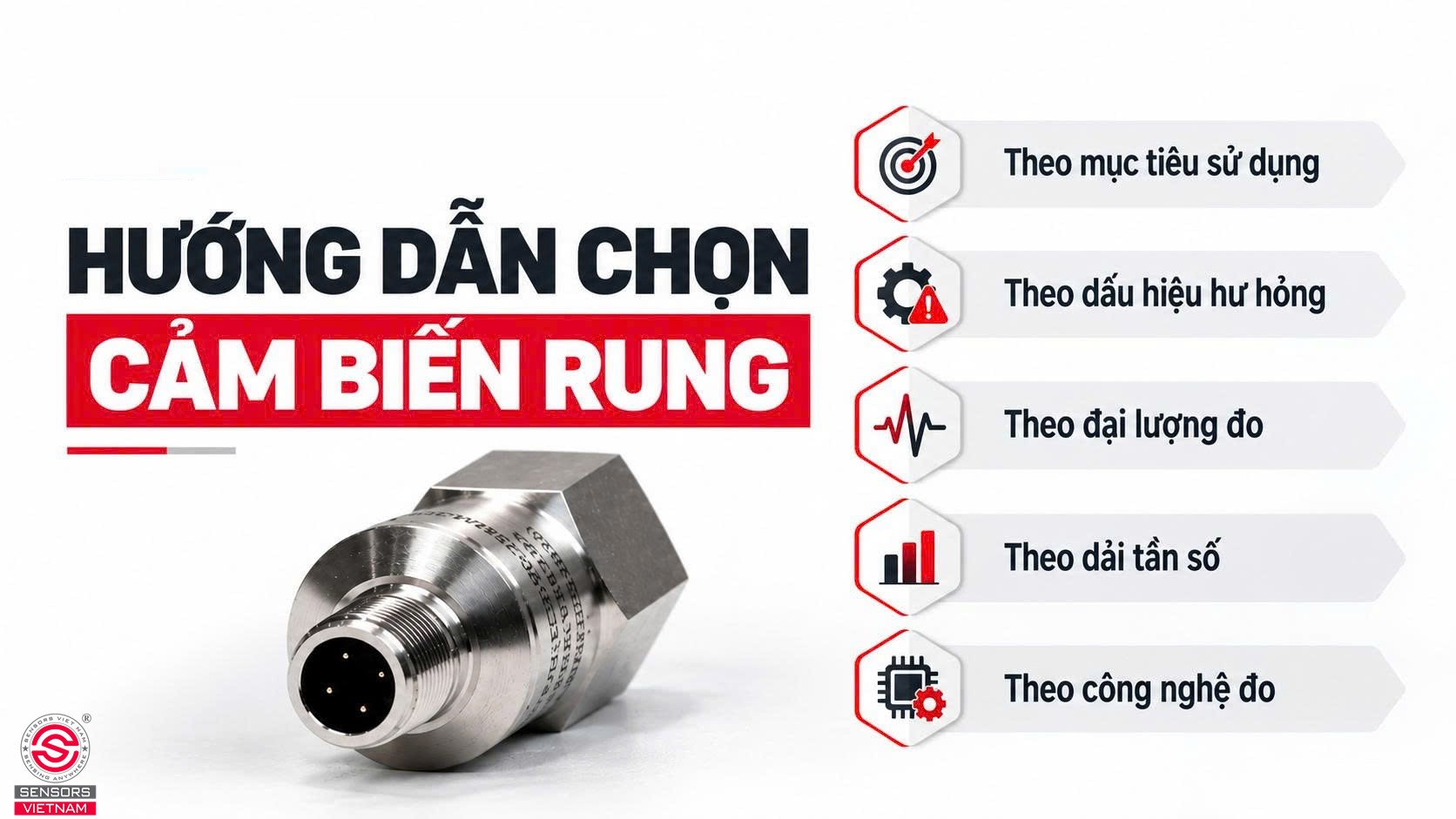
Vibration sensors are devices that convert machine vibrations into electrical signals that monitoring systems can read, display, and analyze. In industrial applications, vibration sensors are commonly installed on motors, pumps, fans, compressors, gearboxes, and turbines to monitor mechanical condition.
Most vibration monitoring projects fail to deliver the expected results not because of poor equipment quality, but because the selected vibration sensor does not meet the actual application requirements. To help you avoid this issue, Sensors Vietnam shares several practical tips for selecting the right vibration sensor to ensure reliable operation and effective integration with your system.
HOW TO CHOOSE A VIBRATION SENSOR BASED ON YOUR MONITORING OBJECTIVES
There are three common monitoring objectives, each requiring a different approach to vibration sensor selection.
How to choose a vibration sensor for overall machine condition monitoring
For this application, the requirement is relatively simple: determine whether a machine is vibrating within acceptable limits. This approach is commonly used for industrial fans, centrifugal pumps, air compressors, electric motors, and conveyor systems. The monitored parameters typically include RMS vibration velocity, which reflects the overall vibration severity, overall acceleration, or displacement. The measured signals are then transmitted to a PLC, HMI, SCADA system, or local alarm unit.
The primary objective is to trigger timely alarms when vibration levels exceed predefined thresholds. Therefore, vibration sensors with simple signal outputs, such as 4 to 20 mA, are often preferred for applications involving a large number of measurement points due to their cost effectiveness.
How to choose a vibration sensor for predictive maintenance
Predictive maintenance requires long term vibration monitoring to identify abnormal changes in machine operating conditions. Therefore, the sensor must provide stable measurements, minimize temperature related measurement errors, and remain permanently installed at the same measurement location. This allows users to track gradual increases in vibration levels and identify early signs of damage to bearings, gears, and other rotating components before serious equipment failures occur.
How to choose a vibration sensor for advanced vibration analysis
Advanced vibration diagnostics require sensors capable of accurately capturing vibration signals and identifying the frequencies present during machine operation. Therefore, the sensor should offer a wide frequency response, high sensitivity, and low noise. The data acquisition system must also provide a sufficiently high sampling rate to capture high frequency vibration components without losing important signal information.
This application is commonly found in bearing assemblies, turbines, gearboxes, centrifugal compressors, CNC machines, and high speed rotating equipment.
HOW TO CHOOSE AN INDUSTRIAL VIBRATION SENSOR BASED ON THE FAULTS YOU NEED TO DETECT
Different mechanical faults produce different vibration signatures. Therefore, when selecting a vibration sensor, you should first identify the faults you need to detect and then choose a sensor with an appropriate measurement range.
How to choose a vibration sensor to detect rotor imbalance
When a rotor is unbalanced, the machine typically exhibits strong vibration at the rotational frequency of the shaft, known as 1X. Shaft misalignment can produce vibration at 1X, 2X, or other frequencies, depending on the type and severity of the misalignment. Meanwhile, loose machine foundations or loose mounting bolts can cause abnormal vibration and generate multiple harmonics of the rotational frequency.
For these faults, vibration velocity sensors or accelerometers with a suitable frequency response extending to approximately 1 kHz can often meet general monitoring requirements. For low speed fans and other slow rotating machinery, check the sensor's low frequency response to ensure that it can accurately measure vibration at the actual operating speed.
How to choose a vibration sensor to detect bearing faults
When a bearing becomes worn or damaged, its internal surfaces may experience repeated impacts, generating short duration, high frequency vibration signals. Therefore, to detect bearing faults at an early stage, select an accelerometer capable of measuring high frequency vibration, typically from several kilohertz to tens of kilohertz, depending on the machine and bearing type.
How to choose a vibration sensor for gears, turbines, and high speed rotating machinery
When gears become worn or damaged, abnormal vibration components may appear at the gear mesh frequency. In turbines and high speed rotating machinery, vibration can occur across a wide frequency range, including high frequency components. Therefore, the selected sensor must have an appropriate frequency response, be securely mounted on the machine, and work with a sufficiently fast data acquisition system to capture vibration signals accurately.
In these applications, IEPE accelerometers are commonly used for vibration measurement and analysis. For high temperature locations, such as turbines and compressors, charge output piezoelectric accelerometers may be a suitable alternative.
HOW TO CHOOSE A VIBRATION SENSOR BASED ON THE MEASUREMENT PARAMETER
Machine vibration is commonly evaluated using three parameters: acceleration, velocity, and displacement. Although all three describe vibrational motion, each is suitable for different measurement objectives.
Acceleration
Vibration acceleration is typically expressed in g or m/s². It is suitable for detecting high frequency vibration and small impact events. Therefore, accelerometers are widely used to assess bearing and gear conditions and perform detailed vibration signal analysis. Some compact MEMS accelerometers are also used for overall vibration monitoring, depending on their frequency response and sensitivity.
Velocity
Vibration velocity is typically expressed in mm/s RMS and is widely used to evaluate the overall vibration severity of electric motors, pumps, fans, and other industrial rotating equipment. These vibration sensors help users monitor changes in vibration levels and compare measurements against alarm thresholds or applicable evaluation standards.
Displacement
Vibration displacement is typically expressed in µm or mm and represents the movement of an object away from its equilibrium position. Displacement measurement is useful when monitoring large vibration amplitudes or low frequency motion, such as in slow speed rotating machinery, industrial presses, and machine structures. Depending on the application, users can select a sensor that directly measures displacement or an accelerometer with suitable low frequency measurement capabilities.
HOW TO CHOOSE A VIBRATION SENSOR BASED ON FREQUENCY RANGE
Frequency range is one of the most frequently overlooked selection criteria. The objective is to choose a frequency range that meets the application's requirements, provides an appropriate safety margin, and delivers reliable performance without unnecessary costs.
Three frequency ranges can be used as general reference points:
- Low to medium-speed motors, pumps, and fans: approximately 0.5 to 1 kHz, which is generally sufficient for monitoring imbalance, misalignment, and overall vibration levels.
- Bearings: a measurement range extending to at least approximately 5 to 10 kHz.
- Gearboxes, centrifugal compressors, and turbines: frequency ranges of 20 kHz or higher may be required, together with rigid sensor mounting and a high speed data acquisition system.
When selecting a vibration sensor, remember that the actual measurable frequency range depends on both the sensor specifications and the installation method. For the same sensor, direct stud mounting typically provides better high frequency measurement performance than magnetic mounting, adhesive mounting, or handheld probe measurements.
In addition, consider selecting a sensor with a frequency response approximately 30 to 50% higher than the maximum frequency you need to analyze. For example, if bearing vibration analysis requires measurements up to 8 kHz, choose a sensor with a linear frequency response extending to at least 10 to 12 kHz and install it using stud mounting. This helps provide an adequate measurement range and reduces the risk of operating near the sensor's own resonance frequency.
HOW TO CHOOSE A VIBRATION SENSOR BASED ON SENSING TECHNOLOGY
Three commonly used technologies in industrial vibration sensors are piezoelectric, IEPE, and MEMS.
Piezoelectric vibration sensors
Piezoelectric sensors use piezoelectric crystals or ceramics to generate an electrical signal in response to machine vibration. These sensors do not incorporate an internal electronic signal conditioning circuit, allowing certain models to withstand higher operating temperatures and perform reliably in harsh industrial environments.
However, they require a dedicated charge amplifier to condition the output signal. Therefore, these sensors are often used for vibration measurement in high temperature applications, including turbines, compressors, industrial furnaces, and internal combustion engines.
IEPE industrial vibration sensors
IEPE sensors also use piezoelectric sensing elements to measure vibration, but they incorporate a built in electronic signal conditioning circuit. These sensors require a constant current power supply from the data acquisition system and provide a voltage output, simplifying integration with measurement systems and reducing the impact of electrical interference during signal transmission.
As a result, IEPE accelerometers are widely used in industrial predictive maintenance applications. However, because they contain internal electronics, their operating temperature is limited. The appropriate model must therefore be selected according to the installation environment and temperature requirements.
MEMS vibration sensors
MEMS vibration sensors use microelectromechanical systems technology, allowing them to offer a compact design, low power consumption, and easy integration into wireless monitoring and IoT systems. These sensors are suitable for monitoring overall vibration levels, detecting unexpected machine shutdowns, triggering alarms when vibration exceeds predefined thresholds, and monitoring multiple machines across different locations.
However, some MEMS sensors have a narrower frequency response than piezoelectric accelerometers. Therefore, when high frequency vibration analysis is required to detect early bearing faults, gear damage, or resonance phenomena, carefully check the frequency response and measurement capabilities of each model before making a selection.
In practice, if a factory needs to monitor hundreds of machines but only requires basic detection of abnormal vibration, MEMS sensors or vibration transmitters with 4 to 20 mA outputs can help reduce overall system costs.
Conversely, for critical equipment such as compressors, turbines, main gearboxes, and feedwater pumps, consider using permanently installed IEPE accelerometers together with a vibration spectrum analysis system. This approach enables more detailed vibration monitoring, supports early fault detection, and helps maintenance teams schedule servicing before serious equipment failures occur.
BUY ECOSENSE INDUSTRIAL VIBRATION SENSORS FROM SENSORS VIETNAM
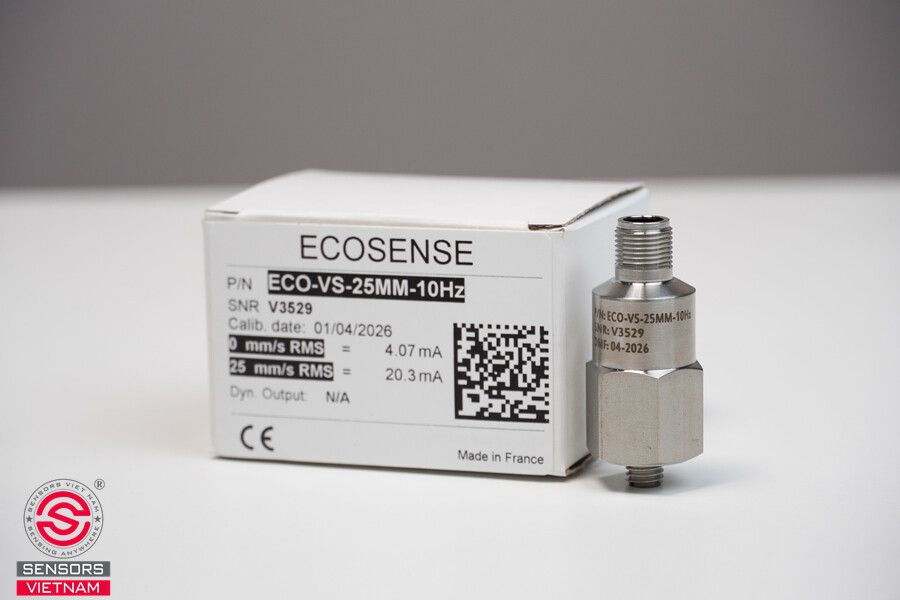
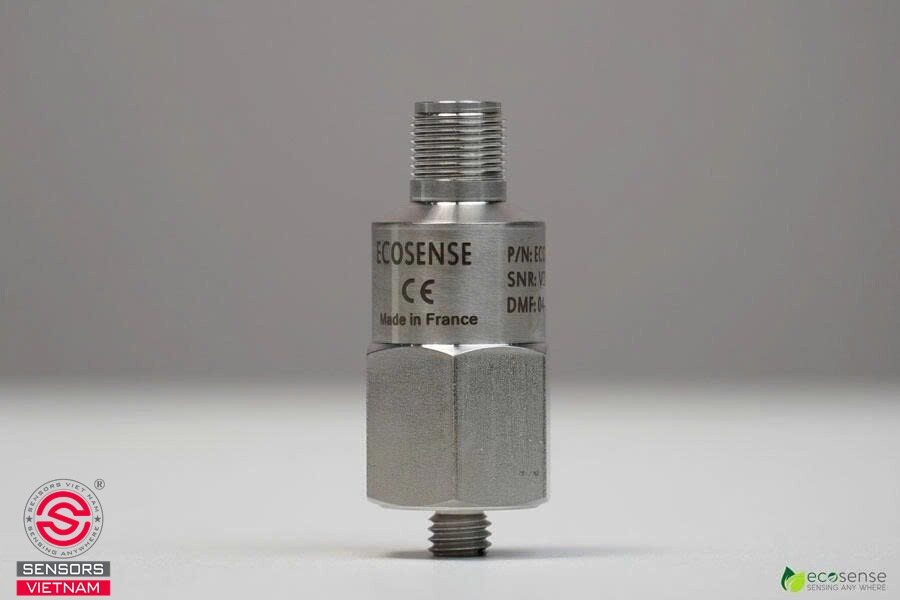
Sensors Vietnam supplies a wide range of vibration sensors with different measurement ranges and mounting configurations, suitable for applications ranging from HVAC systems to machinery used in industrial production lines. One notable product range is the ECOSENSE ECO VS bearing vibration sensor series from France, designed for industrial vibration monitoring applications. With a 4 to 20 mA output signal, these sensors can connect to PLC and SCADA systems to monitor vibration levels, generate alarms, and support automatic machine shutdown when dangerous thresholds are reached, depending on the system configuration.
The ECO VS industrial vibration sensor series is designed to monitor overall vibration levels in motors, pumps, fans, and compressors. Available measurement ranges include 0 to 10, 0 to 25, 0 to 50, and 0 to 100 mm/s RMS, with a frequency range from 10 Hz to 1,000 Hz. These options support vibration monitoring requirements across a variety of industrial applications.
The ECO VS series features a stainless steel housing, an IP67 protection rating, and an operating temperature range from minus 50°C to plus 90°C. These characteristics make the sensors suitable for a range of industrial operating conditions, including environments exposed to moisture or dust.
To learn more about vibration sensors or request technical advice and a quotation for the ECO-VS industrial vibration sensor series, please visit sensors.vn or cambien.com.vn.
Hot news




SENSORS VIETNAM CO., LTD
VAT CODE: 0313 355 473
Head Office: 03rd Floor, Indochina Tower, 04 Nguyen Dinh Chieu, Tan Dinh Ward, Ho Chi Minh City, Vietnam.
HCM Branch: 92/14/9A Vuon Lai Str., An Phu Dong Ward, Ho Chi Minh City, Vietnam.
Hanoi Branch: S106 Tower, Vinhomes Smart City, Tay Mo Ward, Hanoi City, Vietnam.

® Registered trademark – National Office of Intellectual Property Vietnam
OUR SERVICES
Specializing in the import and distribution of industrial sensors.
Sensors for HVAC/R systems and building automation applications.
Supplying gauges, transmitters, switches, controllers, PLCs, HMIs, and gas detectors.
Providing integrated consulting services for sensor and controller systems.


CONTACT US
Email: sales(at)sensors.vn
Hotline: +84 0911 660 660
Asia Commercial Bank Account (ACB):
VND: 357 246 888 | USD: 1357 246 888
Support Online ZALO Official Account
(From 8:00 am to 5:00 pm)





SENSORS VIETNAM CO., LTD
- Specialized in the import and distribution of sensors and controllers.
- Integrated data acquisition systems and industrial communication solutions.
- Design and installation of smart home systems and industrial equipment.
- Stack lights, signal beacons, LED warning horns, and RGB warning lights.