






CUSTOMER SERVICE
www.sensors.vn
Admin@sensors.vn
www.cambien.com.vn
THERMOWELL AND IMMERSION WELL
Date 27/Jul/2023 at 05:19 PM - View: 2630
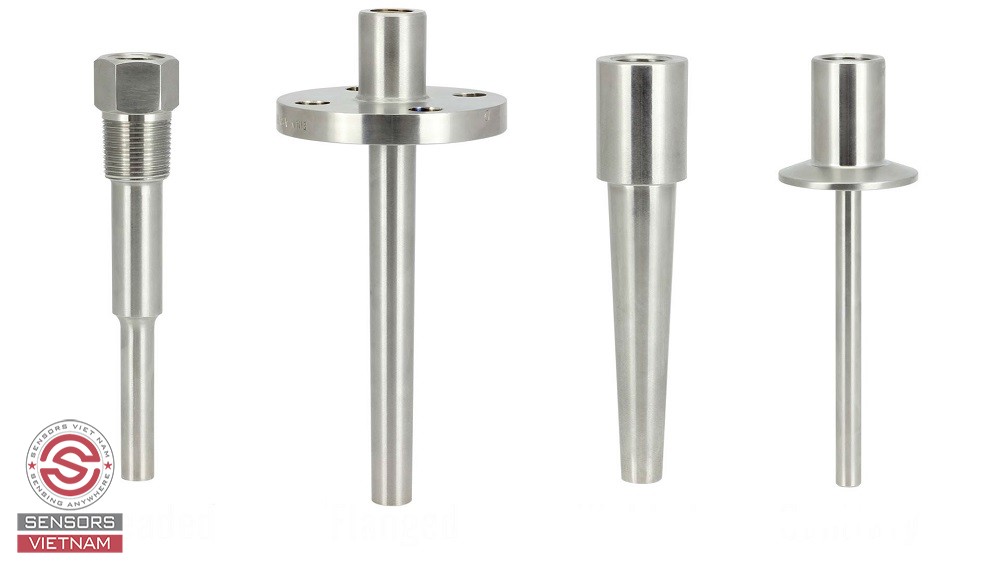
Thermowell or immersion well is a cylindrical fitting used to protect temperature sensors installed when measuring liquid such as in the production of beer, the thermowell protects the thermometer when measuring the temperature as well as protects the liquid from contamination. The thermowell acts as a barrier between the device measuring temperature and the liquid as well as the liquid from the outside air.
Thermowells are recommended whenever a temperature element is to be inserted into a process where corrosion, pressure, abrasion, or shear forces may threaten the life of the element. In addition, thermowells allow for a defective instrument to be removed without shutting down or draining the process. They fit into three broad categories: screwed, flanged, or weld-in, and can be designed to accept thermocouples, RTDs, temperature gauges or filled systems.
Thermowells can be machined from solid bar stock, or fabricated from pipe. Fabricated thermowells offer a lower cost alternative where high pressure is not a design consideration. Standard thread forms are BSP and NPT (others available to order), and flange size and rating can be supplied to suit any requirements.
Thermowells are hollow tubes closed off on one end and threaded at the other end. They are permanently placed into pipes, tanks or sumps so that temperature measurement probes can be inserted into them to measure the contents temperature. The temperature of the content is transferred through the wall of the thermowell to the temperature measurement probe. The thermowell prevents the content of the pipe from escaping and holds in the pressure of pressurized pipes. Thermowells are sold by insertion length, which is the length of the thermowell inside the pipe. Fig 1 shows a 4” thermowell; notice that the 4” dimension is an approximate insertion length that is based on a schedule 80, 8” diameter pipe.
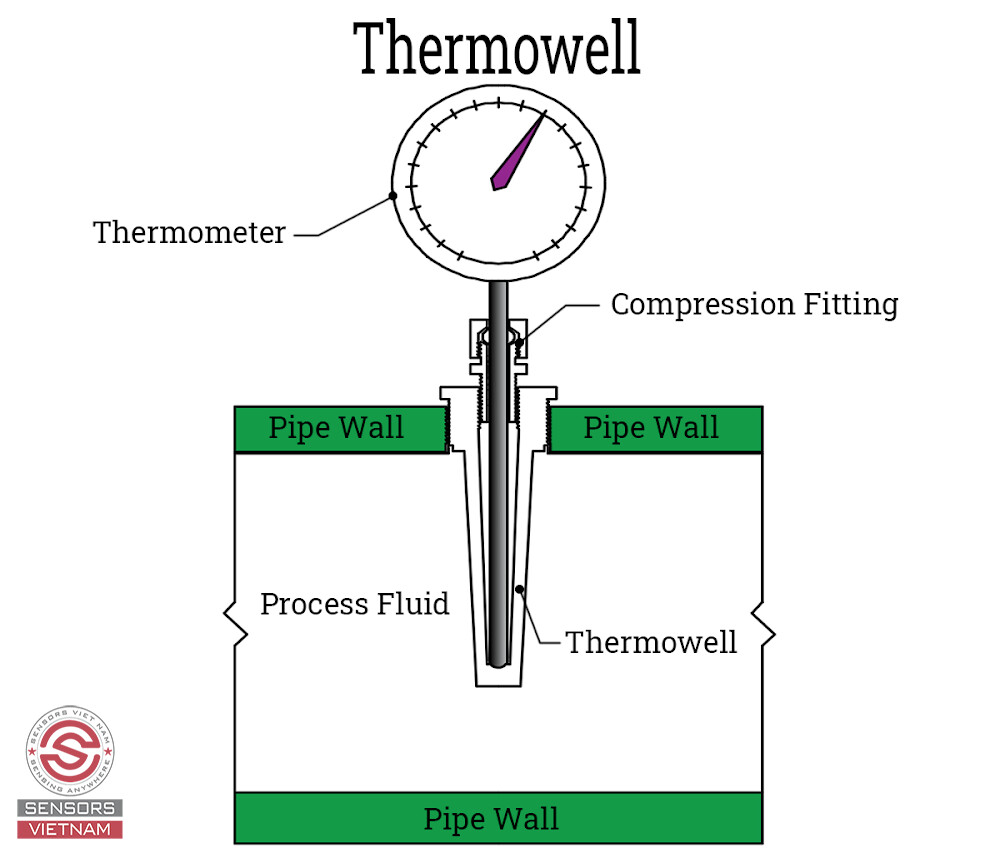 What is a Thermowell and their purpose?
A thermowell is a cylindrical fitting used to protect temperature sensors installed when measuring liquid such as in the production of beer, the thermowell protects the thermometer when measuring the temperature as well as protects the liquid from contamination.
Thermowell Material specifications
Inconel® 625
A nickel‐chromium alloy with excellent resistance to pitting and crevice corrosion, unaffected by radiation embrittlement; widely used in aerospace applications and in marine environments. Good weld-ability can be used in the as‐welded condition. Maximum temperature: 1093°C.
Incoloy® 800
Superior to alloy 600 in sulphur, cyanide salts and neutral salts. Extensively used in steam/hydrocarbon reforming plants for pigtail piping, manifolds, and waste heat boilers, and in the internal components of secondary reformers. Widely used in heat treatment equipment and as a heater sheath material. Maximum temperature: 1093°C.
Incoloy® 825
A nickel‐iron‐chromium alloy with exceptional resistance to many corrosive environments. Superior to almost all metallic materials for handling sulphuric acid and shows excellent resistance to phosphoric acid. Widely used in chemical processing, oil and gas recovery, acid production, pickling operations, nuclear fuel reprocessing, and handling of radioactive wastes. Maximum temperature: 540°C.
Incoloy® MA956
An iron‐chromium‐aluminium alloy produced by mechanical alloying, it features great strength at high temperatures with excellent resistance to oxidation, carburisation, and hot corrosion. These properties make it especially suitable for gas‐turbine combustion chambers and other aggressive environments containing sulphur and chloride salts. Maximum temperature: 1350°C.
Monel® 400
Nickel‐copper alloy with very good corrosion resistance, commonly used to handle sea water, hydrofluoric acid, sulphuric acid, hydrochloric acid, and most alkalis. Typical applications include marine fixtures, chemical processing equipment, gasoline and water tanks, process vessels and piping and boiler feedwater heaters. Maximum temperature: 538°C.
Hastelloy® C276
Nickel‐molybdenum‐chromium alloy with excellent corrosion resistance especially in chlorinated environments. Widely used in chemical plants where it tolerates ferric and cupric chlorides, solvents, chlorine, formic acid, acetic acid, brine, wet chlorine gas and hypochlorite. Can be easily welded and maintains its properties in the as‐welded condition. Maximum temperature: 1093°C.
Hastelloy® B3
A development of the well‐established B2 alloy with improved thermal stability, fabricability and stress corrosion cracking resistance. It is the alloy of choice for handling hydrochloric acid in all concentrations and temperatures; it also withstands hydrogen chloride, sulphuric, acetic, hydrofluoric, and phosphoric acids. Maximum temperature: 538°C, up to 816°C in reducing or vacuum environment.
Hastelloy® C22
A nickel‐chromium‐molybdenum‐tungsten alloy with outstanding resistance to pitting, crevice corrosion and stress corrosion cracking. It shows exceptional resistance to a wide range of chemical process environments, such as ferric and cupric chlorides, chlorine, hot contaminated solutions, formic and acetic acids and seawater or brine solutions. The material has superior weld-ability and retains its properties in the as‐welded state.
Hastelloy® X
A high temperature alloy with excellent resistance to oxidising, reducing and neutral atmospheric conditions. Is widely used in aircraft jet engine components. Very good high temperature strength makes it ideal for furnace applications. Resistant to stress corrosion cracking in petrochemical applications. Maximum Temperature: 1204°C.
Haynes alloy 214
Excellent high temperature material, with the highest resistance to oxidation and carburisation of almost any alloy, it is recommended for temperatures of 950°C and above, it shows useful resistance up to 1315°C but its strength is severely reduced. Applications include ceramic firing furnace parts, automotive catalytic converter internals and in the industrial heating industry furnace flame hoods and rotary calciners. Has good resistance to chlorine contaminated environments, which allows its use in hospital waste incinerators. Maximum temperature: 1204°C.
Haynes alloy 230
Excellent high temperature strength, oxidation resistance and long term thermal stability. Used in aerospace, chemical processing and high temperature heating applications. Recommended for use in nitriding environments. Maximum temperature: 1149°C.
Haynes alloy 556
A multipurpose alloy which offers good resistance to sulphidising, carburising and chlorine bearing atmospheres. Common applications include waste incinerators, petroleum processes where sulphur is present, chloride salt baths, exhaust gas probes, the alloy is one of very few that can survive in molten zinc, making it ideal for galvanising processes. Maximum temperature: 1093°C.
Haynes alloy HR160
A high temperature alloy with outstanding resistance to high temperature corrosion, it has excellent resistance to sulphidation, and chloride attack in both reducing and oxidising atmospheres. Its resistance to attack by the products of combustion of low‐grade fuels makes it particularly useful in municipal, industrial, hazardous, and nuclear waste incinerators. Maximum temperature: 1204°C.
Titanium
A lightweight material with good strength in the 150 ‐ 470°C range. Excellent resistance to oxidising acids such as nitric or chromic. Also resistant to inorganic chloride solutions, chlorinated organic compounds and moist chlorine gas. Its good resistance to seawater and salt spray allows it to be used in offshore installations. Can be welded with special precautions to protect from atmospheric contamination.
Tantalum
Refractory metal that is ductile. Use only in inert atmospheres or very good vacuums. <10(‐3) torr. Hydrogen and nitrogen will react with tantalum above 400°C (750°F) resulting in nitride and hydride formation that will affect life. Tantalum is almost completely immune to chemical attack at temperatures below 150°C, and is attacked only by hydrofluoric acid, acidic solutions containing the fluoride ion, and free sulphur trioxide. Alkalis attack it slowly. At high temperatures, tantalum becomes much more reactive. Normally used by cladding a thin layer onto a less expensive material, such as steel or stainless-steel Tantalum’s corrosion resistance is like that of glass, making it the material of choice in critical chemical and pharmaceutical processes requiring maximum corrosion resistance and minimum contamination. Typical applications are: Chemical production (HCl, H2SO4), insecticides, pharmaceuticals, fine chemicals, explosives, plastics, dyestuff’s, condensation of phosgene derivatives, synthetic fibers, chromic acid plating solutions and operations involving chlorine, bromine, iodine and their compounds, high purity product manufacturing (cosmetics, soaps, perfumes) and separation of high boiling organic acids.
Hot news





SENSORS VIETNAM CO., LTD
VAT CODE: 0313 355 473
Head Office: 03rd Floor, Indochina Tower, 04 Nguyen Dinh Chieu, Tan Dinh Ward, Ho Chi Minh City, Vietnam.
HCM Branch: 92/14/9A Vuon Lai Str., An Phu Dong Ward, Ho Chi Minh City, Vietnam.
Hanoi Branch: S106 Tower, Vinhomes Smart City, Tay Mo Ward, Hanoi City, Vietnam.

® Registered trademark – National Office of Intellectual Property Vietnam
OUR SERVICES
Specializing in the import and distribution of industrial sensors.
Sensors for HVAC/R systems and building automation applications.
Supplying gauges, transmitters, switches, controllers, PLCs, HMIs, and gas detectors.
Providing integrated consulting services for sensor and controller systems.


CONTACT US
Email: sales(at)sensors.vn
Hotline: +84 0911 660 660
Asia Commercial Bank Account (ACB):
VND: 357 246 888 | USD: 1357 246 888
Support Online ZALO Official Account
(From 8:00 am to 5:00 pm)





SENSORS VIETNAM CO., LTD
- Specialized in the import and distribution of sensors and controllers.
- Integrated data acquisition systems and industrial communication solutions.
- Design and installation of smart home systems and industrial equipment.
- Stack lights, signal beacons, LED warning horns, and RGB warning lights.