






CUSTOMER SERVICE
www.sensors.vn
Admin@sensors.vn
www.cambien.com.vn
VIBRATION SENSORS
Date 22/Oct/2025 at 09:40 AM - View: 126
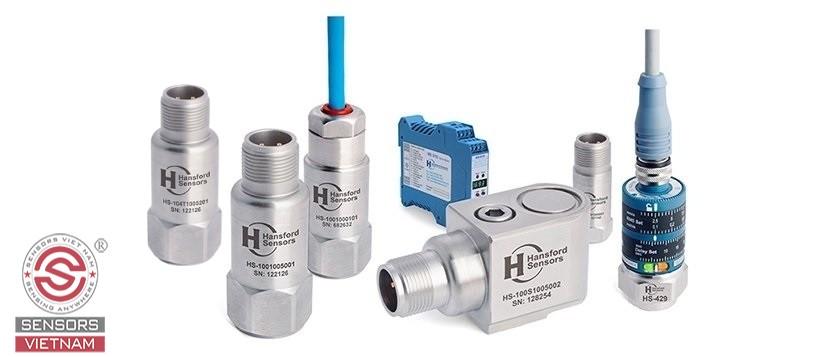
In the realms of engineering, manufacturing, construction, automotive industries, and even consumer electronics, vibration sensing plays an essential role. Vibration Sensors are critical tools that help in monitoring equipment health, predicting failures, ensuring safety, improving design, and optimizing processes.
Vibrations can indicate a range of phenomena — from minor imbalances and misalignments to impending catastrophic failures. Detecting and analyzing these vibrations accurately enables timely maintenance and significant cost savings.
What Is a Vibration Sensor?
A vibration sensor, also known as a vibration detector, vibration analyzer, or accelerometer (depending on the specific type), is a device that measures the vibration level, frequency, or motion of an object or system.
It converts mechanical movement (vibrations) into an electrical signal that can be monitored, recorded, and analyzed. Based on the data collected, users can determine equipment health, detect anomalies, and take preventive actions.
Vibration sensors are fundamental in predictive maintenance (PdM) and condition monitoring (CM) strategies across industries.
How Does a VOC Sensor Work?
Most vibration sensors operate by detecting physical movement or oscillations of a structure relative to a reference. These oscillations can be caused by various sources such as motor imbalance, gear wear, loose components, or external forces like earthquakes.
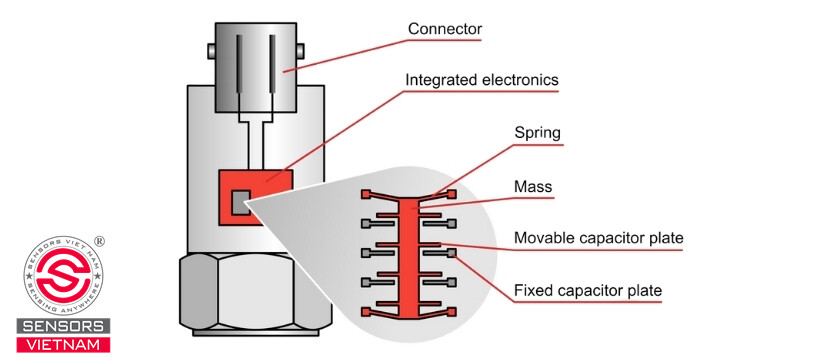
The vibration sensor typically measures:
Amplitude (size of the vibration)
Frequency (rate of vibration)
Velocity (rate of displacement change)
Acceleration (rate of velocity change)
Depending on the vibration sensor type, different transduction mechanisms are used:
Piezoelectric effect (voltage generation under mechanical stress)
Capacitive sensing (distance changes between conductive plates)
Optical sensing (light reflection or refraction changes)
Resistive sensing (change in resistance due to deformation)
Types of vibration sensors:
Accelerometer
The accelerometer is the most commonly used type of vibration sensor, designed to measure the acceleration forces generated by mechanical vibrations. These sensors operate based on various technologies such as piezoelectric, capacitive, MEMS, or piezoresistive principles. With a wide frequency range and high measurement accuracy, accelerometers are ideal for machine condition monitoring and rotating equipment diagnostics in industrial applications.
Velocity Sensor
A velocity vibration sensor measures the vibration velocity of an object and is typically used in medium-frequency applications. This type of sensor is ideal for monitoring motors, pumps, fans, and compressors, helping to detect early signs of imbalance, misalignment, or bearing faults before major failures occur.
Displacement Sensor
The displacement vibration sensor is designed to measure the amplitude of vibration or displacement distance of a moving object. It is best suited for low-frequency or static vibration measurements, often utilizing proximity probes or capacitive sensing technology to achieve high precision in small displacement measurements.
Piezoelectric Vibration Sensor
The piezoelectric vibration sensor operates based on the piezoelectric effect, generating an electric charge when subjected to mechanical stress. This sensor offers high frequency response, excellent sensitivity stability, and self-generating capability—meaning it does not require an external power source. It is widely used in high-precision vibration monitoring systems and harsh industrial environments.
MEMS Vibration Sensor
The MEMS vibration sensor (Micro-Electro-Mechanical Systems) is a compact, low-power device that can be easily integrated into electronic devices, IoT systems, and wearable technologies. These sensors provide a cost-effective and portable solution for real-time vibration monitoring and detection in both industrial and consumer applications.
Strain Gauge-Based Vibration Sensor
A strain gauge vibration sensor detects minute changes in material strain caused by vibration. Thanks to its exceptional sensitivity, it is used in structural analysis, fatigue testing, and low-amplitude vibration monitoring, where high precision and reliability are essential.
Optical Vibration Sensor
The optical vibration sensor utilizes laser interferometers or fiber-optic systems to measure microscopic vibrations and displacements without physical contact. With outstanding accuracy, stability, and immunity to electromagnetic interference, this sensor is widely used in scientific research, aerospace engineering, and sensitive environments where conventional vibration sensors are unsuitable.
Applications of Vibration Sensors
Vibration sensors are widely used across industrial and consumer sectors due to their ability to detect, measure, and analyze mechanical vibrations with high precision. By monitoring vibration signals, engineers can assess equipment conditions, predict failures, perform structural health monitoring, and ensure operational safety. From manufacturing plants and automotive systems to aerospace, electronics, and healthcare, vibration sensors play a vital role in enhancing system efficiency, reliability, and longevity.
Industrial Equipment Monitoring
Vibration sensors are extensively applied in monitoring the condition of industrial machinery such as motors, pumps, compressors, and turbines. By measuring and analyzing vibration signals, these sensors detect early signs of imbalance, misalignment, bearing wear, and mechanical faults. This enables preventive maintenance, reduces downtime, and optimizes operational efficiency across industrial environments.
Predictive Maintenance
In advanced maintenance systems, vibration sensors serve as a cornerstone of predictive maintenance (PdM) strategies. They detect potential faults before failures occur, minimizing unexpected shutdowns and extending equipment lifespan. Real-time vibration data analysis supports accurate maintenance decisions, helping businesses reduce repair costs and improve asset reliability.
Structural Health Monitoring (SHM)
Vibration sensors are integrated into structural health monitoring systems for bridges, buildings, dams, and large infrastructures. Vibration data allows engineers to evaluate structural integrity, identify cracks, deformations, or resonance issues, and ensure long-term safety and stability. This approach provides early warnings of potential structural failures and supports sustainable infrastructure management.
Automotive Industry
In the automotive sector, vibration sensors are used to analyze engine vibrations, evaluate suspension systems, and detect mechanical faults in critical components. They are also employed in component quality testing and material durability assessments, enhancing vehicle performance, comfort, and safety. Vibration analysis is key to achieving smoother rides and higher manufacturing precision.
Aerospace Industry
In aerospace applications, vibration sensors play a critical role in monitoring aircraft engines and structural components. High-frequency vibration analysis enables early fault detection, preventing in-flight failures and ensuring operational safety. These sensors are essential for maintaining reliability standards in aircraft design, testing, and maintenance.
Consumer Electronics
Vibration sensors are embedded in smartphones, gaming controllers, and wearable devices to provide haptic feedback, track physical activity, and monitor posture. Their compact size and precision enhance user experience by offering intuitive and responsive feedback mechanisms that simulate real-world sensations in digital environments.
Seismic Detection
Vibration sensors are core components in seismographs, detecting and recording even the smallest ground motions. The collected data supports earthquake prediction research, early-warning systems, and disaster prevention. Their high sensitivity and accuracy make them indispensable in geophysical monitoring and safety applications.
Medical Devices
In medical technology, vibration sensors are applied in prosthetics, where they monitor vibrational feedback to enable more natural motion control. They are also used in diagnostic equipment for respiratory and cardiovascular analysis, helping measure physiological vibrations with precision for improved patient monitoring and care.
Vibration sensors are essential components in modern monitoring and maintenance systems, enabling early fault detection, enhancing safety, and optimizing performance across industries. With a diverse range of technologies — including accelerometers, velocity sensors, displacement sensors, MEMS vibration sensors, and optical types — users can select the ideal solution for specific measurement needs.
By accurately converting mechanical vibrations into reliable electrical signals, vibration sensors are transforming industries from manufacturing and construction to aerospace, automotive, healthcare, and consumer electronics. Investing in high-quality vibration sensing systems not only protects equipment and reduces maintenance costs but also drives safer, smarter, and more sustainable operations.
Sensors Vietnam is a leading importer and distributor of industrial sensors and automation equipment in Vietnam. If you are looking for high-performance vibration sensors, please contact Sensors Vietnam for expert consultation and the latest quotation.
HS420-020-54-08 – Hansford Vibration Sensor
Measuring range: 0–20 mm/s
Output: 4–20 mA (2-wire)
Thread: M8 x 1.25 mm male
Connector: M12 4-pin
HS420-100-01-05 – Hansford Vibration Sensor
Measuring range: 0–100 mm/s
Output: 4–20 mA (2-wire)
Connection: Quick Fit female thread
Cable: Integrated 2 m PUR cable
HS420-100-01-08 – Hansford Vibration Sensor
Measuring range: 0–100 mm/s
Output: 4–20 mA (2-wire)
Connection: M8 male thread
Cable: Integrated 2 m PUR cable
HS420-050-01-08 – Hansford Vibration Sensor
Measuring range: 0–50 mm/s
Output: 4–20 mA (2-wire)
Connection: M8 male thread
Cable: Integrated 2 m PUR cable
HS420-025-01-08 – Hansford Vibration Sensor
Measuring range: 0–25 mm/s
Output: 4–20 mA (2-wire)
Connection: M8 male thread
Cable: Integrated 2 m PUR cable
HS420-RT-025-01-08 – Hansford Vibration Sensor with Temperature Output
Measuring range: 0–25 mm/s
Output: 4–20 mA (2-wire)
Additional output: PT100 temperature sensor
Connection: M8 male thread
Cable: Integrated 2 m PUR cable
HS420-RT-050-01-08 – Hansford Vibration Sensor with Temperature Output
Measuring range: 0–50 mm/s
Output: 4–20 mA (2-wire)
Additional output: PT100 temperature sensor
Connection: M8 male thread
Cable: Integrated 2 m PUR cable
HS420-RT-100-01-08 – Hansford Vibration Sensor with Temperature Output
Measuring range: 0–100 mm/s
Output: 4–20 mA (2-wire)
Additional output: PT100 temperature sensor
Connection: M8 male thread
Cable: Integrated 2 m PUR cable
For detailed specifications and product documentation, please visit: https://cambien.com.vn/cam-bien-do-rung
Hot news


SENSORS VIETNAM CO., LTD
VAT CODE: 0313 355 473
Head Office: 03rd Floor, Indochina Tower, 04 Nguyen Dinh Chieu, Tan Dinh Ward, Ho Chi Minh City, Vietnam.
HCM Branch: 92/14/9A Vuon Lai Str., An Phu Dong Ward, Ho Chi Minh City, Vietnam.
Hanoi Branch: S106 Tower, Vinhomes Smart City, Tay Mo Ward, Hanoi City, Vietnam.

® Registered trademark – National Office of Intellectual Property Vietnam
OUR SERVICES
Specializing in the import and distribution of industrial sensors.
Sensors for HVAC/R systems and building automation applications.
Supplying gauges, transmitters, switches, controllers, PLCs, HMIs, and gas detectors.
Providing integrated consulting services for sensor and controller systems.


CONTACT US
Email: sales(at)sensors.vn
Hotline: +84 0911 660 660
Asia Commercial Bank Account (ACB):
VND: 357 246 888 | USD: 1357 246 888
Support Online ZALO Official Account
(From 8:00 am to 5:00 pm)





SENSORS VIETNAM CO., LTD
- Specialized in the import and distribution of sensors and controllers.
- Integrated data acquisition systems and industrial communication solutions.
- Design and installation of smart home systems and industrial equipment.
- Stack lights, signal beacons, LED warning horns, and RGB warning lights.